The final two candidates for a senior Salesforce developer role both interviewed well. One had stronger Apex skills, the other better judgment with stakeholders, and the team could not agree. A bad hire at this level costs months of salary, a recruiting fee, and the time to start over. So the hiring manager asked a different question: could the team work with the person for three months before deciding?
That is the idea behind Salesforce contract to hire, sometimes called temp to perm. A Salesforce professional starts as a contractor, usually employed by a staffing firm, and converts to a full-time employee if both sides want to continue. It lowers the risk of a wrong hire and gets work moving faster, but it comes with costs and trade-offs worth understanding before you use it.
This guide explains how the model works, when it fits Salesforce roles, how conversion fees are calculated, the legal basics, how it compares with direct hire, and how to run it well.
How Salesforce Contract to Hire Works
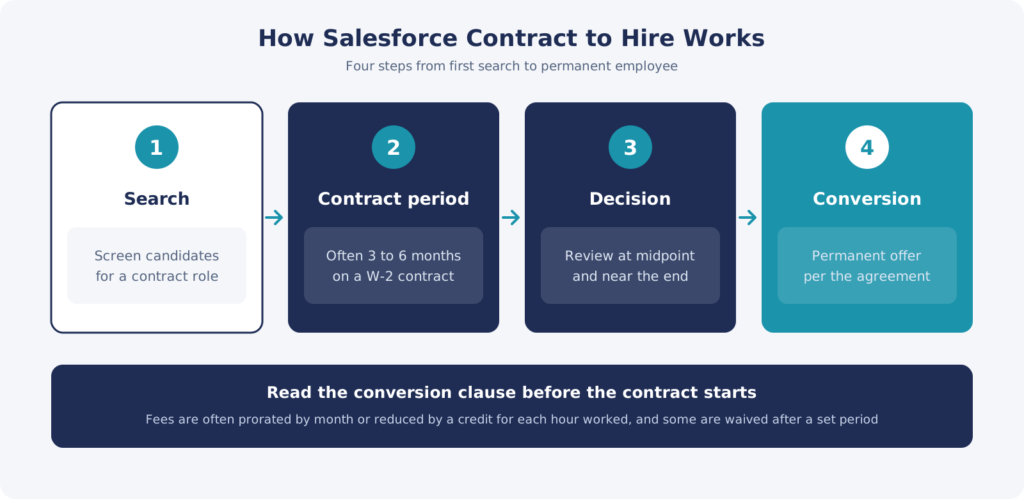
A Salesforce contract to hire arrangement usually follows four steps:
- Search. A staffing firm finds and screens candidates for a contract role with an expected conversion.
- Contract period. The professional works on your team, usually employed and paid by the staffing firm, while you pay the firm an hourly bill rate.
- Decision. Near the end of the contract period, you and the professional decide whether to make the role permanent.
- Conversion. If both agree, the professional becomes your employee, and you pay any conversion fee in the contract.
Temp to perm is common across staffing. The American Staffing Association reports that nearly 2.0 million temporary and contract employees worked for US staffing companies in an average week in 2025, and that 64% work in staffing to fill the gap between jobs or to help them land a job. Many contractors are open to a permanent offer if the fit is right.
When Contract to Hire Fits Salesforce Roles
Salesforce contract to hire works best in a few situations, and teams that use it well tend to share them:
- You are unsure of the level. You do not know whether you need a mid-level or senior developer until you see the work.
- The team is new. A first admin or first developer has nobody internal to judge their work against, so a trial period helps.
- You need someone now. A contractor can start while a permanent budget or headcount approval catches up.
- Fit matters as much as skill. Roles that work closely with sales or service leaders depend on trust that interviews cannot fully test.
Salesforce contract to hire fits less well for scarce senior roles. Technical architects and experienced Agentforce specialists often have several permanent offers and may not accept a contract period. For those, direct hire is usually faster. Our guide to Salesforce roles shows which roles are scarce and which have plenty of candidates.
Contract to Hire vs Direct Hire vs Contract
Each model suits a different situation. Here is how contract to hire vs direct hire vs a straight contract compare for Salesforce teams:
| Model | Best for | Main trade-off |
|---|---|---|
| Contract | Defined projects with an end date | No long-term ownership after the project |
| Contract to hire | Uncertain level, new teams, fit-sensitive roles | Higher hourly cost during the trial, plus a possible conversion fee |
| Direct hire | Clear, long-term roles and scarce senior talent | Less chance to see the work before committing |
Our comparison of contract vs full-time Salesforce hires covers the first and last options in depth, and our guide to headhunters vs staffing vs placement agencies explains which kind of firm runs each model.
What Salesforce Contract to Hire Costs
There are two parts to the cost: the hourly bill rate during the contract, and the conversion fee if you hire the person.
The bill rate
During a Salesforce contract to hire period, you pay the staffing firm an hourly rate that covers the contractor’s pay, employer taxes, benefits if offered, and the firm’s margin. Our Salesforce contractor rates guide lists typical ranges by role, such as $75 to $135 an hour for admins and $100 to $170 for developers.
The conversion fee
Conversion fees vary by firm and are set in your agreement. Staffing firm FoxHire describes two common structures:
- Prorated fee. The fee is a share of the standard placement fee that shrinks as the contract runs, often in twelfths. In its example, a client converting after one month owes 11/12 of a 25% fee.
- Credit against the placement fee. The full placement fee, minus a credit for each hour the contractor has worked. Its example uses a 25% fee on first-year pay, minus $5 per hour worked.
Here is how those structures play out for a Salesforce developer converting after three months at a $130,000 salary, using the same 25% fee for illustration:
| Structure | Calculation | Fee owed |
|---|---|---|
| Standard placement fee | 25% of $130,000 | $32,500 |
| Prorated after 3 months | $32,500 × 9/12 | $24,375 |
| Hourly credit after about 520 hours | $32,500 − (520 × $5) | $29,900 |
Some firms waive the fee entirely after a set contract period. Read the conversion clause carefully, because it decides the real cost of the hire.
The Legal Basics
In most Salesforce contract to hire arrangements, the professional is a W-2 contractor, meaning an employee of the staffing firm during the contract. That keeps payroll, taxes, and worker classification with the firm.
Hiring someone directly as a 1099 independent contractor with plans to convert them is riskier. The IRS guidance on independent contractors says classification depends on the right to control the details of how the work is done, weighed across behavioral, financial, and relationship factors. A contractor who works set hours on your team, under your direction, may look like an employee, and misclassification can leave you liable for employment taxes. This guide is not legal advice, so check your arrangement with your own counsel or HR.
Salesforce Roles and Rates for Contract to Hire
The table below pairs typical contract rates with permanent salaries for the roles we see most often in Salesforce contract to hire searches. Contract rates come from our contractor rates guide, and salaries are mid-level ranges from our 2027 salary guide.
| Role | Contract rate (per hour) | Mid-level permanent salary |
|---|---|---|
| Salesforce administrator | $75 to $135 | $90,000 to $115,000 |
| Salesforce developer | $100 to $170 | $110,000 to $140,000 |
| Functional consultant | $105 to $160 | $100,000 to $125,000 |
| Technical consultant | $120 to $185 | $105,000 to $135,000 |
Industry cloud experience, such as Financial Services Cloud or Health Cloud, usually adds 10% to 15% to permanent pay. Admins and developers are the most common Salesforce contract to hire roles because there are more candidates and the work is easy to judge in a few months. For a developer search, see our guide to hiring a Salesforce developer, and for admins, our Salesforce admin recruiters page.
When you budget, remember the contractor’s take-home pay is lower than the bill rate. A W-2 contractor earning $80 an hour often expects a permanent salary near the low end of the market range once benefits are included, so compare the full package when you make the offer.
How to Run Salesforce Contract to Hire Well
Agree on the length and the goal
Set the Salesforce contract to hire period up front, often three to six months, and write down what success looks like by the end. Tell candidates the role is intended to convert, so the right people apply.
Agree on the conversion terms
Put the expected salary range, benefits, and start date for the permanent role in writing early. Candidates who do not know the permanent offer may keep interviewing elsewhere.
Treat the contractor like a team member
Give them the same onboarding, access, and feedback a new employee would get. Our Salesforce onboarding guide covers the first weeks. A contractor left out of team meetings will not show you how they would perform as an employee.
Review at the midpoint
Check in halfway through the Salesforce contract to hire period. If the fit is poor, end it early. If it is strong, make the offer before the contractor accepts another one.
Screen as carefully as a direct hire
A Salesforce contract to hire role still needs proper screening. Use structured interviews and real scenarios, and verify credentials on Trailhead’s credential verification page. Our list of Salesforce interview questions for hiring managers helps.
Common Salesforce Contract to Hire Mistakes
- Using the contract period to avoid deciding, then losing the person to a permanent offer
- Offering a permanent salary below the market, so the contractor declines conversion
- Skipping the conversion clause, then facing an unexpected fee
- Using it for scarce senior roles where candidates will not accept a trial
Pay matters at the conversion point. Check offers against our 2027 Salesforce salary guide, and see our guide to retaining Salesforce talent for keeping them once they convert.
Our recruiters are Salesforce certified and place contract, contract to hire, and permanent Salesforce professionals. For contract roles, we draw on a vetted network of Salesforce contractors.
Frequently Asked Questions
What is Salesforce contract to hire?
Salesforce contract to hire is a hiring model where a Salesforce professional starts as a contractor, usually employed by a staffing firm, and converts to a full-time employee if both sides want to continue after the contract period.
How long is a typical contract to hire period?
Three to six months is common, but the length is set in your agreement. Longer periods may lower the conversion fee but raise the risk that the contractor accepts another offer.
How much is a contract to hire conversion fee?
It depends on the firm. Common structures are a placement fee that shrinks as the contract runs, or the full fee minus a credit for hours worked. Some firms waive the fee after a set period.
Is contract to hire better than direct hire?
Not always. In the contract to hire vs direct hire choice, the role matters most. It lowers the risk of a wrong hire for uncertain or fit-sensitive roles, but scarce senior candidates often prefer a direct offer. Choose based on the role and the candidate market.
Who employs the contractor during the contract period?
Usually the staffing firm, which treats the professional as a W-2 contractor and handles payroll and taxes. Hiring someone directly as a 1099 contractor carries misclassification risk, so check with your HR or legal team.
What happens if we do not convert the contractor?
The contract ends at the agreed date, and no conversion fee applies. Many firms can replace the contractor if the fit was wrong.
Try Before You Commit
Salesforce contract to hire lets you see real work before making a permanent offer. It costs more per hour than a direct hire and may carry a conversion fee, but it can save you from a far more expensive wrong hire. Set clear terms, treat the contractor as part of the team, and decide on time.
Ready to try Salesforce contract to hire? Talk to our Salesforce recruiters.