
You have three quotes for the same Salesforce developer contract. One says $65 an hour. One says $125. One says $165. All three describe the candidate as “senior.” Which number is right?
Possibly all of them. Salesforce contractor rates depend on the role, the seniority, where the person works, whether you are paying a staffing firm or the contractor directly, and how specialized the work is. Without knowing which of those you are comparing, hourly rates are easy to misread.
This guide sets out typical Salesforce contractor rates for 2027 by role, explains the difference between bill rates and pay rates, compares onshore and offshore rates, covers what pushes a rate up or down, and shows how contract costs compare with a full-time hire.
Table of Contents
Salesforce Contractor Rates by Role for 2027
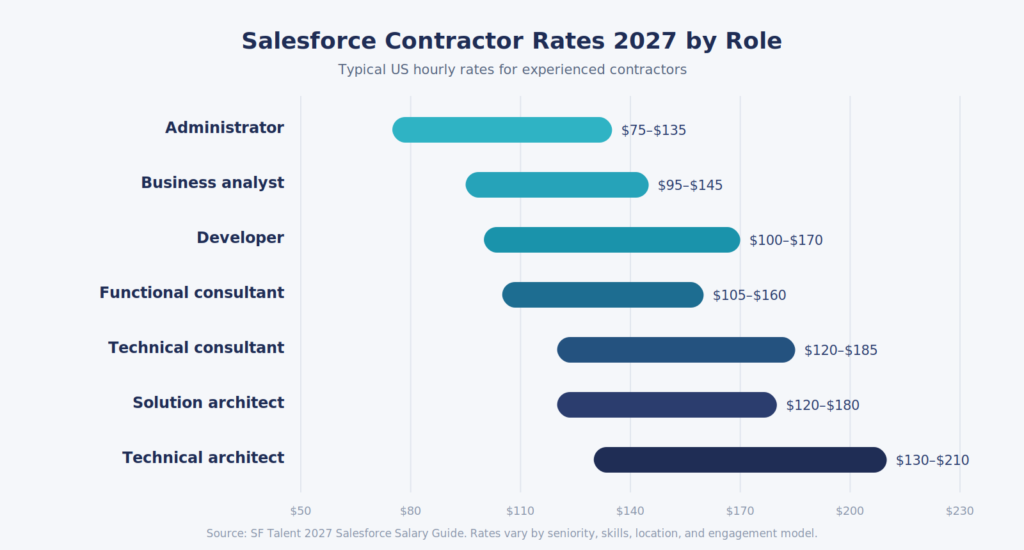
These are typical US hourly rates for experienced Salesforce contractors heading into 2027, consistent with our 2027 Salesforce salary guide. They reflect what companies commonly pay for contractors placed through a staffing firm or engaged directly for professional work.
| Role | Typical US hourly rate |
|---|---|
| Salesforce administrator | $75 to $135 |
| Business analyst | $95 to $145 |
| Salesforce developer | $100 to $170 |
| Functional consultant | $105 to $160 |
| Technical consultant | $120 to $185 |
| Solution architect | $120 to $180 |
| Technical architect | $130 to $210 |
The bottom of each band usually reflects mid-level contractors on well-defined work. The top reflects senior specialists, scarce skills, or urgent starts. Certified Technical Architects and contractors with production Agentforce experience can bill above these ranges. The Salesforce consultant hourly rate also depends on the type of consultant: technical consultants usually bill more than functional consultants at the same level.
You will also see much lower averages quoted online. ZipRecruiter, for example, reports an average of about $62 an hour for freelance Salesforce work in the US. That figure blends part-time work, junior roles, and what contractors are paid rather than what clients are billed, so it sits well below the rates companies typically pay for experienced, full-time contract help.
For role-by-role salary context, see our guides to Salesforce admin recruiters, hiring Salesforce developers, and how to hire Salesforce architects.
Bill Rate vs Pay Rate: Why Quotes Differ
The biggest source of confusion in Salesforce contractor rates is mixing up two numbers.
- The bill rate is what your company pays per hour.
- The pay rate is what the contractor actually receives.
When you hire through a staffing firm, the difference covers the firm’s margin and its costs: payroll taxes, insurance, benefits for W-2 contractors, recruiting, and often a replacement guarantee if the contractor leaves early. When you hire an independent contractor directly, the bill rate and pay rate are the same, but the contractor covers their own taxes, insurance, and downtime, which is why independent rates are rarely as low as they first look.
How you engage a contractor shapes the rate you see:
| Engagement model | How rates work | Watch for |
|---|---|---|
| Staffing firm (W-2 or corp-to-corp) | One bill rate that includes the firm’s margin and costs | Ask what is included, such as replacement and conversion terms |
| Independent contractor (1099) | You pay the contractor directly | Worker classification rules, contracts, and your own vetting time |
| Freelance marketplace | Rates set by the freelancer, plus platform fees | Wide quality range and limited vetting |
| Consulting partner | Blended team rates for a scoped project | Higher rates that include project management and delivery risk |
Marketplace fees add up quickly. Second Talent’s cost guide lists Upwork buyer fees of 3% to 10% plus a per-contract fee, with typical Upwork Salesforce rates spanning $25 to $150 an hour.
None of these models is always cheaper. Compare the total cost of getting the work done well, including your time to find, vet, and manage the contractor. Our comparison of a Salesforce headhunter vs staffing vs placement agency explains how staffing engagements are structured.
Onshore vs Nearshore vs Offshore Salesforce Contractor Rates
Location is one of the biggest drivers of Salesforce contractor rates. 360 Degree Cloud’s 2026 offshore Salesforce rate benchmark, one Salesforce partner’s published view, puts typical developer rates at:
| Model | Region | Typical developer rate | Time difference from US East Coast |
|---|---|---|---|
| Onshore | United States | $100 to $170 an hour | 0 to 3 hours |
| Nearshore | Latin America | $40 to $65 an hour | 0 to 2 hours |
| Offshore | Eastern Europe | $45 to $70 an hour | 6 to 8 hours |
| Offshore | India | $35 to $55 an hour | 9.5 to 10.5 hours |
The hourly rate is only part of the cost. Offshore work usually needs clearer specifications, more review, and more management time, and time-zone gaps slow down anything that requires quick back-and-forth. Nearshore teams cost more than offshore but overlap with US working hours.
A common pattern is to keep architecture, discovery, and stakeholder work onshore, and send well-specified builds offshore or nearshore. Our guide to offshore Salesforce developers explains which work fits each model.
What Pushes a Salesforce Contractor Hourly Rate Up or Down
Within each band, a handful of factors decide where a quote lands.
| Pushes the rate up | Pulls the rate down |
|---|---|
| Scarce skills: Agentforce, Data 360, Revenue Cloud and CPQ, MuleSoft integration | Common skills on well-documented work |
| Industry cloud depth, such as Health Cloud or Financial Services Cloud, typically 10% to 15% more | General Sales or Service Cloud experience |
| Senior credentials such as Certified Technical Architect | Mid-level experience with a clear specification |
| Short engagements and urgent starts | Longer commitments of six months or more |
| Part-time or fractional hours | Full-time hours for the length of the contract |
| On-site work or travel | Fully remote work |
| High-cost metros such as the Bay Area, New York, or Seattle | Lower-cost regions, or nearshore and offshore delivery |
Two factors deserve a closer look.
Short and part-time engagements cost more per hour because the contractor has more unbilled time between projects. If you need a few hours a week of admin help, our guide to the fractional Salesforce admin model covers how that pricing works.
AI skills carry the largest premium right now. Our 2027 Salesforce salary guide found that shipped Agentforce and Data 360 work is among the most valuable experience on a Salesforce resume, and contract rates for that work tend to follow. If your project involves agents, budget toward the top of the band.
Contractor vs Full-Time: The Real Cost Comparison
Contract rates look expensive next to salaries until you compare like with like. Here is a simple illustration for a senior Salesforce developer, using the midpoint of our salary guide range and roughly 30% added for benefits and payroll taxes.
| Full-time employee | Contractor at $135 an hour | |
|---|---|---|
| Base pay or rate | $155,000 a year | $135 an hour |
| Benefits and payroll taxes | About $46,500 | Included in the rate |
| Annual cost at full-time hours | About $201,500 | About $280,800 for 2,080 hours |
| Cost for a 6-month project | About $100,750, plus hiring time and an ongoing commitment | About $140,400, with no commitment after the project |
Over a full year, the contractor costs noticeably more. For a defined project, the gap narrows once you count what a full-time hire adds: weeks or months to recruit, onboarding time, and a role you have to keep busy after the project ends.
That is why contracting usually wins for work with an end date, such as an implementation, a migration, an Agentforce launch, or cover for parental leave, and full-time usually wins for ongoing ownership of the platform. Contract-to-hire splits the difference: you pay the contract rate while you confirm the fit, then convert.
Our comparison of contract vs full-time Salesforce hires walks through the decision in more detail, and our guide to the Salesforce consultant vs in-house hire covers when a consulting partner makes more sense than either.
How to Budget and Negotiate Salesforce Contractor Rates
A few habits keep contract costs predictable and help you get the right person at a fair rate.
- Define the work first. A clear scope, expected hours per week, and an end date let contractors quote accurately. Vague scopes get padded rates.
- Compare like with like. Ask every source for the bill rate, the role level, and what is included. A low quote from a marketplace and a higher quote from a staffing firm may not cover the same thing.
- Benchmark against the bands. Use the ranges above as a sanity check. A senior architect quoted well below market is a reason to ask more questions, not a bargain.
- Trade commitment for rate. Longer engagements, full-time hours, and remote work are reasonable levers for a lower hourly rate.
- Agree the exit terms. Settle notice periods, replacement terms, and contract-to-hire conversion fees before the contractor starts.
- Budget for management time. Even a strong contractor needs access, onboarding, and someone to make decisions. Include that time in the true cost.
Verify certifications on Salesforce’s credential verification page before you commit, especially for senior rates. And if you need someone quickly, our 30-day hiring plan shows how contract and permanent searches compare on timing.
Frequently Asked Questions
What is the hourly rate for a Salesforce contractor?
Typical US Salesforce contractor rates heading into 2027 run about $75 to $135 an hour for administrators, $100 to $170 for developers, $105 to $185 for functional and technical consultants, and $120 to $210 for architects, depending on seniority, skills, and how the contractor is engaged.
What is the hourly rate for a Salesforce developer?
The typical Salesforce developer hourly rate for experienced US contractors is $100 to $170. Offshore developers usually cost much less, roughly $35 to $70 an hour depending on the region, according to one partner’s published benchmark.
What are Salesforce architect contract rates?
Solution architects typically bill about $120 to $180 an hour and technical architects about $130 to $210. Certified Technical Architects and architects with production Agentforce experience can bill above those ranges.
What does a Salesforce admin consultant charge per hour?
Contract Salesforce administrators typically bill $75 to $135 an hour in the US. Part-time or fractional admin work often sits at the higher end because of the shorter commitment.
Why are freelance Salesforce rates quoted so much lower online?
Averages from job sites often blend part-time and junior work and report what contractors are paid rather than what clients are billed. Rates for experienced, full-time contract help are usually higher.
Is it cheaper to hire a Salesforce contractor or a full-time employee?
For ongoing work, a full-time employee usually costs less over a year. For defined projects with an end date, a contractor is often the better value once you count recruiting time, onboarding, and the commitment that comes with a permanent hire.
Know the Rate Before You Compare Quotes
Salesforce contractor rates make sense once you know what you are comparing: the role, the seniority, the location, and whether the number is a bill rate or a pay rate. Use the ranges in this guide as a benchmark, budget toward the top for scarce skills like Agentforce and Data 360, and weigh the hourly rate against the cost of getting the work done well.
Need a Salesforce contractor, or a quote you can trust? Talk to our Salesforce recruiters. We can tell you what a role costs in today’s market and find contractors who have done your kind of work before.