
The quote came in at $45 an hour. Your onshore contractor bills $150. For a team of three on a six-month build, that difference looks like more than $300,000 back in the budget, and your CFO has already done the math.
Then the project starts. Questions sit unanswered overnight. A requirement gets built the way it was written instead of the way it was meant. Your senior admin spends half her week reviewing work and rewriting user stories. By month four, the savings look smaller and the deadline looks further away.
Offshore Salesforce developers can save real money, and plenty of companies run them well. But the hourly rate is only one line of the cost. This guide compares onshore, nearshore, and offshore Salesforce developers on rate, time zone, quality, and risk, shows which Salesforce work fits each model, and explains the hybrid setup most successful teams end up using.
Table of Contents
Onshore, Nearshore, and Offshore Salesforce Developers Defined
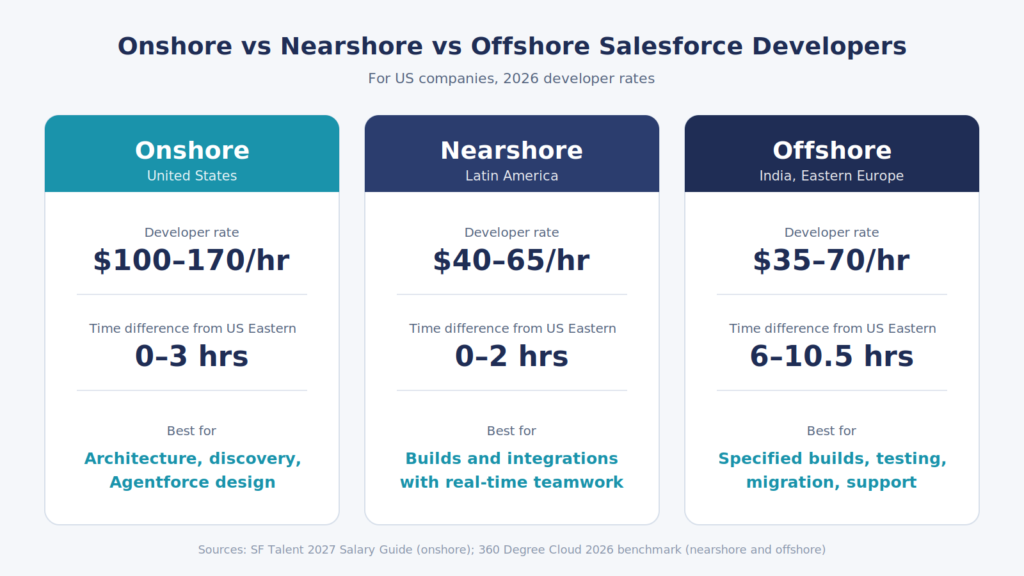
For a US company, the three models break down by distance and time zone:
- Onshore means Salesforce developers in your own country, as employees, contractors, or through a domestic partner.
- Nearshore means developers in a nearby country with a similar time zone. For US companies, that usually means Latin America.
- Offshore means developers in a distant time zone, most often India, with Eastern Europe and the Philippines as other common sources.
| Model | Typical regions | Time difference from US Eastern | Developer rate (2026) |
|---|---|---|---|
| Onshore | United States | 0 to 3 hours | $100 to $170 an hour (contract) |
| Nearshore | Mexico, Colombia, Argentina, Brazil | 0 to 2 hours | $40 to $65 an hour |
| Offshore, Eastern Europe | Poland, Romania, Ukraine, Bulgaria | 6 to 8 hours | $45 to $70 an hour |
| Offshore, India | India | 9.5 to 10.5 hours | $35 to $55 an hour |
The onshore range comes from our 2027 Salesforce salary guide. The nearshore and offshore ranges come from one Salesforce partner’s 2026 rate benchmark, which also notes that India has the deepest pool of certified offshore Salesforce professionals. Treat all of these as starting points. Senior architects cost more everywhere, and rates vary widely between partners.
The Real Cost of Offshore Salesforce Developers
The hourly rate is the number on the quote. The real cost includes everything your own team does to make that rate productive:
- Specification time. Offshore teams need detailed, written requirements. Someone onshore has to write them.
- Review and rework. Code and configuration need review, and misunderstandings that would take five minutes to fix in a hallway can take a day across time zones.
- Overlap meetings. Someone on your side shifts their day to cover the overlap window.
- Turnover. A developer who leaves a partner mid-project takes context with them, and the replacement needs ramp-up time.
A simple way to compare models is to apply an overhead multiplier to each rate. The multipliers below are illustrative assumptions, not measured figures. Use your own once you have a project or two of data.
| Model | Example rate | Illustrative overhead | Effective cost per productive hour |
|---|---|---|---|
| Onshore contractor | $150 | 1.1x | $165 |
| Nearshore developer | $55 | 1.2x | $66 |
| Offshore developer, India | $45 | 1.5x | $68 |
Even with generous overhead, offshore Salesforce developers usually stay cheaper per productive hour. The catch is where the overhead lands. It falls on your most senior Salesforce people, who spend their time writing specifications and reviewing work instead of designing the org. If they are already stretched, that hidden cost can outweigh the savings. Our comparison of contract vs full-time Salesforce hires covers the onshore side of the same math.
Quality and Risk: Where Onshore vs Offshore Salesforce Really Differs
Skill is rarely the problem. There are excellent Salesforce developers in every region, and India in particular has a very large pool of certified Salesforce talent. The differences show up in how the work gets done.
| Factor | Onshore | Nearshore | Offshore |
|---|---|---|---|
| Real-time collaboration | Full workday overlap | Most of the workday | A short overlap window, or none |
| Business context | Easier to absorb informally | Good with regular calls | Must be written down |
| Requirement ambiguity | Resolved quickly | Resolved same day | Can cost a day per question |
| Regulated data access | Simplest to approve | Needs review | Often restricted by policy or contract |
| Continuity | Depends on the person | Depends on the partner | Depends heavily on the partner’s bench and turnover |
Two risks deserve extra attention.
Data access. If your org holds health, financial, or government data, check your contracts and compliance policies before giving offshore teams production access. Many companies restrict offshore work to sandboxes with masked data, which is workable but needs planning.
Verification. A partner’s certification count only matters if the certifications are real and belong to the people on your project. Ask for the names of the developers assigned to you and check them on Salesforce’s credential verification page. Our guide to the Salesforce certifications that matter when hiring explains which credentials to look for by role.
Which Salesforce Work Fits Offshore, Nearshore, or Onshore
Start by asking which work tolerates distance.
| Salesforce work | Best fit | Why |
|---|---|---|
| Architecture and solution design | Onshore | Needs constant access to business leaders and fast decisions |
| Requirements and discovery | Onshore or nearshore | Depends on live conversation with stakeholders |
| Admin work for a small org | Onshore | Small, fast requests do not survive a time-zone handoff |
| Well-specified Apex and LWC builds | Offshore or nearshore | Clear inputs and outputs; overnight progress is an advantage |
| Data migration and testing | Offshore | Repeatable, well-defined work that benefits from scale |
| Integrations with in-house systems | Nearshore or onshore | Needs real-time coordination with other technical teams |
| Ongoing support and monitoring | Offshore or nearshore | Follow-the-sun coverage extends support hours |
| Agentforce and Data 360 design | Onshore | New, ambiguous work tied closely to business processes |
The pattern is consistent. The more ambiguous the work and the closer it sits to business decisions, the more it benefits from being onshore. The more defined and repeatable it is, the better it travels. Our Salesforce implementation staffing guide breaks down which roles each project phase needs.
The Hybrid Model Most Salesforce Teams Use
Most companies that use offshore Salesforce developers successfully do not go fully offshore. They split the team by the kind of work:
- Onshore: a solution architect or senior admin who owns the design, talks to the business, writes or approves requirements, and reviews what gets built.
- Nearshore or offshore: developers and testers who build to those requirements, often overnight from the US point of view.
- A named lead on the offshore side who joins the overlap window every day and manages the handoff.
The onshore role is what makes the model work. Without a strong owner on your side, requirements drift, reviews get skipped, and the cost savings disappear into rework. With one, a small onshore core can direct a larger offshore team efficiently.
That onshore owner is also the hardest role to fill. Senior Salesforce talent who can design an org and lead a distributed team are in short supply, as our Salesforce talent gap analysis explains. For running a team across time zones day to day, our guide to managing a remote Salesforce team covers the tools and routines that work.
How to Hire Offshore Salesforce Developers That Deliver
Most offshore Salesforce developers work through a consulting partner rather than as individual contractors. Salesforce’s AppExchange lists consulting partners with their ratings, completed projects, number of certified experts, and where those experts are based. Salesforce’s Trailhead guide to finding a consultant on AppExchange walks through how to filter and compare them.
Before you sign, check these:
- Named team. Ask who will actually work on your project, and verify their certifications by name.
- A paid pilot. Start with a small, well-defined piece of work for two to four weeks before committing to a large engagement.
- Overlap window. Agree on at least two hours of shared working time every day, with a named lead who attends.
- Definition of done. Write down what finished means: tests, documentation, peer review, and deployment through your pipeline.
- Data rules. Agree on which environments the team can access, and whether they work only in sandboxes with masked data.
- Replacement terms. Ask how quickly the partner replaces someone who leaves, and who pays for the ramp-up time.
- Knowledge transfer. Make documentation and a handover part of the contract, not a favor at the end.
If you would rather keep the build onshore but flexible, Salesforce staffing through a contract model is the alternative. Our comparison of a Salesforce headhunter vs staffing vs placement agency explains how contract staffing works, and our guide to Salesforce consultant vs in-house hires covers when a partner makes more sense than your own team.
Frequently Asked Questions
How much do offshore Salesforce developers cost?
One 2026 Salesforce partner benchmark puts offshore Salesforce developer rates at about $35 to $55 an hour in India and $45 to $70 an hour in Eastern Europe, with nearshore Latin American developers at about $40 to $65. Onshore US contract developers typically run $100 to $170 an hour. Senior architects cost more in every region.
What is the difference between nearshore and offshore Salesforce developers?
Nearshore Salesforce developers work in a nearby country with a similar time zone, which for US companies usually means Latin America. Offshore developers work in distant time zones, most often India or Eastern Europe, with little or no workday overlap.
Are offshore Salesforce developers good quality?
Many are excellent, and India has one of the largest pools of certified Salesforce professionals. Quality problems usually come from unclear requirements, limited overlap, and turnover rather than skill. Verify certifications by name and start with a small pilot.
Is onshore or offshore Salesforce development better?
Neither is better for everything. Onshore works best for architecture, requirements, small admin requests, and new Agentforce or Data 360 design. Offshore and nearshore work best for well-specified builds, testing, data migration, and extended support coverage.
What is a hybrid onshore-offshore Salesforce model?
A hybrid model keeps a small onshore core, usually a solution architect or senior admin, who owns design and requirements, while nearshore or offshore developers handle the build and testing. It captures most of the cost savings while keeping control of the design.
Can offshore Salesforce developers access production data?
It depends on your contracts, industry regulations, and internal policies. Many companies limit offshore teams to sandboxes with masked data, especially for health, financial, or government data. Settle this before the project starts.
Choose the Model by the Work, Not the Rate
Offshore Salesforce developers can cut build costs substantially, nearshore teams trade some of those savings for real-time collaboration, and onshore talent remains the strongest choice for design, discovery, and anything close to the business. Most strong Salesforce teams use all three, with an onshore owner directing the work. Decide what your project needs from each, then hire for that.
Need the onshore Salesforce talent that makes an offshore team work? Talk to our Salesforce recruiters. We place the solution architects, senior admins, and technical leads who own the design, write the requirements, and keep a distributed team on track.