A prospective student fills out an inquiry form in October. Admissions sees it in one system, financial aid in another, and the student’s application lands in a third. By the time an advisor calls, the student has already committed elsewhere. Two years later, the same pattern plays out with current students: an advisor cannot see that a student stopped logging into courses until the drop deadline has passed.
An Education Cloud consultant is hired to connect those pieces. Salesforce’s education platform brings recruitment, admissions, student success, advising, and advancement into one view of each learner. A good consultant designs that view around how the institution actually works, then configures it, migrates the data, and gets staff to use it.
This guide explains what the product is now, including its new name, what the consultant builds, how the role compares with others, the certification changes, five skills to test, pay, and how to hire.
Table of Contents
What Education Cloud Is in 2027
The product has a new name. Trailhead’s Education Cloud basics module says Education Cloud is now called Agentforce Education, and that you may still see the old name in the application and documentation. Expect both names on resumes and in job descriptions.
The same unit describes Agentforce Education as an integrated platform for academic institutions of all types and sizes, combining CRM, an adaptable data model, next-generation student information system (SIS) capabilities, analytics, and agentic AI. Salesforce lists AI uses such as answering prospective student questions around the clock, helping learners explore career interests, and making advisors more productive. Its Agentforce for Education page covers those agent capabilities in more detail.
Many institutions still run the older Education Data Architecture (EDA). Trailhead describes EDA as a data architecture for educational institutions, installed as a package and built on standard accounts and contacts plus custom objects such as relationships and affiliations, with program and course enrollments. Newer customers use the integrated platform instead. According to Cloud for Good, Salesforce has no plans to retire EDA but strongly recommends that EDA customers move to Education Cloud, which launched in 2023.
That split shapes the hire. A consultant who has only worked in EDA may need time on the newer data model, and an institution on EDA needs someone who can plan a migration.
What an Education Cloud Consultant Does
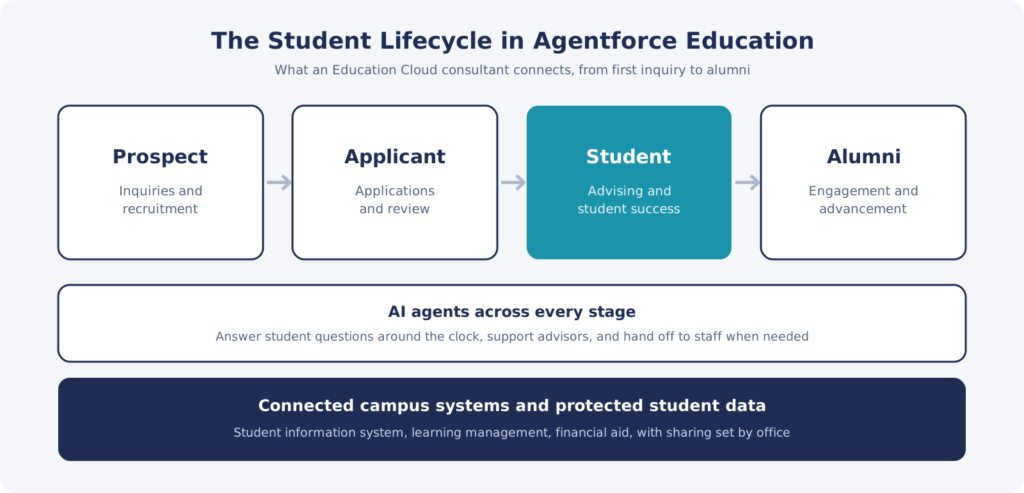
An Education Cloud consultant designs how learners, programs, staff, and processes fit together in Salesforce, then configures them. The work usually spans the student lifecycle:
| Area | Typical consultant work |
|---|---|
| Recruitment and admissions | Inquiry capture, applications, application review, and handoff to enrollment |
| Student success and advising | Advisor views, alerts, appointment scheduling, case management, and early intervention |
| Academic data | Programs, terms, courses, enrollments, and the connection to the student information system |
| Advancement and alumni | Alumni records, engagement, and fundraising, often alongside a nonprofit or fundraising solution |
| Portals | Student, applicant, and alumni sites, often built on Experience Cloud |
| AI agents | Agents that answer student questions, support advisors, and hand off to staff when needed |
Colleges that adopt Salesforce for higher education usually start with one office, often admissions, and add others over time. Few institutions start from scratch. Most connect Salesforce to an existing SIS, learning management system, and financial aid system, so integration and data work come up on nearly every project.
Education Cloud Consultant vs Developer vs Architect
| Role | Main focus | When you need it |
|---|---|---|
| Education Cloud consultant | Business process design and configuration across the student lifecycle | New implementation, EDA migration, new office rollout, agent rollout |
| Salesforce developer | Apex, Lightning Web Components, and custom automation | Custom logic and complex integrations |
| Experience Cloud developer | Student, applicant, and alumni portals | Self-service sites for learners |
| Solution architect | Data model, integration strategy, and multi-cloud design | Large universities, several campuses, many connected systems |
Our guides to hiring an Experience Cloud developer and hiring a Salesforce architect cover those roles. Institutions with a fundraising arm often overlap with nonprofit work, which our guide to the Nonprofit Cloud consultant covers, and our overview of Salesforce industry cloud hiring shows how the industry clouds compare.
The Education Cloud Certification Is Retiring
Salesforce Certified Education Cloud Consultant is one of 24 certifications retiring on February 1, 2027. According to Salesforce’s certification retirements article, all exams had to be completed by August 31, 2026, retired certifications stay on the holder’s Trailblazer profile as part of their professional history, and maintenance requirements have been removed.
Salesforce does not name a direct replacement. Its retirements article points Education Cloud candidates to Trailhead learning content and to two exams for foundational knowledge: Platform Administrator and Data 360 Consultant.
| Credential | Status | How to treat it |
|---|---|---|
| Education Cloud Consultant | Retiring February 1, 2027 | Strong evidence of past product knowledge; it can no longer be earned |
| Platform Administrator | Active | Recommended baseline |
| Data 360 Consultant | Active | Recommended next step for data unification work |
For hiring, treat the retiring credential as a plus and give real project work more weight, especially since newer candidates can no longer earn it. Verify credentials on the credential verification page, and see our guide to the Salesforce certifications that matter when hiring. For data unification across student systems, our guide to hiring a Data 360 consultant covers that role.
5 Skills to Look For in an Education Cloud Consultant
These five skills separate a strong Education Cloud consultant from a general Salesforce consultant.
1. How institutions work
Admissions, registrar, advising, financial aid, and advancement offices each have their own goals, calendars, and data. The best consultants understand terms, programs, and enrollment cycles, and know that the admissions calendar sets hard deadlines for go-live.
2. The education data model
Look for hands-on work with the current Agentforce Education data model, and with EDA if your institution still uses it. Ask which model the candidate built on most recently and what they would change about it.
3. SIS and system integration
Most projects connect Salesforce to a student information system, a learning management system, and other campus systems. A strong consultant knows what data should live where, how often it syncs, and how to work with integration developers. Our guide to hiring a MuleSoft developer covers the integration side.
4. Student privacy and data access
Student records carry legal privacy obligations, and access often differs by office. A good consultant designs sharing and field access carefully and brings the institution’s privacy and compliance staff in early. Hire for configuration skill and good judgment, and leave the legal calls to the institution’s own counsel.
5. Agents and adoption
An Education Cloud consultant in 2027 should know how to scope an agent for prospective student questions or advisor support, ground it in accurate program data, and hand off to staff when needed. Adoption matters just as much: advisors and admissions counselors need training and simple screens. Our guide to the Agentforce specialist role explains when agent work needs its own hire.
Education Cloud Consultant Salary and Rates in 2027
Our 2027 Salesforce salary guide found that industry cloud specialists earn 10% to 15% more than generalists. The estimates below apply that premium to the guide’s functional consultant bands.
| Level | Functional consultant base | Estimated with industry premium |
|---|---|---|
| Associate (0 to 2 years) | $75,000 to $95,000 | $83,000 to $109,000 |
| Mid-level (3 to 5 years) | $100,000 to $125,000 | $110,000 to $144,000 |
| Senior (5 to 10 years) | $125,000 to $160,000 | $138,000 to $184,000 |
| Principal (10+ years) | $155,000 to $195,000 | $171,000 to $224,000 |
Pay at universities often sits below corporate ranges, while consulting partners serving education pay closer to market. Contract functional consultants typically bill $105 to $160 an hour, according to our Salesforce contractor rates guide.
How to Hire an Education Cloud Consultant
Know which platform you are on
Check whether your org runs EDA or the current Agentforce Education platform, and which offices use it. A migration from EDA needs someone who has done one. A new implementation needs someone current on the newer data model.
Plan around the academic calendar
Admissions cycles, term starts, and registration windows set real deadlines. Ask candidates how they would phase a rollout so no office goes live in its busiest month.
Test with a real scenario
Ask the candidate to design how a prospective student becomes an applicant, then an enrolled student, then an alumnus, and what each office sees along the way. Listen for questions about the SIS, privacy, and who owns each record.
Choose contract or full time
A contractor fits a defined implementation or EDA migration. A full-time hire fits an institution that keeps adding offices and processes. Our comparison of contract vs full-time Salesforce hires covers the trade-offs.
Watch for red flags
- Has never connected Salesforce to a student information system
- Cannot explain the difference between EDA and the current platform
- Treats student privacy as an afterthought
- Talks about AI agents with no plan for accuracy or handoff to staff
Our recruiters are Salesforce certified and screen every Education Cloud consultant on real platform experience. We also place contractors from a vetted network for implementations and migrations.
Frequently Asked Questions
What does an Education Cloud consultant do?
An Education Cloud consultant designs and configures Salesforce for schools, colleges, and universities: recruitment and admissions, advising and student success, academic data, alumni and advancement, portals, and AI agents. They connect the platform to campus systems and help staff adopt it.
Is Agentforce Education the same as Education Cloud?
Yes. Trailhead says Education Cloud is now called Agentforce Education, and the old name may still appear in the application and documentation.
Is the Education Cloud Consultant certification still available?
No. It retires on February 1, 2027, and exams had to be completed by August 31, 2026. Salesforce points candidates to Trailhead content and to the Platform Administrator and Data 360 Consultant exams.
Should we move from EDA to Education Cloud?
Salesforce has no announced plan to retire EDA, but partners such as Cloud for Good say Salesforce strongly recommends moving. A consultant can assess your customizations and integrations before you decide.
How much does an Education Cloud consultant earn?
Applying the 10% to 15% industry premium from our 2027 salary guide, estimated US base pay runs from about $83,000 for associates to about $224,000 for principal consultants. Universities often pay below corporate ranges.
Does an Education Cloud consultant handle FERPA compliance?
No. The consultant configures sharing and access, but the institution’s privacy, compliance, and legal staff decide what the rules are. Hire someone who works well with them.
Find Your Education Cloud Consultant
The right hire understands how institutions work, knows your platform version, connects the SIS, and protects student data. Plan around the academic calendar and test with a real scenario.
Ready to hire an Education Cloud consultant? Talk to our Salesforce recruiters.