The Agentforce pilot looked great until someone asked it about an order. The answer lived in the ERP, the shipping status lived in a logistics system, and the customer’s contract lived in a third tool. The agent could not reach any of them. The project did not need a better prompt. It needed integration.
That is why companies are again trying to hire MuleSoft developers. MuleSoft is Salesforce’s integration platform, and integration has become the bottleneck for almost every serious Salesforce program, from data unification to AI agents that need to act across systems.
This guide explains what MuleSoft developers and architects do, how MuleSoft fits with Agentforce, the skills and current certifications to look for, what to pay, and how to assess candidates before you make an offer.
Table of Contents
What MuleSoft Is, and Why Integration Talent Matters Now
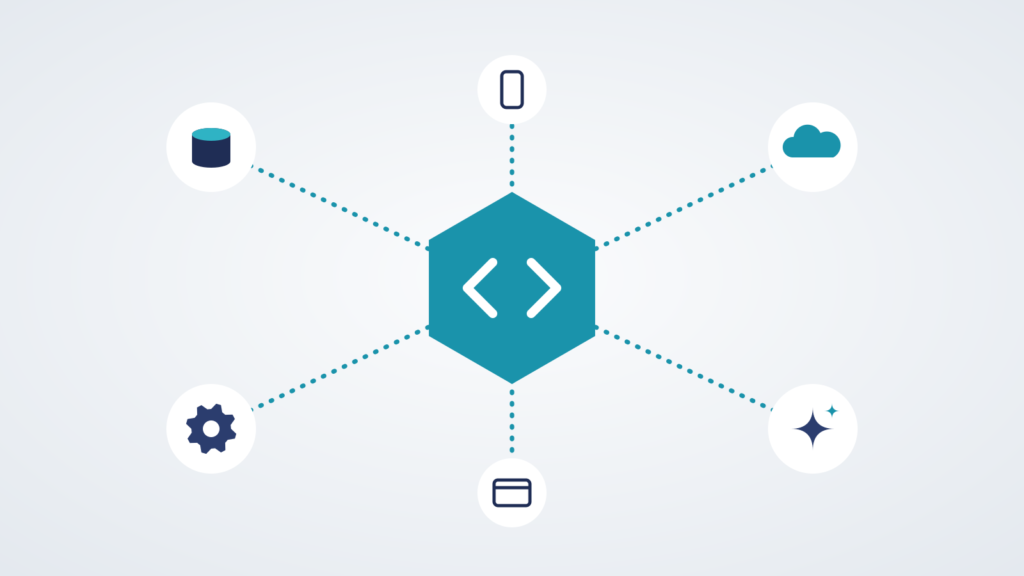
MuleSoft is the integration platform Salesforce owns. Its Anypoint Platform lets teams design, build, secure, and manage APIs and integrations that connect Salesforce with ERP systems, databases, data warehouses, and almost any other application.
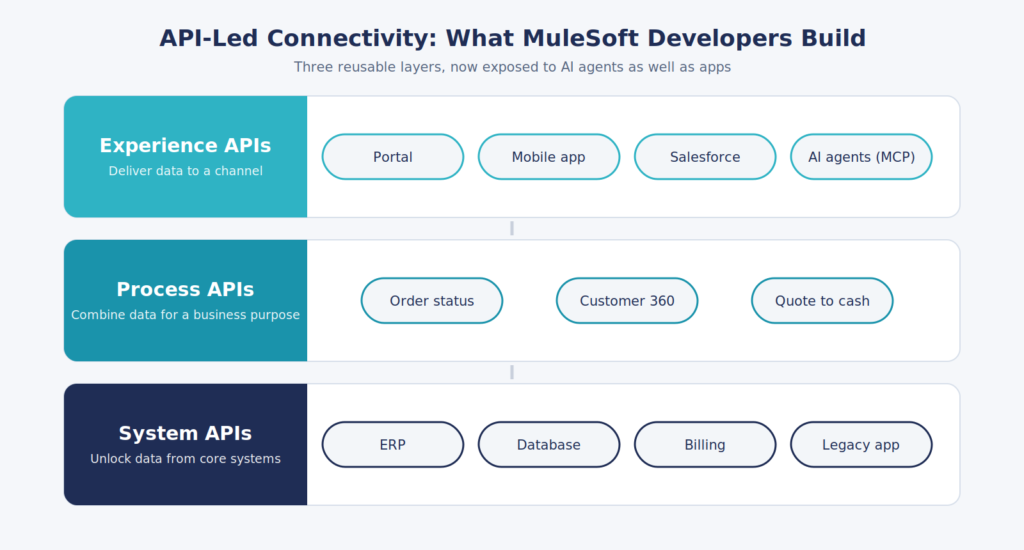
Most MuleSoft work follows an approach called API-led connectivity, which organizes integrations into three layers:
- System APIs unlock data from core systems such as SAP, Oracle, NetSuite, or a legacy database.
- Process APIs combine and shape that data for a business purpose, such as building a single view of an order.
- Experience APIs deliver the result to a specific channel, such as a portal, a mobile app, or Salesforce.
The layers make integrations reusable. Build a system API for the ERP once, and many projects can use it.
AI agents have made this work more important. In its MuleSoft agent orchestration announcement, Salesforce described MCP support that turns existing APIs into tools AI agents can use, an A2A connector for communication between agents, and tools for turning APIs into Agentforce actions. MCP and A2A are emerging open standards for how agents call systems and talk to each other.
Then came MuleSoft Agent Fabric. As Salesforce Ben’s breakdown explains, it is designed to register, orchestrate, govern, and observe AI agents from different vendors, extending Agentforce to work with agents built elsewhere.
The result: when companies hire MuleSoft developers today, they are hiring the people who decide what agents can reach and how safely they reach it.
MuleSoft Developer vs MuleSoft Integration Architect vs Platform Architect
Before you hire MuleSoft developers, decide which of three roles you actually need.
| Role | What they own | Typical background |
|---|---|---|
| MuleSoft developer | Building, testing, and deploying Mule applications and APIs | Java or integration developers, Salesforce developers who moved into integration |
| MuleSoft integration architect | Designing specific integration solutions: patterns, performance, reliability, error handling | Senior MuleSoft developers and integration specialists |
| MuleSoft platform architect | Owning the overall Anypoint Platform strategy: standards, governance, reuse, and a center for enablement | Enterprise and integration architects |
A MuleSoft integration architect focuses on how individual integrations are designed to work under real load. A platform architect focuses on how the whole integration estate is run, including which teams build what, how APIs are reused, and how the platform is governed. Smaller organizations often combine the two.
MuleSoft developers are also different from Salesforce developers. A Salesforce developer builds on the Salesforce platform with Apex and Lightning Web Components. A MuleSoft developer builds the integrations between Salesforce and everything else, using MuleSoft’s own tools and its DataWeave language. Some people do both, and they are especially valuable on Agentforce projects. Our guide to hiring Salesforce developers covers the Salesforce side.
Skills to Look for in a MuleSoft Developer
When you hire MuleSoft developers, look for these core skills:
- Building Mule applications in Anypoint Studio or Anypoint Code Builder
- DataWeave, MuleSoft’s language for transforming data between formats
- API design with RAML or OpenAPI, and the API-led connectivity approach
- Connectors for Salesforce, SAP, databases, messaging systems, and files
- Error handling, retries, and reliable messaging for systems that fail
- Deployment to CloudHub or Runtime Fabric, plus monitoring and logging
- API security and policies through API Manager and Flex Gateway
Skills that matter more every year:
- CI/CD and automated testing for Mule applications, including MUnit
- Designing for high volume and high availability
- Exposing APIs as tools for AI agents through MCP, and connecting agents with A2A
- Working with Salesforce data models, Platform Events, and Data 360
For architects, add judgment: choosing between synchronous and event-driven designs, planning for failure, setting standards that make APIs reusable, and governing an integration estate that keeps growing. Our guide to how to hire an Agentforce architect covers the role that designs how agents use these integrations.
MuleSoft Certification: What Each Credential Signals
MuleSoft credentials now sit inside Salesforce’s certification program. Trailhead’s MuleSoft Developer page lists the current family:
| Credential | What it signals | Best fit |
|---|---|---|
| MuleSoft Integration Foundations | Knows core integration and API-led connectivity terms | Analysts, project managers, new team members |
| MuleSoft Developer | Can design, build, test, deploy, and manage basic APIs and integrations | Developer roles |
| MuleSoft Developer II | Works independently on production-ready Mule applications in a DevOps environment | Senior developer roles |
| MuleSoft Hyperautomation Developer | Builds automation across Salesforce and MuleSoft products | Automation-focused roles |
| MuleSoft Platform Integration Architect | Translates requirements into integration designs | Integration architect roles |
| MuleSoft Platform Architect | Defines and owns an organization’s Anypoint Platform strategy | Platform architect roles |
Three reading tips for resumes:
- Older shorthand is still common. Candidates may write MCD for MuleSoft Developer, MCIA for Integration Architect, and MCPA for Platform Architect.
- Do not confuse the MuleSoft Platform Integration Architect with the Salesforce Platform Integration Architect. The second covers integration design on the Salesforce platform itself.
- The MuleSoft Catalyst Consultant certification retires on February 1, 2027, as part of Salesforce’s 2026 certification changes. It remains valid but can no longer be earned.
Verify any credential on Salesforce’s credential verification page. A MuleSoft certification proves knowledge of the platform. Production integrations prove the rest.
MuleSoft Developer Salary and Contract Rates
Our 2027 Salesforce salary guide does not yet break out MuleSoft as its own band, so companies that hire MuleSoft developers should use the closest developer and architect ranges as benchmarks:
| MuleSoft role | Closest benchmark | US base range (2027) |
|---|---|---|
| MuleSoft developer, mid-level | Salesforce developer, mid-level | $110,000 to $140,000 |
| Senior MuleSoft developer | Senior developer or technical consultant | $135,000 to $175,000 |
| MuleSoft integration architect | Technical architect | $160,000 to $190,000 |
| Senior integration or platform architect | Senior technical architect | $185,000 to $230,000 |
Integration skills tend to sit toward the top of these bands, because integration is a common bottleneck on large Salesforce and Agentforce programs. Candidates who have exposed APIs to AI agents, or who combine MuleSoft with strong Salesforce development, are especially hard to find.
MuleSoft work is also common on contract, especially for migrations and large implementations. Our guide to Salesforce contractor rates puts typical developer rates at $100 to $170 an hour and technical architect rates at $130 to $210, which are reasonable starting points for MuleSoft developers and architects.
How to Assess and Hire MuleSoft Developers
Run a short DataWeave exercise
Give the candidate a sample order payload and ask them to transform it into the format Salesforce expects, handling missing fields, nested line items, and date formats. Thirty minutes with a real transformation shows more than any resume. Strong candidates write clean, readable DataWeave and explain how they would test it.
Talk through an integration design
Try a scenario such as: “Orders created in Salesforce must reach the ERP within five minutes. The ERP goes offline for maintenance every Sunday. Finance needs to know if anything fails.” Listen for API-led layering, queues or events instead of fragile point-to-point calls, retries, error notifications, and monitoring.
Add an agent scenario
For roles that will support Agentforce, ask how they would let an agent look up order status in the ERP safely. Strong answers cover exposing the right API as a tool, limiting what the agent can access, rate limits, and logging every call.
Walk through production work
Ask for an integration they built that runs in production today: what it connects, the volumes it handles, what broke, and how they fixed it.
Know where to look
Strong candidates often come from MuleSoft consulting partners, from enterprise integration teams, and from Java or integration engineers who moved into MuleSoft. Senior integration architects rarely apply to postings, so a targeted search usually works better. Our comparison of a Salesforce headhunter vs staffing vs placement agency explains which model fits. For the engineers who embed with business teams to ship agents, see our guide to the forward deployed engineer.
Frequently Asked Questions
What does a MuleSoft developer do?
A MuleSoft developer builds, tests, and deploys integrations and APIs on MuleSoft’s Anypoint Platform, connecting Salesforce with ERP systems, databases, and other applications, and transforming data between them using DataWeave.
What is the difference between a MuleSoft developer and a Salesforce developer?
A Salesforce developer builds on the Salesforce platform with Apex and Lightning Web Components. A MuleSoft developer builds the integrations between Salesforce and other systems using MuleSoft’s tools. Some people do both.
What MuleSoft certifications should I look for?
For developers, look for Salesforce Certified MuleSoft Developer and, for senior roles, MuleSoft Developer II. For architects, look for MuleSoft Platform Integration Architect or MuleSoft Platform Architect. Candidates may still use older shorthand such as MCD, MCIA, and MCPA.
How much does a MuleSoft developer earn?
MuleSoft developers generally benchmark against Salesforce developer pay, roughly $110,000 to $175,000 in US base salary from mid to senior levels, with integration architects at about $160,000 to $230,000.
What is MuleSoft Agent Fabric?
MuleSoft Agent Fabric is a Salesforce solution, launched in 2025, for registering, orchestrating, governing, and observing AI agents from different vendors, extending Agentforce to work with agents built elsewhere.
Why do Agentforce projects need MuleSoft developers?
Agents can only act on data and systems they can reach. MuleSoft developers build and secure the APIs that let agents look up and update information in ERP and other systems, and newer MuleSoft tools can expose those APIs to agents through MCP.
Integration Is the Work Behind the Work
Every ambitious Salesforce program eventually runs into the same wall: the data and actions it needs live in other systems. MuleSoft developers and integration architects are the people who take that wall down, and with AI agents now depending on those integrations, the role has never mattered more. When you hire MuleSoft developers, test real DataWeave and integration design, read certifications in both old and new forms, and look for production work that has survived failures.
Need to hire MuleSoft developers or integration architects? Talk to our Salesforce recruiters. We find integration specialists who have connected Salesforce to the systems that matter, and we can tell you what the market looks like for your role today.