

The implementation was due to go live in March. It is now June. The partner says the delays came from late requirements, the business says the partner missed deadlines, and the data migration has not started because nobody owned it. The budget is 40% spent, three executives want weekly updates, and each one has heard a different date.
A Salesforce project manager is hired to keep this from happening. The role owns the plan for a Salesforce project: scope, schedule, budget, risks, people, and communication from kickoff to go-live. When the product owner decides what to build and the team builds it, the project manager makes sure it lands on time and on budget.
This guide explains what the role involves, how it differs from a product owner and a business analyst, useful certifications, five skills to test, pay, and how to hire.
Table of Contents
What a Salesforce Project Manager Does
The work follows the project from start to finish. A typical scope:
| Phase | What the project manager does |
|---|---|
| Initiate | Confirms scope, goals, budget, and success measures with sponsors, and sets up the project team |
| Plan | Builds the schedule, staffing plan, risk log, and communication plan, including the Salesforce release calendar |
| Deliver | Runs sprints or phases, tracks progress, removes blockers, and manages partner and vendor work |
| Control | Manages change requests, budget, and risks, and reports status honestly to leadership |
| Go-live | Coordinates testing, data migration, training, cutover, and early support |
| Close | Hands the platform to the team that will run it and records lessons learned |
The US Bureau of Labor Statistics describes project management specialists as people who coordinate the budget, schedule, staffing, and other details of a project. On a Salesforce project, those details include three platform releases a year, sandbox and deployment timing, data migration, and the business users who need to test and adopt the new system.
Salesforce Project Manager vs Product Owner vs Business Analyst
These three roles work side by side on most Salesforce implementation projects, and the lines blur on small teams. Each answers a different question:
| Role | Main question | Owns |
|---|---|---|
| Salesforce project manager | Will we deliver on time and on budget? | Schedule, budget, risks, resources, status |
| Salesforce product owner | What should we build next, and why? | The ordered backlog and acceptance of work |
| Salesforce business analyst | What exactly does the business need? | Requirements, process maps, user stories |
| Scrum master | Is the team working well together? | Agile practices, ceremonies, team impediments |
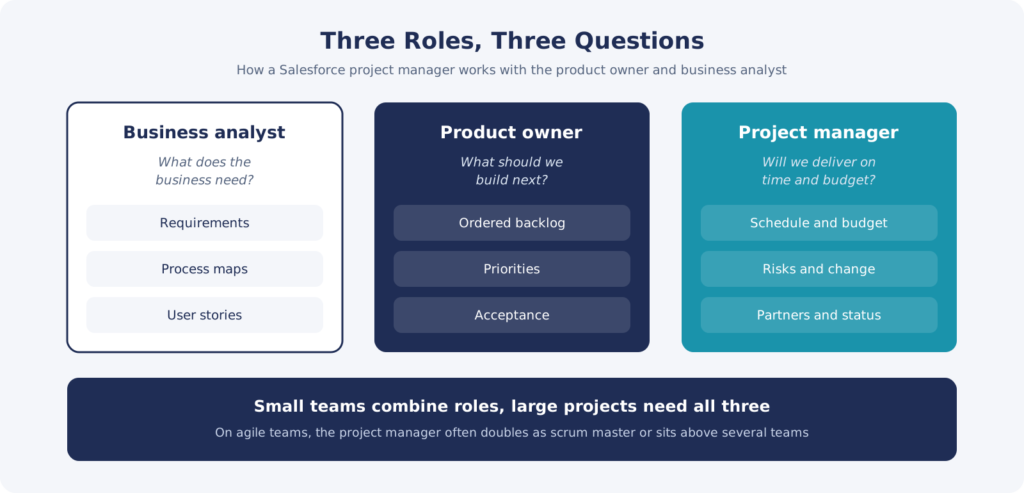
Agile teams sometimes ask whether they need a project manager at all. The 2020 Scrum Guide defines three accountabilities on a Scrum team: the product owner, the scrum master, and the developers. It has no project manager. In practice, many Salesforce projects still need someone to manage budgets, partner contracts, deadlines, and work across several teams, so the Salesforce project manager often doubles as the scrum master or sits above several teams.
Our guides to the Salesforce product owner and the Salesforce business analyst cover the other two roles, and our Salesforce implementation staffing guide shows how they fit together on a project team.
When a Salesforce Project Needs a Dedicated Project Manager
Not every change needs one. An admin adding fields or building a Flow can manage the work alone. The picture changes as projects grow. Common signs you need a dedicated project manager:
- The project has a fixed go-live date tied to a contract, a merger, or a system being switched off
- More than one team or partner is involved, and someone has to coordinate them
- The budget is large enough that leadership wants regular reports on spend
- The work includes data migration, integrations, or several clouds
- Executives already hear different dates from different people
Consulting partners usually bring their own project manager. Many companies still hire one of their own, because the partner’s manager answers to the partner. An internal Salesforce project manager protects your budget, holds the partner to the statement of work, and keeps the business side ready for testing and training.
Certifications and Credentials
Salesforce does not offer a project management certification. The most recognized general credential is the Project Management Professional (PMP) from the Project Management Institute, and PMP certification is common in Salesforce project manager job descriptions. According to PMI’s PMP certification page, candidates need 36 months of experience leading projects within the past eight years plus 35 hours of project management education if they hold a four-year degree, or 60 months of experience without one. The exam has 180 questions.
Agile credentials such as Certified ScrumMaster from Scrum Alliance or Professional Scrum Master from Scrum.org are common on Salesforce teams. A Salesforce credential matters too, because a project manager who knows the platform can judge estimates and spot risks earlier. Platform Administrator is the most useful baseline. Verify any Salesforce credential on the credential verification page, and see our guide to the Salesforce certifications that matter when hiring.
5 Skills to Look For in a Salesforce Project Manager
These five skills separate a Salesforce project manager who delivers from one who only tracks dates.
1. Salesforce delivery experience
Generic project management experience helps, but Salesforce projects have their own risks: sandbox strategy, deployment windows, three major releases a year, data migration, and integrations. The Salesforce Admins blog recommends testing in a preview sandbox before each upgrade, and a good project manager builds that into the schedule. Ask for a Salesforce project the candidate ran from kickoff to go-live.
2. Scope and change control
Most Salesforce projects slip because scope grows quietly. Look for someone who documents scope, runs a clear change request process, and explains the cost of each change before it is approved.
3. Partner and vendor management
Many projects involve a consulting partner, AppExchange vendors, and contractors. The project manager should read statements of work, track partner delivery, and raise problems early. Our guide to consultants vs in-house hires covers how those relationships work.
4. Risk management and honest reporting
Strong candidates keep a live risk log and report bad news early. Ask how they told a sponsor a project would miss its date, and what they proposed instead. Watch for status reports that stay green until the week before go-live.
5. Go-live and adoption planning
A Salesforce implementation project succeeds when people use the system. Look for experience planning training, cutover, data migration, and early support. Our guides to hiring a Salesforce data migration specialist and a Salesforce QA tester cover two of the roles a project manager coordinates before go-live.
Salesforce Project Manager Salary in 2027
Our 2027 Salesforce salary guide does not have a separate project manager band. Two benchmarks help:
| Benchmark | US base pay | Source |
|---|---|---|
| Project management specialists, all industries, median (May 2025) | $102,320 | US Bureau of Labor Statistics |
| Mid-level functional consultant (3 to 5 years) | $100,000 to $125,000 | SF Talent 2027 salary guide |
| Senior functional consultant (5 to 10 years) | $125,000 to $160,000 | SF Talent 2027 salary guide |
The BLS figure covers project managers in every field. Salesforce project managers with platform experience usually compete with functional consultants for the same candidates, so the consultant bands are a closer guide. Large multi-cloud programs, regulated industries, and program management across several teams push an offer higher.
Many companies hire project managers on contract for a single implementation. Functional consultants typically bill $105 to $160 an hour, according to our Salesforce contractor rates guide, and experienced Salesforce project managers are usually priced in that range.
How to Hire a Salesforce Project Manager
Decide whether the need is a project or a program
A single implementation with a clear end date suits a project manager on contract. Several projects running at once, or a long rollout across departments, may need a program manager who stays on. Our comparison of contract vs full-time Salesforce hires walks through the trade-offs.
Test with a real situation
Give candidates a short case: a project three weeks behind, a partner asking for more budget, and a sponsor who wants a new feature added. Ask what they would do in the first week and how they would report it. Listen for trade-offs, honesty, and specific next steps.
Check references on delivery
Ask past sponsors whether the project landed on time and on budget, how surprises were handled, and whether they would hire the person again. A reference who cannot recall a single problem may not have been close to the work.
Watch for red flags
- Has never run a Salesforce project end to end
- Talks only about tools and templates, never about outcomes
- Cannot describe a project that went wrong and what they learned
- Treats change requests as approvals to sign, without explaining their cost
Our recruiters are Salesforce certified and screen every Salesforce project manager on real delivery experience. For defined implementations, we also place project managers from a vetted network of contractors.
Frequently Asked Questions
What does a Salesforce project manager do?
A Salesforce project manager plans and runs Salesforce projects: scope, schedule, budget, risks, team, and communication from kickoff to go-live. They coordinate admins, developers, partners, testers, and business users so the project lands on time and on budget.
What is the difference between a Salesforce project manager and a product owner?
The project manager owns delivery: dates, budget, risks, and resources. The product owner owns priorities: what gets built next and why. Large projects usually need both.
Does a Salesforce project manager need a PMP?
Not always. PMP is the best-known project management credential, and PMI requires 36 to 60 months of experience leading projects to sit the exam. Salesforce delivery experience often matters more, and many Salesforce teams also value agile credentials.
How much does a Salesforce project manager earn?
The Bureau of Labor Statistics reports a May 2025 median of $102,320 for project managers across all industries. Salesforce project managers often compete with functional consultants, whose base pay runs $100,000 to $160,000 at mid to senior level in our 2027 salary guide.
Do agile Salesforce teams need a project manager?
The Scrum Guide has no project manager role, but many Salesforce projects still need someone to manage budgets, partners, deadlines, and work across several teams. On smaller teams, one person often covers project management and scrum master duties.
Should we hire a Salesforce project manager on contract?
For a single implementation with a clear end date, a contract project manager is often the better fit. For several overlapping projects or an ongoing program, a full-time hire usually pays off.
Find Your Salesforce Project Manager
The right hire knows how Salesforce projects go wrong, controls scope, manages partners, and reports bad news early. Decide between project and program, test with a real situation, and check delivery references.
Ready to hire a Salesforce project manager? Talk to our Salesforce recruiters.