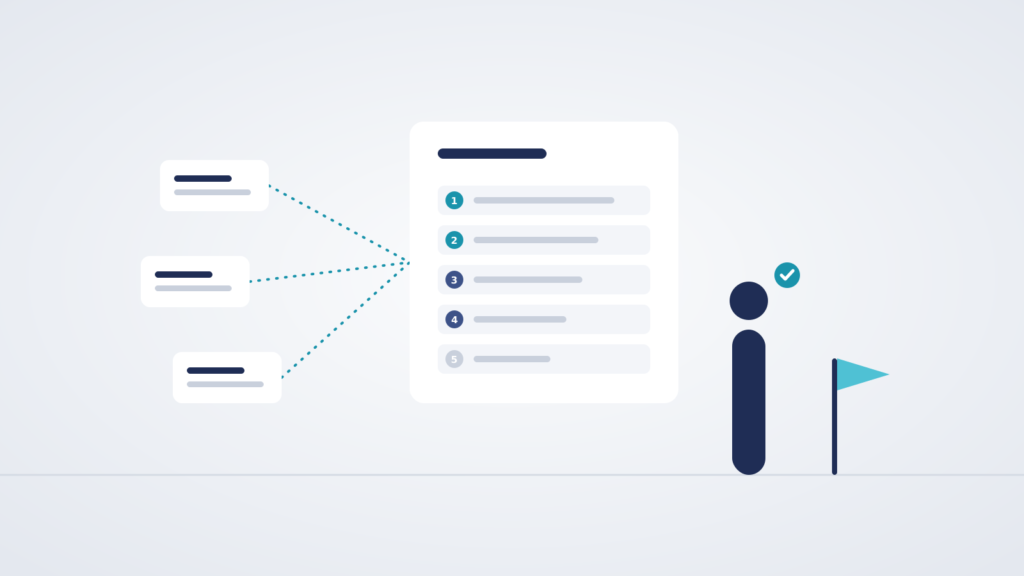
Sales wants an AI agent for lead follow-up. Service wants the case page redesigned. Marketing wants a new integration, and finance wants the quoting process fixed before year end. Every request lands in the admin’s inbox, and the loudest executive usually wins. Six months later, the org has a dozen half-finished projects and nobody can say which ones mattered.
A Salesforce product owner is hired to end that pattern. The role owns one ordered list of work for the Salesforce platform, decides what gets built next and why, and makes sure each release delivers business value. Teams that treat Salesforce as a product, with a single owner, tend to get more from it than teams that treat it as a ticket queue.
This guide explains what the role is, what the work involves, how it differs from a business analyst and a product manager, useful credentials, five skills to test, pay, and how to hire.
Table of Contents
What a Salesforce Product Owner Is
The product owner role comes from Scrum. The 2020 Scrum Guide makes the product owner accountable for maximizing the value of the product, developing the product goal, and ordering the product backlog. It also says the product owner must be a single person, and that anyone who wants to change the backlog has to convince that person.
Salesforce uses the same idea internally. Its Trailhead unit on Scrum at Salesforce describes the product owner as responsible for the what and why: prioritizing the product backlog, communicating the highest-value work, and defining, prioritizing, and approving work for the team.
The role fits Salesforce well because a Salesforce org is never finished. Business processes change, three platform releases a year add new features, and AI agents bring a new stream of requests. Without a single owner, each department pulls the org in its own direction, and the admin team ends up refereeing instead of building. A product owner turns those competing demands into one plan.
One note on job titles. Salesforce itself employs product owners and product managers who build its products. This guide is about the role on the customer side: the person who owns your company’s Salesforce platform, or one part of it, and directs your internal team or partner.
What a Salesforce Product Owner Does
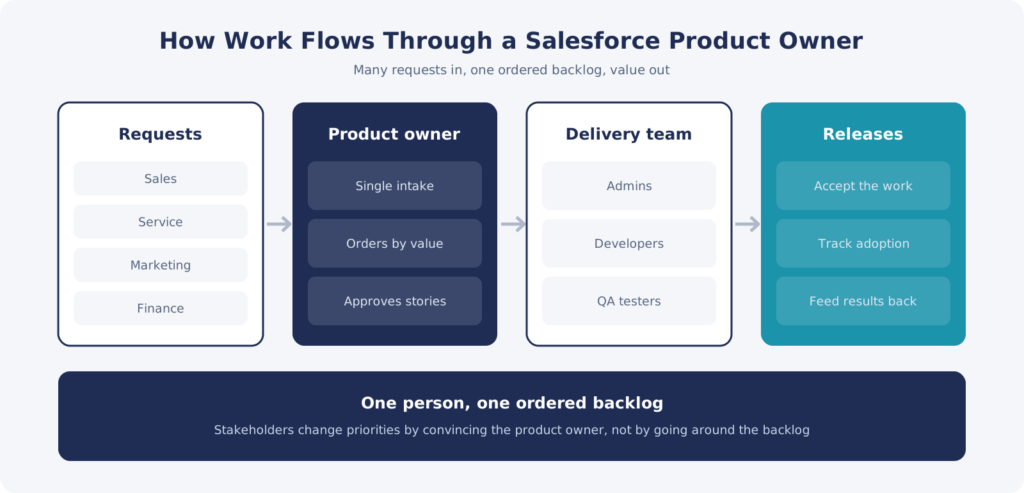
The work centers on the backlog, but it reaches across the business:
| Area | What the product owner does |
|---|---|
| Intake | Runs one front door for requests so work does not arrive through side channels |
| Backlog | Orders work by business value, effort, risk, and deadlines, and keeps it visible |
| User stories | Writes or approves stories with clear acceptance criteria before sprint planning |
| Roadmap | Maintains the Salesforce roadmap and explains trade-offs to leadership |
| Acceptance | Reviews finished work, supports user acceptance testing, and approves releases |
| Outcomes | Tracks adoption and results after release and feeds them back into priorities |
In larger orgs, several product owners each own one area, such as sales, service, or a business unit, and coordinate through a head of product or a Salesforce Center of Excellence. A real example: a May 2026 Salesforce Product Owner posting at George Mason University in Fairfax, Virginia, described owning the backlog for assigned university functions inside its Salesforce Center of Excellence and contributing to a single platform roadmap alongside fellow product owners.
Salesforce Product Owner vs Business Analyst vs Product Manager
The product owner vs business analyst question causes the most confusion. The roles overlap, and small teams often combine them, but they answer different questions:
| Role | Main question | Owns |
|---|---|---|
| Salesforce product owner | What should we build next, and why? | The ordered backlog and acceptance of work |
| Salesforce business analyst | What exactly does the business need? | Requirements, process maps, and detailed stories |
| Salesforce product manager | Where should the platform go over the next year? | Strategy and the multi-year roadmap, often across several product owners |
| Salesforce admin | How do we configure it? | The build and day-to-day support |
A business analyst can be an excellent product owner, but only if the company gives them authority to say no. Our Salesforce business analyst hiring guide covers the analyst role in depth, and our guide to Salesforce team structure shows where each role fits as a team grows.
Certifications and Credentials
Salesforce does not have a product owner certification. Two outside credentials are common: Certified Scrum Product Owner (CSPO) from Scrum Alliance and Professional Scrum Product Owner (PSPO) from Scrum.org. The George Mason posting listed CSPO or an equivalent agile product credential as preferred, alongside Salesforce Business Analyst and Administrator certifications.
The Salesforce certifications matter because an agile product owner who doesn’t understand the platform cannot judge effort or trade-offs. Platform Administrator is the most useful baseline. Verify any Salesforce credential on the credential verification page, and see our guide to the Salesforce certifications that matter when hiring.
5 Skills to Look For in a Salesforce Product Owner
These five skills separate a Salesforce product owner who drives value from one who only manages a list.
1. Prioritizing by value
Strong product owners order work by business value, effort, risk, and dependencies, and they can explain every ranking. Ask a candidate how they would rank eight competing requests from four executives.
2. Platform fluency
A Salesforce product owner should know what standard features can do, what needs code, and how each of the three yearly Salesforce releases might change plans. They also need enough technical judgment to spot work that adds technical debt and to give cleanup a place in the backlog.
3. Clear stories and acceptance criteria
Developers and testers build and test from what the product owner approves. Look for stories that state the user, the need, and testable acceptance criteria. Our guide to hiring a Salesforce QA tester shows how testers use them.
4. Stakeholder management
The hardest part of the job is saying no, or “not yet,” to senior people. Ask for an example where a candidate pushed back on an executive request and what happened next.
5. Outcomes and AI ownership
Good product owners measure adoption and results after release. In 2027, many will also own AI agents: what each agent may do, how its work is reviewed, and when to expand it. Our guide to the Agentforce specialist role covers the hands-on agent work they direct.
Salesforce Product Owner Salary in 2027
Our 2027 Salesforce salary guide does not have a separate product owner band. Most product owners come from business analyst, admin, or consultant backgrounds, so the guide’s functional consultant band is the closest benchmark:
| Level | Functional consultant base (benchmark) |
|---|---|
| Mid-level (3 to 5 years) | $100,000 to $125,000 |
| Senior (5 to 10 years) | $125,000 to $160,000 |
| Principal (10+ years) | $155,000 to $195,000 |
Scope moves the number more than the title does. A product owner for one team’s processes sits lower in the range than one who owns the roadmap for a multi-cloud org, sets priorities for AI agents, or leads other product owners.
How to Hire a Salesforce Product Owner
Confirm you need one
Signs you need a Salesforce product owner include constant priority fights, a backlog nobody trusts, releases that ship features nobody uses, and an admin acting as gatekeeper by default. One admin supporting a small team usually does not need one yet.
Give the role real authority
The Scrum Guide says the organization must respect the product owner’s decisions. If executives can skip the backlog, the hire will fail. Agree on the decision rights before you write the posting; our Salesforce job description guide helps with the rest.
Test with a real backlog
Give finalists a list of real requests and ask them to order it, explain the top three, and write one user story with acceptance criteria. Then ask how they would tell the executive whose request ranked last.
Choose contract or full time
An interim or contract product owner can stabilize a backlog during an implementation. A full-time hire makes sense when Salesforce supports several departments and the roadmap runs for years. Our comparison of contract vs full-time Salesforce hires covers the trade-offs.
Watch for red flags
- Describes the job as taking orders from stakeholders
- Cannot explain how they ranked past work
- Has no Salesforce platform knowledge
- Measures success by stories delivered instead of business results
Our recruiters are Salesforce certified and screen every Salesforce product owner on real platform and delivery experience. We also place interim product owners from a vetted network of contractors.
Frequently Asked Questions
What does a Salesforce product owner do?
A Salesforce product owner owns the ordered list of Salesforce work, decides what gets built next and why, writes or approves user stories, accepts finished work, and tracks results after release. The role makes sure the platform delivers business value.
What is the difference between a product owner and a business analyst?
The product owner decides what to build next and owns the backlog. The business analyst works out exactly what the business needs and documents the requirements. Small teams often combine the roles, but the product owner needs authority to make priority calls.
Do Salesforce product owners need a certification?
Salesforce does not offer a product owner certification. Common credentials are CSPO from Scrum Alliance and PSPO from Scrum.org, ideally paired with the Salesforce Platform Administrator certification.
How much does a Salesforce product owner earn?
Our 2027 salary guide has no separate product owner band. The closest benchmark, the functional consultant band, runs from $100,000 for mid-level to $195,000 for principal roles, with scope driving where an offer lands.
Is a Salesforce product owner the same as a Salesforce product manager?
Not quite. On most customer teams, a product manager sets long-term platform strategy, often across several product owners, while each product owner manages a backlog and works with a delivery team.
Can an admin be the product owner?
In a small org, yes, but it is hard to build and judge your own work at the same time. As Salesforce supports more departments, a separate product owner usually pays off.
Find Your Salesforce Product Owner
The right hire knows the platform, ranks work by value, and has the backbone to hold a priority call. Give them real authority and test with a real backlog.
Ready to hire a Salesforce product owner? Talk to our Salesforce recruiters.