Three proposals arrive for the same Salesforce project. One is from a global systems integrator, with a price that would cover two full-time hires. One is from a boutique firm that has done exactly this work twice. One is from an offshore team at a third of the cost. Each promises certified experts, proven methods, and an on-time go-live. Six months later, only one of those promises will still look true.
Choosing a Salesforce consulting partner is one of the highest-stakes decisions a company makes about its platform. The right partner sets up a clean org, transfers knowledge to your team, and leaves you stronger. The wrong one leaves technical debt, a missed deadline, and a team that cannot maintain what was built.
This guide explains the types of partners, what Salesforce’s new partner tiers mean, seven ways to evaluate a firm, what to put in the statement of work, red flags, and when you need a partner at all.
Table of Contents
What a Salesforce Consulting Partner Does
A Salesforce consulting partner is a firm that designs, builds, and launches Salesforce solutions for customers. Most belong to Salesforce’s partner program, which gives them training, sandbox access, and a listing where customers can find them. Partners typically handle:
- Discovery, requirements, and solution design
- Configuration, custom development, and integrations
- Data migration, testing, and training
- Go-live support and, sometimes, ongoing managed services
A partner sells a delivered outcome with a team behind it. That is the main difference from hiring an individual consultant or contractor, who sells their own time and skills. Our guide to hiring a Salesforce consultant covers the individual route.
Types of Salesforce Partners
| Type | Strengths | Watch for |
|---|---|---|
| Global systems integrator | Scale, multi-cloud programs, industry depth, global delivery | High cost, junior staff on your project, slower decisions |
| Boutique or specialist firm | Deep expertise in one cloud or industry, senior attention | Limited capacity, key-person risk |
| Offshore or nearshore partner | Lower rates, large teams, extended hours | Time zones, communication, quality control |
| Independent contractors | Flexibility, direct access to the person doing the work | No delivery team behind them, gaps when they leave |
The best Salesforce consulting partner for you depends on the size and risk of the project. A global systems integrator suits a multi-year, multi-cloud transformation. A boutique Salesforce implementation partner often wins on a focused project in one cloud. Offshore teams can work well with strong internal oversight, as our guide to offshore Salesforce developers explains.
What Salesforce Partner Tiers Mean in 2026
Salesforce overhauled its partner program in early 2026. According to Futurum Group’s analysis, Salesforce consolidated its four consulting tiers (Base, Ridge, Crest, and Summit) into two: Summit and Select. It also reduced 170 Navigator distinctions to 28 core competencies. Within each competency, partners are classified as Accredited or Expert based on project volume and customer satisfaction scores.
Salesforce Ben’s coverage adds that the program now focuses on agentic AI and verifiable customer outcomes, with Summit for partners aligned to strategic growth and Select for proven delivery partners that meet clear performance standards.
| Program element | Before 2026 | Now |
|---|---|---|
| Consulting tiers | Base, Ridge, Crest, Summit | Select, Summit |
| Specialization | 170 Navigator distinctions | 28 competencies |
| Competency levels | Varied by distinction | Accredited or Expert |
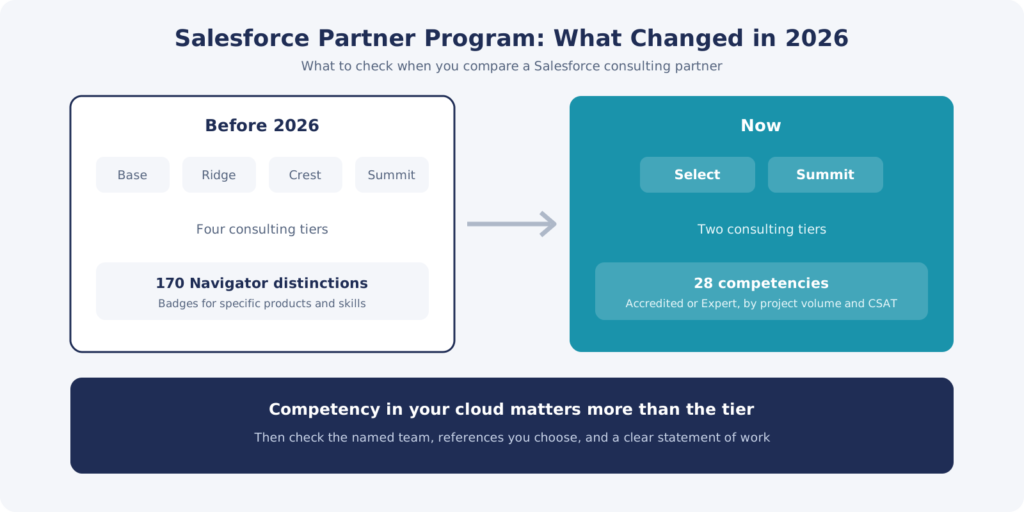
When you compare each Salesforce consulting partner, the competency matters more than the tier. A Select partner rated Expert in exactly your cloud may serve you better than a Summit partner with no depth there. Expect older proposals and websites to still use the Ridge and Crest names for a while.
7 Ways to Evaluate a Salesforce Consulting Partner
1. Proven work in your cloud and industry
Ask each Salesforce consulting partner for two or three projects that match yours in cloud, industry, and size. A partner that has built Health Cloud for a regional hospital will ramp faster on your hospital project than one that mostly builds Sales Cloud for software companies.
2. The actual team
Ask who will work on your project, by name, and for how many hours a week. Meet the lead consultant or architect before signing. The senior people in the sales meeting are not always the people who do the work.
3. References you choose
Ask for a list of recent clients and pick the references yourself. Ask each one whether the project landed on time and on budget, how the partner handled problems, and whether the internal team could maintain the result afterward.
4. Delivery method and governance
Good partners explain how they run discovery, sprints, testing, and change requests. Ask how they report status, how they escalate risks, and who on their side is accountable. A clear method protects both sides.
5. Knowledge transfer
The project should leave your team able to run the platform. Ask how the partner documents decisions, trains admins, and hands over. Our guide to the Salesforce Center of Excellence explains why internal ownership matters after go-live.
6. Clean technical design
Ask how the partner decides between configuration and code, how they handle existing automation, and how they keep the org maintainable. Rushed builds create Salesforce technical debt that your team pays for later.
7. Commercial terms that match the risk
Fixed-price contracts suit well-defined scope. Time-and-materials contracts suit projects where scope will change. Ask how the partner handles change requests, what happens if a milestone slips, and what support is included after go-live.
How to Run the Selection Process
A structured process makes proposals comparable and protects you from choosing on the sales pitch alone.
Write a short brief
Describe the business problem, the clouds involved, the systems to integrate, the data to migrate, the deadline, and the budget range. A clear brief gets you proposals you can compare. A vague one gets you three different projects at three different prices.
Shortlist three to five firms
Choose a mix of sizes if you are unsure what fits. Check each Salesforce consulting partner’s competencies in your cloud, and check named consultants’ certifications on Trailhead’s credential verification page.
Score proposals the same way
Use one scorecard for every Salesforce consulting partner on the list: relevant experience, named team, method, knowledge transfer, technical approach, references, and price. Weight price last, since a low bid that excludes testing or migration is not cheaper in the end.
Run a paid discovery if the project is large
For big implementations, a short paid discovery with your top choice tests how the Salesforce consulting partner works with your team before you commit to the full build. It also produces a scope both sides trust.
Questions to Ask Every Salesforce Consulting Partner
- Which of your recent projects most resembles ours, and what went wrong on it?
- Who exactly will work on our project, and what percentage of their time is ours?
- How do you decide between configuration and custom code?
- What is included in your price, and what assumptions could change it?
- How will our admins be able to maintain this after you leave?
- What does your post-go-live support include, and for how long?
Strong partners answer these directly and admit past problems. Our guide to hiring a Salesforce architect covers the technical questions an internal architect would add.
What to Put in the Statement of Work
The statement of work is where most disputes with a Salesforce consulting partner start or end. Make sure it covers:
- Scope, deliverables, and what is explicitly out of scope
- Named roles, seniority, and expected hours
- Milestones, acceptance criteria, and how acceptance is signed off
- Change request process and pricing
- Data migration, testing, and training responsibilities
- Documentation and knowledge transfer deliverables
- Post-go-live support period and terms
An internal Salesforce project manager can hold the partner to these terms. Data migration is often vague in proposals, so define it clearly; our guide to hiring a Salesforce data migration specialist shows what the work involves.
Red Flags When Choosing a Salesforce Consulting Partner
Walk away, or at least slow down, if a Salesforce consulting partner shows any of these signs:
- A firm date and price before any discovery
- No named team, or a bait-and-switch after signing
- References they choose, all from years ago
- Every answer involves custom code
- No plan for documentation, training, or handover
- Pressure to sign before the end of a quarter
Partner, Contractor, or In-House Hire?
Not every project needs a Salesforce consulting partner. A partner makes sense for a large implementation, a new cloud, or work your team has never done. Individual contractors suit defined tasks where you already have strong internal leadership. An in-house hire makes sense when the work is ongoing.
| Option | Best for | Cost pattern |
|---|---|---|
| Salesforce consulting partner | Large or high-risk projects, new clouds, multi-team delivery | Highest rates, includes delivery management and a bench of skills |
| Independent contractor | Defined tasks, extra capacity, specialist skills | Hourly; our contractor rates guide lists typical ranges by role |
| In-house hire | Ongoing ownership, continuous improvement | Salary and benefits, with no project end date |
Many companies combine them: a partner for the implementation, contractors for peaks, and an in-house team to own the result. Our comparison of a Salesforce consultant vs an in-house hire and our implementation staffing guide cover how to mix them. As the platform grows, a head of Salesforce usually takes over partner selection and management.
SF Talent is a recruiting firm, not an implementation partner. We help companies hire the in-house team and contractors that work alongside partners or replace them once the build is done.
Frequently Asked Questions
What does a Salesforce consulting partner do?
A Salesforce consulting partner designs, builds, and launches Salesforce solutions for customers, covering discovery, configuration, development, integration, data migration, testing, training, and go-live support. Many also offer ongoing managed services.
What are the Salesforce partner tiers in 2026?
Salesforce consolidated its four consulting tiers (Base, Ridge, Crest, and Summit) into two: Summit and Select. Partners are also rated Accredited or Expert in 28 competencies, based on project volume and customer satisfaction.
Is a Summit partner always the best choice?
No. Tier reflects a Salesforce consulting partner’s overall standing with Salesforce. For your project, competency in your specific cloud and industry, and the actual team assigned, matter more.
Should I hire a Salesforce consultant or do it myself?
Small changes in a simple org can often be handled by a capable admin. Large implementations, new clouds, integrations, and data migrations usually justify a partner or experienced consultant, because mistakes there are expensive to undo.
How do I compare proposals from different partners?
Compare the named team, hours, scope, assumptions, and what is out of scope before you compare price. A cheaper proposal often excludes data migration, testing, or training that another proposal includes.
What is the difference between a Salesforce implementation partner and a recruiter?
An implementation partner delivers a project with its own team. A recruiter helps you hire people for your own team or as contractors. Many companies use both.
Build the Team Around Your Partner
The right Salesforce consulting partner proves its work in your cloud, names its team, transfers knowledge, and signs a clear statement of work. The best outcomes come when a strong internal team works alongside it.
Need in-house Salesforce talent to work with your partner? Talk to our Salesforce recruiters.