The merger closed in June. Now two sales teams share one Salesforce org, and the other company’s customer history still lives in a legacy CRM that goes dark at the end of the quarter. The first test load brought in 40,000 accounts, half of them duplicates, with contacts pointing at the wrong owners and three years of activity history missing. The go-live date has not moved.
A Salesforce data migration specialist is hired to prevent exactly this. Every implementation, org merge, and system replacement eventually comes down to moving data: getting it out of the old system, cleaning it, mapping it to Salesforce, loading it in the right order, and proving it arrived intact. It is the part of a project most teams underestimate, and the part users notice first when it goes wrong.
This guide explains what the work involves now, how the role compares with architects and developers, the useful credentials, five skills to test, pay benchmarks, and how to hire.
Table of Contents
What Salesforce Data Migration Involves in 2027
Salesforce offers two built-in loading tools, and the choice depends on volume. According to Trailhead’s data import unit, the Data Import Wizard handles up to 50,000 records at a time for objects it supports, while Salesforce Data Loader, a client application, can import up to 150 million records at a time and can switch from the SOAP API to the Bulk API for faster, parallel processing. Above that, Trailhead suggests working with a Salesforce partner.
The same unit sets out the basics every migration should follow: clean the import file first, map columns to Salesforce fields carefully, make any configuration changes the data needs, watch for validation rules that will reject records, and run a small test file before the full load.
Large migrations add another layer. Salesforce’s large data volume guidance for API loads recommends Bulk API 2.0 for any operation over 2,000 records. It also advises clean data before loading, because batch errors slow Bulk API jobs badly, and disabling Apex triggers, workflow rules, and validations during the load. Other steps include deferring sharing calculations until the data is in and grouping child records by parent to avoid locking conflicts. These are the settings that separate a load that finishes in an evening from one that runs for days.
The demand for a Salesforce data migration specialist also shows up beyond a classic CRM switch. Teams moving OmniStudio off managed packages, consolidating several orgs into one, or retiring an old marketing tool all need someone who can move data safely. Our guide to hiring an OmniStudio developer covers one of the most common migration projects of 2027.
What a Salesforce Data Migration Specialist Does
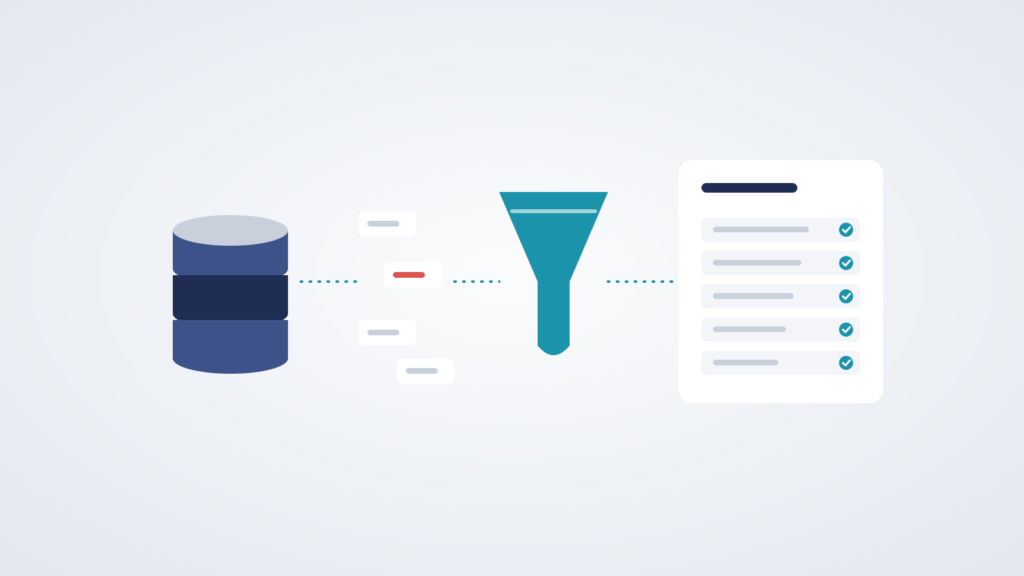
A Salesforce data migration specialist owns the data from the old system to the new one. A typical project moves through five stages:
| Stage | What the specialist does |
|---|---|
| Extract | Pulls data from the legacy CRM, spreadsheets, ERP, or another Salesforce org, and profiles what is actually there |
| Clean | Removes duplicates, fixes formats, standardizes picklist values, and decides what not to migrate |
| Map and transform | Maps old fields to Salesforce objects, builds transformation rules, and assigns external IDs and record owners |
| Load | Loads data in dependency order with the right tool and settings, then fixes rejected records |
| Validate and cut over | Reconciles record counts and totals, supports user testing, and runs the final cutover and rollback plan |
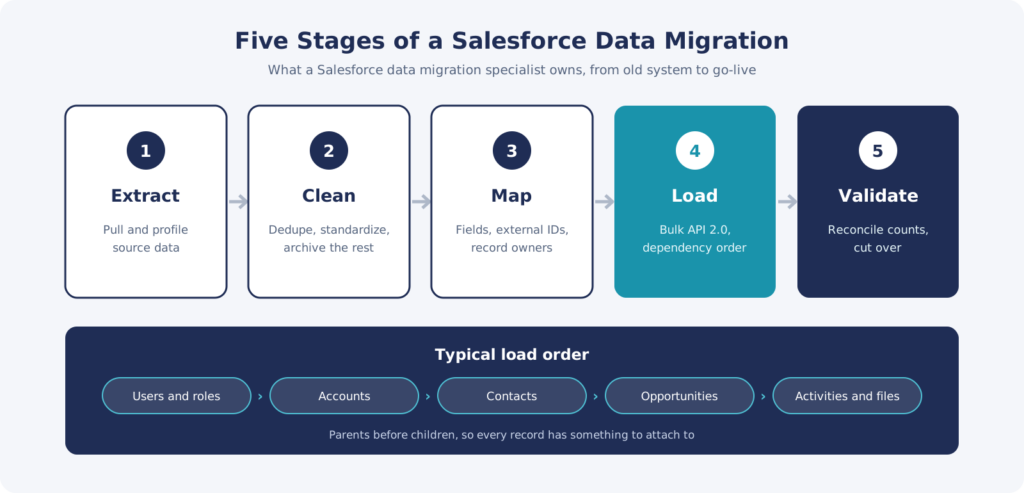
Load order matters because related records depend on each other, and a Salesforce data migration specialist plans it before the first test load. Users and roles usually come first, then accounts, contacts, opportunities, and finally activities and attachments. Get the order wrong and child records arrive with no parent to attach to.
Data Migration Specialist vs Data Architect vs Developer
| Role | Main focus | When you need it |
|---|---|---|
| Salesforce data migration specialist | Extracting, cleaning, mapping, loading, and validating data | Implementations, org merges, system replacements |
| Data architect | Data model design, large data volumes, governance | Complex models, very large orgs, long-term data strategy |
| Integration developer | Ongoing data flows between systems through APIs or MuleSoft | Data that must keep syncing after go-live |
| Salesforce developer | Apex, components, and custom automation | Custom logic, post-load batch jobs |
The key difference is time. A migration moves data once, or in a few waves, while an integration keeps it moving. Many projects need both: a Salesforce data migration specialist brings the history in, then an integration developer keeps it current. Our guide to hiring a MuleSoft developer covers that side. If you want to unify data across systems without moving it all into Salesforce, our guide to hiring a Data 360 consultant explains that approach.
Smaller teams sometimes hire a data migration consultant for a defined project and lean on their architect for the data model. Our guide to hiring a Salesforce architect covers where that role begins.
Certifications and Credentials
Salesforce has no certification for data migration itself. The closest credential is Salesforce Certified Platform Data Architect, formerly called Data Architect, which covers data modeling, large data volumes, and data management. As Salesforce Ben reported, Salesforce added “Platform” to that name and to Administrator, which is now Platform Administrator. Neither appears on the list of certifications retiring in February 2027.
Platform Administrator is a sensible baseline for any Salesforce data migration specialist, because the job depends on understanding objects, record types, and sharing. Experience with ETL tools such as MuleSoft, Informatica, or Jitterbit helps, and some vendors offer their own training. Verify Salesforce credentials on the credential verification page, and see our guide to the Salesforce certifications that matter when hiring.
5 Skills to Look For in a Salesforce Data Migration Specialist
These five skills separate a Salesforce data migration specialist who protects your go-live from one who only knows how to run Data Loader.
1. Data profiling and mapping
Strong candidates look at the source data before they promise anything. They profile it, find gaps and junk, and build a field-by-field mapping document that business owners sign off. Ask to see a mapping document from a past project.
2. The Salesforce data model and load order
The specialist should know how objects relate, why external IDs matter, how record ownership and record types affect a load, and which order keeps parent and child records connected. They should also know when to use Salesforce Data Loader, Bulk API 2.0, or an ETL tool.
3. Salesforce data cleansing
Most migrations are also cleanup projects. Look for experience with duplicate matching, address and phone standardization, and agreeing with the business on which records to archive and leave behind. Clean data also matters for AI agents, which give poor answers from messy records.
4. Performance at scale
For large loads, ask how the candidate handles automation, sharing recalculation, and locking errors. Good answers mention deferring sharing, disabling triggers and validation rules with a plan to turn them back on, and grouping child records by parent.
5. Validation, reconciliation, and cutover
The job continues after the load finishes. A Salesforce data migration specialist should reconcile record counts and key totals, test with real users, and run cutover with a freeze window and a rollback plan. Our guide to hiring a Salesforce QA tester covers the testing side.
Salesforce Data Migration Specialist Salary and Rates in 2027
Our 2027 Salesforce salary guide does not have a separate data migration band. Most specialists do technical work with SQL, ETL tools, and APIs, so the guide’s Salesforce developer band is the closest benchmark:
| Level | Salesforce developer base (benchmark) |
|---|---|
| Junior (0 to 2 years) | $85,000 to $110,000 |
| Mid-level (3 to 5 years) | $110,000 to $140,000 |
| Senior (5 to 8 years) | $135,000 to $175,000 |
| Lead (8+ years) | $160,000 to $200,000 |
Most migrations are projects, so contract work is common. Technical consultants typically bill $120 to $185 an hour, according to our Salesforce contractor rates guide. Experience with very large volumes, org merges, or regulated data pushes a rate toward the top of that range.
How to Hire a Salesforce Data Migration Specialist
Size the migration first
Count the source systems, objects, and records, and note how much history you need. Moving 20,000 contacts from spreadsheets is a different job from merging two enterprise orgs with years of activity history and attachments.
Test with real data
Give each Salesforce data migration specialist on your shortlist a small, anonymized sample of your messy data. Ask them to profile it, propose a mapping, list the cleanup decisions the business must make, and explain the load order. Their questions will tell you as much as their answers.
Plan for cutover from day one
Ask how the candidate would handle the final weekend: freeze windows, delta loads for records changed during the project, and what triggers a rollback. A specialist who has never run a cutover is a risk on a large project.
Choose contract or full time
A one-time migration suits a contractor or a data migration consultant. Companies that acquire often, run several orgs, or migrate in waves may justify a full-time hire. Our comparison of contract vs full-time Salesforce hires walks through the trade-offs, and our implementation staffing guide shows where migration fits in a project team.
Watch for red flags
- Promises a load date before seeing the source data
- Has only used the Data Import Wizard
- Has no reconciliation or rollback plan
- Treats cleanup as the business’s problem alone
Our recruiters are Salesforce certified and screen every Salesforce data migration specialist on real platform experience. For time-boxed migrations, we also place contractors from a vetted network.
Frequently Asked Questions
What does a Salesforce data migration specialist do?
A Salesforce data migration specialist moves data from a legacy system or another org into Salesforce. The work covers extracting, cleaning, mapping, loading, and validating the data, plus planning the final cutover.
Should we use the Data Import Wizard or Data Loader?
Trailhead says the Data Import Wizard handles up to 50,000 records at a time for supported objects, while Data Loader can import up to 150 million records and switch to the Bulk API for speed. Large migrations usually use Data Loader, the Bulk API, or an ETL tool.
Is there a Salesforce data migration certification?
No. The closest credential is Salesforce Certified Platform Data Architect, formerly Data Architect. Platform Administrator is a useful baseline for any migration hire.
How much does a Salesforce data migration specialist earn?
Our 2027 salary guide has no separate migration band. The closest benchmark, the Salesforce developer band, runs from $85,000 for juniors to $200,000 for leads. Contract technical consultants typically bill $120 to $185 an hour.
How long does a Salesforce data migration take?
It depends on the number of systems, records, and history you need, and how clean the data is. Cleanup and business decisions usually take longer than the loads themselves, so plan for several test loads before cutover.
Can our admin handle the migration?
For a small, simple import, often yes. For large volumes, several source systems, or a merger, a dedicated specialist reduces the risk of lost history, broken relationships, and a delayed go-live.
Find Your Salesforce Data Migration Specialist
The right hire profiles the data before promising dates, loads it in the right order, and proves it arrived intact. Size the job first, test with real data, and ask about cutover.
Ready to hire a Salesforce data migration specialist? Talk to our Salesforce recruiters.