An insurance carrier’s quote process runs on an OmniScript built years ago on a Vlocity managed package. It works, but each change takes days to deploy with older build tools, the developer who built it has moved on, and Salesforce has said it wants every customer off the managed package runtime. Meanwhile, the service team wants an AI agent that can pull a policy summary using the same back-end logic.
An OmniStudio developer is hired for exactly this work. OmniStudio is the low-code toolset behind most Salesforce industry clouds, used to build guided processes, customer and agent screens, and the data plumbing between them. Good OmniStudio developers are hard to find, because the skill sits between configuration and code and grew up inside a product most developers never touched.
This guide explains what OmniStudio is now, what the developer builds, how the role compares with other Salesforce developers, the certification, five skills to test, 2027 pay, and how to hire.
Table of Contents
What OmniStudio Is in 2027
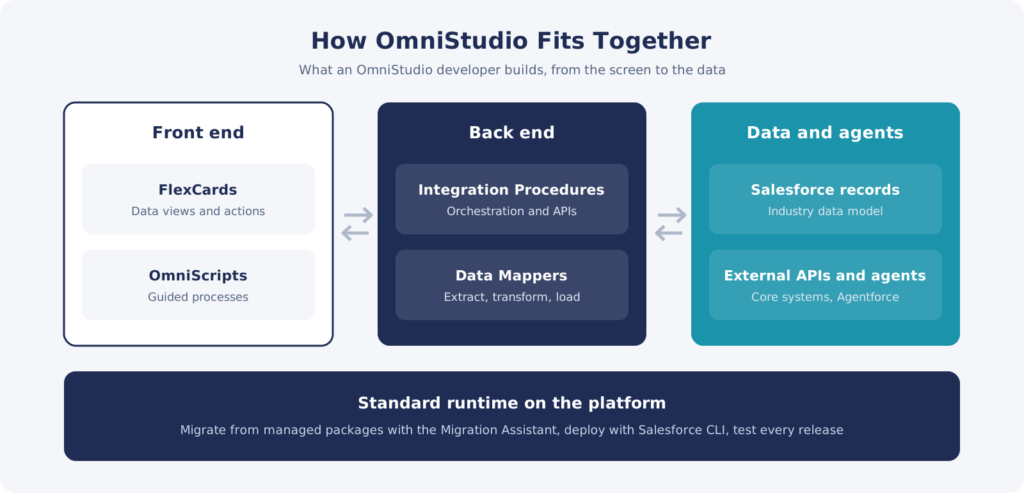
OmniStudio came to Salesforce with its acquisition of Vlocity. It has four core building blocks. As the Salesforce Developers blog explains, OmniScripts and FlexCards handle the front-end experience, while Data Mappers and Integration Procedures handle back-end data work. Data Mappers were previously called DataRaptors, so expect both names on resumes. Salesforce now styles the product as “Omnistudio,” and you will see both spellings.
The bigger change is where OmniStudio runs. It started inside managed packages: the Vlocity industry packages for communications, media, energy, insurance, and public sector, and later a Foundation package for clouds such as Financial Services Cloud and Health Cloud. Since Summer ’25, OmniStudio is package-free for new customers, with the designers and runtime built into the platform.
Existing customers have to migrate. In August 2026, Salesforce published a migration guide for the OmniStudio standard runtime, stating its goal of moving all customers off the managed packages. It describes the OmniStudio Migration Assistant, a Salesforce CLI plugin that assesses and converts components, and says internal tests showed the standard runtime running two to five times faster. The same post notes that some items, such as older Angular-based components, still need manual work, and that HTML tags change between runtimes, which affects automated tests.
The standard runtime also opens new features, including the ability to configure Integration Procedures for use with Agentforce. That puts OmniStudio developers in the middle of AI agent projects in regulated industries.
What an OmniStudio Developer Does
An OmniStudio developer builds the screens, processes, and data flows that industry cloud users and customers work with every day. Typical work by tool:
| Tool | What the developer builds |
|---|---|
| OmniScripts | Guided, multi-step processes such as onboarding, quoting, claims intake, and address changes |
| FlexCards | Compact views of customer, account, or policy data that launch actions and OmniScripts |
| Integration Procedures | Server-side orchestration that calls Salesforce data and outside APIs in one request |
| Data Mappers | Extract, transform, and load mappings between OmniStudio and Salesforce records |
| Deployment and migration | Salesforce CLI deployments, runtime migration, and regression testing |
OmniStudio work shows up in almost every industry cloud. Our guides to hiring a Financial Services Cloud consultant and a Health Cloud consultant cover the business side of those projects, and OmniStudio components also run on Experience Cloud sites, which our guide to hiring an Experience Cloud developer covers.
OmniStudio Developer vs Salesforce Developer vs Consultant
| Role | Main focus | When you need it |
|---|---|---|
| OmniStudio developer | OmniScripts, FlexCards, Integration Procedures, Data Mappers | Industry cloud builds, guided processes, runtime migration |
| Salesforce developer | Apex, Lightning Web Components, triggers, platform integrations | Custom logic outside OmniStudio, complex code, performance work |
| OmniStudio consultant | Requirements and solution design using OmniStudio tools | Discovery and design, often paired with a developer |
| Integration developer | MuleSoft or other middleware to external systems | Heavy, high-volume, or many-system integrations |
The strongest OmniStudio developers also know Apex and Lightning Web Components, because custom components and remote actions fill the gaps OmniStudio leaves. Our guide to hiring a Salesforce developer covers that broader skill set, and our guide to hiring a MuleSoft developer covers integration-heavy projects.
The OmniStudio Developer Certification
The credential is the Salesforce Certified Omnistudio Developer. Trailhead describes holders as having hands-on experience using OmniStudio tools to design and configure applications. A separate Omnistudio Consultant certification covers the design side. Neither was renamed in the July 2026 changes.
One related credential is going away. Salesforce Certified Industries CPQ Developer, which covered Vlocity-era quoting for communications, media, and energy, retires February 1, 2027, according to Salesforce Time’s list of 2026 retirements. A retired credential stays valid; it simply cannot be earned anymore. Our guide to Revenue Cloud and CPQ hiring covers where quoting skills are heading.
Verify credentials on Salesforce’s credential verification page. Platform Developer I alongside the OmniStudio Developer certification is a strong combination.
5 Skills to Look For in an OmniStudio Developer
These five skills separate a productive OmniStudio developer from someone who has only completed the Trailhead modules.
1. OmniScript and FlexCard design
Look for developers who keep OmniScripts short and reusable, use FlexCards as entry points, and know when a process is better split into smaller pieces. Salesforce’s new Design Assistant flags components that approach system limits, and good developers already design with those limits in mind.
2. Integration Procedures and Data Mappers
Most performance problems live in the back end. A strong OmniStudio developer can explain how they cache responses, limit the fields a Data Mapper pulls, and handle errors from outside APIs inside an Integration Procedure.
3. Runtime migration
Ask whether the candidate has moved components from a managed package to the standard runtime, and how they tested it. Experience with the Migration Assistant, namespace changes, and rebuilding older components is in demand right now.
4. Apex and Lightning Web Components
OmniStudio covers a lot, but real projects still need custom Lightning Web Components inside OmniScripts and Apex remote actions for complex logic. An OmniStudio developer who can write both needs less hand-holding from the rest of the team.
5. Deployment and testing discipline
The standard runtime uses Salesforce CLI deployments in place of older Vlocity build tools. Look for version control, sandbox strategy, and automated regression tests. Our guide to hiring a Salesforce DevOps engineer covers the release side.
OmniStudio Developer Salary and Rates in 2027
Our 2027 Salesforce salary guide found that industry cloud specialists earn 10% to 15% more than generalists. OmniStudio is the build layer of the industry clouds, so the estimates below apply that premium to the guide’s Salesforce developer bands.
| Level | Salesforce developer base | Estimated with industry premium |
|---|---|---|
| Junior (0 to 2 years) | $85,000 to $110,000 | $94,000 to $127,000 |
| Mid-level (3 to 5 years) | $110,000 to $140,000 | $121,000 to $161,000 |
| Senior (5 to 8 years) | $135,000 to $175,000 | $149,000 to $201,000 |
| Lead or staff (8+ years) | $160,000 to $200,000 | $176,000 to $230,000 |
Contract Salesforce developers typically bill $100 to $170 an hour, according to our Salesforce contractor rates guide. OmniStudio developers with migration experience usually sit in the upper half, especially for time-boxed runtime migrations.
How to Hire an OmniStudio Developer
Know which runtime you are on
Check whether your org runs the managed package runtime or the standard runtime, and which package it came from. A migration project needs someone who has done one. A new build on the standard runtime needs someone current on the new designers.
Test with a real build
Give candidates a short exercise: a three-step OmniScript that reads a record through a Data Mapper, calls an outside API through an Integration Procedure, and shows the result on a FlexCard. Ask how they would handle a slow API and a failed save. Our guide to the Salesforce technical interview has more on scenario questions.
Look for industry context
An OmniStudio developer who has built insurance quoting thinks differently from one who has built patient intake. Industry experience shortens ramp-up, so weigh it when two candidates are close.
Choose contract or full time
A runtime migration has a clear start and finish, which suits a contractor. An ongoing industry cloud program with a steady stream of new processes usually justifies a full-time OmniStudio developer. Many teams do both: a contractor for the migration, then a permanent hire to own what comes next. Our comparison of contract vs full-time Salesforce hires walks through the trade-offs.
Watch for red flags
- Has only built OmniScripts and never touched Integration Procedures or Data Mappers
- Cannot explain the difference between the managed package and standard runtimes
- Puts all logic in one large OmniScript
- Has no version control or automated testing habits
Our recruiters are Salesforce certified and screen OmniStudio developers on real platform experience. For migrations and other defined projects, we also place contractors from a vetted network.
Frequently Asked Questions
What does an OmniStudio developer do?
An OmniStudio developer builds guided processes, data views, and back-end data flows using OmniScripts, FlexCards, Integration Procedures, and Data Mappers. The work powers onboarding, quoting, claims, and service processes in Salesforce industry clouds.
Is OmniStudio the same as Vlocity?
OmniStudio came from Vlocity, which Salesforce acquired. Older orgs run OmniStudio inside Vlocity or Foundation managed packages, while new customers since Summer ’25 get it built into the platform. Salesforce plans to move all customers to the standard runtime.
Is there an OmniStudio developer certification?
Yes. The Salesforce Certified Omnistudio Developer certification covers hands-on use of OmniStudio tools. There is also an Omnistudio Consultant certification for the design side.
How much does a Salesforce OmniStudio developer earn?
Applying the 10% to 15% industry premium from our 2027 salary guide to developer bands, estimated US base pay runs from about $94,000 for juniors to about $230,000 for leads. Contract developers typically bill $100 to $170 an hour.
Do we need to migrate off the OmniStudio managed package?
Salesforce says its goal is to move all customers to the standard runtime and provides the OmniStudio Migration Assistant to do it. Plan the migration with regression testing, because some components still need manual rework.
Can an Apex developer learn OmniStudio?
Yes, and many do. Apex developers already understand data, limits, and testing. The main learning curve is the OmniStudio designers and when to use configuration in place of code.
Find Your OmniStudio Developer
The right hire knows the four OmniStudio tools, understands your runtime, and can write code when the tools run out. Test with a real build and weigh migration and industry experience.
Ready to hire an OmniStudio developer? Talk to our Salesforce recruiters.