A patient calls to reschedule. The contact center rep can see the appointment, but not the referral that triggered it, and has to put the patient on hold to check another system. Meanwhile, a care coordinator is copying data between the EHR and Salesforce by hand, and the compliance team wants to know exactly who can see which patient records before anyone turns on an AI agent.
That is the job a Health Cloud consultant is hired to fix. Salesforce Health Cloud brings patient and member data, care coordination, and service into one place for providers, payers, and public health organizations. Doing it well takes Salesforce skill, healthcare knowledge, and a careful approach to protected health information.
This guide explains what Health Cloud is used for now, why healthcare hiring is different, which roles you need, the five skills that matter most, credentials and pay, and how to assess candidates.
Table of Contents
What Health Cloud Is Used For in 2026
Health Cloud serves three main groups, and candidates usually have deep experience with one of them:
| Organization type | Common use cases |
|---|---|
| Providers (hospitals, health systems, clinics, home health) | Patient engagement, referrals, care coordination, scheduling, contact centers |
| Payers (health insurers and plans) | Member services, benefits verification, care management, claims inquiries |
| Public health and life sciences | Program management, outreach, disease surveillance, trial recruitment |
AI is now a big part of the product. Salesforce announced Agentforce for Health in February 2025 with prebuilt skills for tasks such as benefits verification, disease surveillance, and clinical trial recruitment. According to Cloud for Good’s guide, Salesforce added six more healthcare agents by March 2026, covering areas such as referral management and hospital operations. Salesforce now also describes its Agentforce Voice capabilities as HIPAA-ready.
For hiring, the shift is clear. A Health Cloud consultant used to be measured mainly on data model and care coordination setup. Today, many projects also involve agents, Data 360, and integration with electronic health record systems. Our Data 360 hiring guide covers the data side of that work.
Compliance and Data: Why Healthcare Hiring Is Different
Healthcare data carries legal obligations that most Salesforce projects never face, and that changes who you should hire.
HIPAA-ready is not the same as compliant
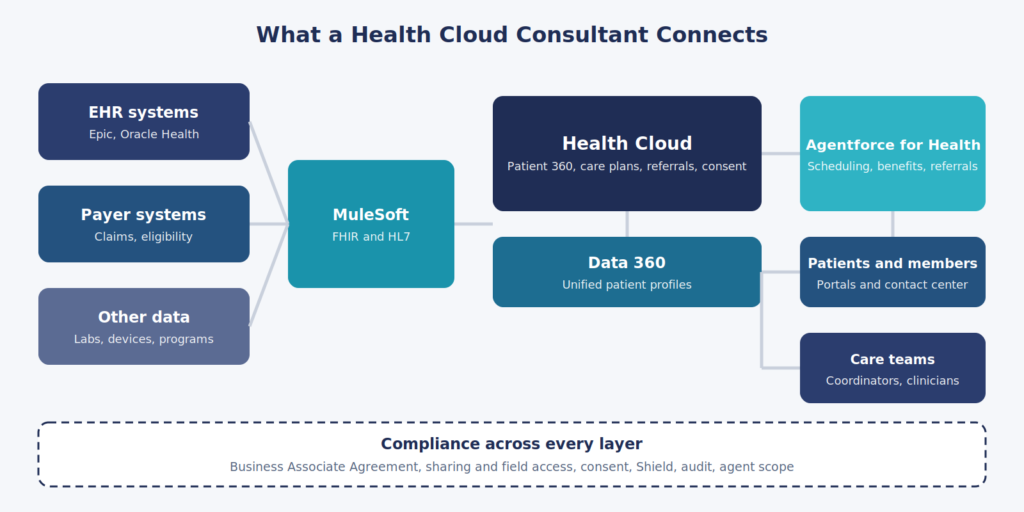
Salesforce’s Health Cloud page states that Health Cloud, including Agentforce, is HIPAA compliant, and lists support for standards such as HL7 FHIR and HITRUST. But as Digital Mass points out, there is a gap between a HIPAA-ready platform and a HIPAA-compliant deployment. The customer still has to configure access, logging, and data handling correctly, and document how protected health information is used.
That gap is where a strong Health Cloud consultant earns their fee. They design sharing models so staff see only the patient information they need, set up consent management, work with Shield features such as encryption and event monitoring, and scope agents narrowly before giving them access to patient data. They also know when to bring in your compliance and legal teams, because this guide, like any consultant, cannot replace their advice.
Integration with clinical systems
Health Cloud rarely works alone. Salesforce’s AI agents for healthcare page describes prebuilt MuleSoft connectors for EHR platforms such as Epic and Oracle Health, plus FHIR-compliant data exchanges and payer core systems. Candidates who have worked with clinical data standards and EHR integration are much harder to find than general Salesforce consultants, which is why our guide to how to hire MuleSoft developers is often relevant to healthcare projects too.
Health Cloud Consultant vs Developer vs Architect
| Role | What they own | Right for |
|---|---|---|
| Health Cloud consultant | Configures the healthcare data model, care programs and care plans, referrals, consent, and service processes | Implementations, redesigns, and new care or member programs |
| Health Cloud developer | Builds Apex and Lightning Web Components, FHIR and EHR integrations, and custom actions for agents | Integration-heavy projects and custom patient or member experiences |
| Health Cloud architect | Designs the full solution across Health Cloud, Service Cloud, Experience Cloud portals, Data 360, and MuleSoft, with security and compliance built in | Large health systems, payers, and multi-cloud programs |
Also decide whether you need provider or payer experience. The processes, data, and vocabulary are very different. A consultant who has run payer member services may need time to learn referral management in a health system, and the reverse is also true.
Patient and member portals usually run on Experience Cloud, so our guide to how to hire an Experience Cloud developer covers that side, and our guide to Salesforce industry cloud hiring compares Health Cloud with other industry clouds.
5 Proven Skills of a Strong Health Cloud Consultant
1. The healthcare data model
Person accounts, households, care programs, care plans, providers, and referrals are the foundation. Strong candidates can explain how they modeled a patient or member with several relationships, such as a caregiver, a primary care provider, and a care team.
2. Protected health information and access
The best Health Cloud consultants design access from the start: who can see diagnoses, who can see only contact details, how consent is recorded, and how access is logged. Ask them to walk through a sharing model they built for patient data.
3. Care coordination and service processes
Referral management, care plans, intake, and contact center workflows are where most value is created. Strong candidates understand the real clinical or member process, not just the Salesforce screens.
4. Interoperability
FHIR resources, HL7 messages, and EHR integration patterns come up in almost every serious project. Candidates do not always need to build integrations themselves, but they must know what data comes from where, how often, and what happens when it is wrong.
5. Agentforce for Health
Agents for scheduling, benefits verification, and referral triage only work safely when they are grounded in the right data, limited to the right actions, and hand off to people for anything clinical. Candidates who have scoped and tested healthcare agents with a compliance team are still rare.
Useful extras include Experience Cloud patient portals, Data 360 for unified patient profiles, and Service Cloud contact center experience. Our Salesforce skills list covers the broader platform skills, and our guide to the Agentforce specialist role covers agent configuration.
Health Cloud Credentials and Pay
Credentials
The Health Cloud Accredited Professional credential was renamed Salesforce Accredited Agentforce Health Professional on July 24, 2026, as listed in Salesforce’s certification name changes FAQ. Treat the old and new names as the same credential. Accredited professional credentials are generally earned through Salesforce’s partner learning programs, so they are most common among consultants who have worked at Salesforce partners.
Alongside it, useful signals include:
- Agentforce Service Consultant, formerly Service Cloud Consultant, since many healthcare projects run contact centers on Service Cloud.
- Platform Developer I or II for Health Cloud developers.
- Experience Cloud Consultant for patient and member portals.
- Data 360 Consultant for unified patient data.
- Healthcare interoperability training, such as HL7 FHIR courses, for integration roles.
Verify Salesforce credentials on the credential verification page. Our guide to the Salesforce certifications that matter when hiring covers the 2026 renames in full.
Pay
Our 2027 Salesforce salary guide found that Health Cloud and other industry cloud specialists typically earn 10% to 15% more than generalists at the same level, because the domain knowledge takes as long to build as the platform knowledge. Use these generalist benchmarks as a starting point and add that premium:
| Role | Generalist benchmark | US base range (2027) |
|---|---|---|
| Health Cloud consultant | Senior functional or technical consultant | $125,000 to $175,000 |
| Health Cloud developer | Mid-level to senior Salesforce developer | $110,000 to $175,000 |
| Health Cloud architect | Solution or technical architect | $145,000 to $230,000 |
Candidates with EHR integration experience, payer or provider depth that matches your organization, or Agentforce for Health deployments sit at the top of these ranges. For contract work, our guide to Salesforce contractor rates covers current hourly ranges, and industry cloud experience typically pushes rates toward the upper end.
How to Hire a Health Cloud Consultant
Run an access scenario
Ask: “Our contact center should see a patient’s appointments and contact details, but not diagnoses. Care coordinators need clinical details for their own patients only. How would you set that up, and how would you prove it works?” Strong candidates talk through the sharing model, permission sets, field-level security, Shield, consent, and testing as each user type, and they mention involving your compliance team.
Ask about an integration
Ask for an EHR or payer system integration they worked on: what data moved, how often, which standard it used, and what happened when records did not match. Vague answers are a warning sign for any role that will touch clinical data.
Scope an agent together
Present a use case such as appointment rescheduling or benefits verification. Ask what data the agent needs, what it must never do, when it hands off to a person, and how they would test it before launch.
Include clinical or operations staff
Have a nurse leader, care manager, or member services leader spend 20 minutes with the candidate. Health Cloud consultants who cannot speak comfortably with clinical and operations teams struggle to design workflows people will use.
Know where to look
Strong candidates often come from Salesforce partners with healthcare practices, from health systems and payers that run Health Cloud, and from healthcare IT professionals who moved into Salesforce. Many are employed and not applying. Our comparison of a Salesforce headhunter vs staffing vs placement agency explains which approach fits a specialist search, and our guide to how to hire a Salesforce consultant covers general consultant hiring.
Frequently Asked Questions
What does a Salesforce Health Cloud consultant do?
A Salesforce Health Cloud consultant designs and implements Health Cloud for providers, payers, or public health organizations: the healthcare data model, care programs and care plans, referrals, consent, service processes, and increasingly Agentforce for Health agents, with careful access controls for patient data.
Is Salesforce Health Cloud HIPAA compliant?
Salesforce states that Health Cloud, including Agentforce, is HIPAA compliant, and signs Business Associate Agreements with customers. Each organization is still responsible for configuring and governing its own deployment correctly, so a HIPAA-ready platform does not by itself make a deployment compliant.
What is Agentforce for Health?
Agentforce for Health is Salesforce’s set of AI agents and prebuilt skills for healthcare, announced in February 2025 and expanded since, covering tasks such as benefits verification, scheduling, referral management, and disease surveillance.
What happened to the Health Cloud Accredited Professional credential?
It was renamed Salesforce Accredited Agentforce Health Professional on July 24, 2026. It is the same credential, so accept either name on a resume.
How much does a Health Cloud consultant earn?
Industry cloud specialists typically earn 10% to 15% more than generalists at the same level. A senior functional or technical consultant benchmark of roughly $125,000 to $175,000 in US base salary is a reasonable starting point, with architects higher.
Should I hire for provider or payer experience?
Match the candidate to your organization. Provider and payer processes, data, and vocabulary differ a lot, so experience in the same segment shortens the learning curve significantly.
Hire for the Platform and the Patient
A strong Health Cloud consultant connects patient data, care teams, and service into one experience while protecting every record that should stay private. Match provider or payer experience to your organization, test access design and integration judgment before anything else, and bring in your compliance team early when agents are part of the plan.
Need to hire a Health Cloud consultant, developer, or architect? Talk to our Salesforce recruiters. We find healthcare Salesforce specialists who understand both the platform and the patient, and we can tell you what the role costs in today’s market.