A regional health system hired a strong Salesforce consultant with six years of Sales and Service Cloud experience. She knew the platform cold. She did not know the difference between a patient and a member, why care plans need their own data model, or which fields could never leave a sandbox. The Health Cloud rollout lost two months while she learned the industry on the job.
Industry clouds raise the bar for hiring. Health Cloud and Financial Services Cloud sit on the same Salesforce platform, but they come with their own data models, their own vocabulary, and regulators who care how data is handled. The specialists who know both the platform and the industry are scarce, and they cost more.
This guide covers Salesforce industry cloud hiring for Health Cloud and Financial Services Cloud: the roles and skills to look for, the credentials Salesforce renamed in 2026, what to pay, and how to assess candidates before you commit.
Table of Contents
Why Salesforce Industry Cloud Specialists Are Different
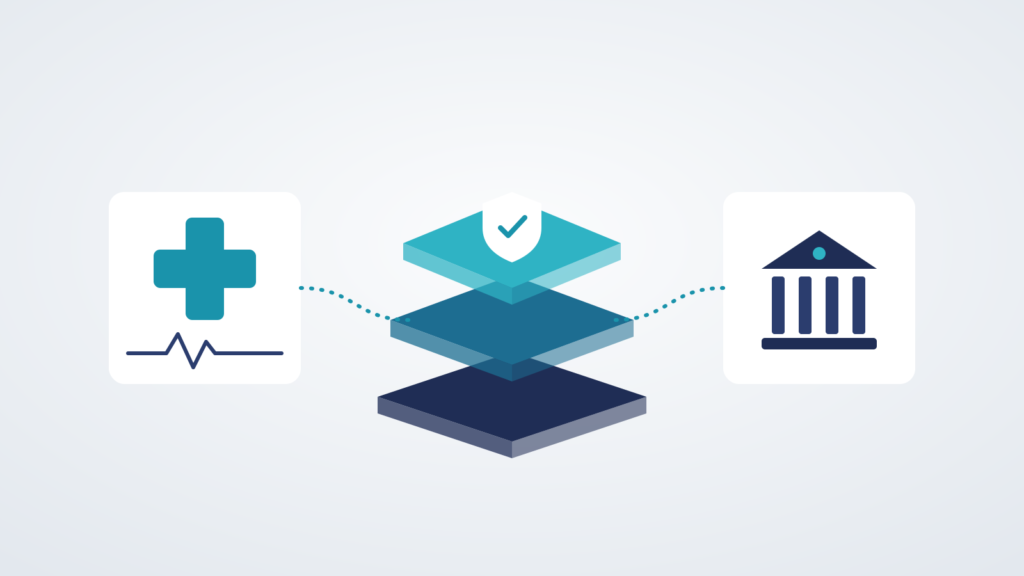
A Salesforce industry cloud is a version of the platform built for one sector, with its own objects, processes, and terminology layered on top of core Salesforce. Health Cloud and Financial Services Cloud are two of the most established, and both demand three kinds of knowledge at once.
- Platform skills. The same foundations any admin, developer, or consultant needs: data model, security, Flow, Apex, and integrations.
- Industry data models. Health Cloud and Financial Services Cloud each add specialized objects and relationships. Someone who has only worked in Sales Cloud will need time to learn how they fit together.
- Domain and regulatory knowledge. Health data and financial data are both heavily regulated. Specialists need to understand what can be stored where, who can see it, and how access is audited.
The third layer is the one generalists most often lack, and it is the hardest to teach quickly. A developer can learn a new object model in weeks. Learning how a bank’s compliance team thinks, or how a care team actually works, usually takes years in the industry.
That scarcity shows up in pay. Our 2027 Salesforce salary guide found that Health Cloud, Financial Services Cloud, and Manufacturing Cloud specialists typically earn 10% to 15% more than generalists at the same level, because the domain knowledge takes as long to build as the platform knowledge.
Hiring a Health Cloud Consultant or Developer
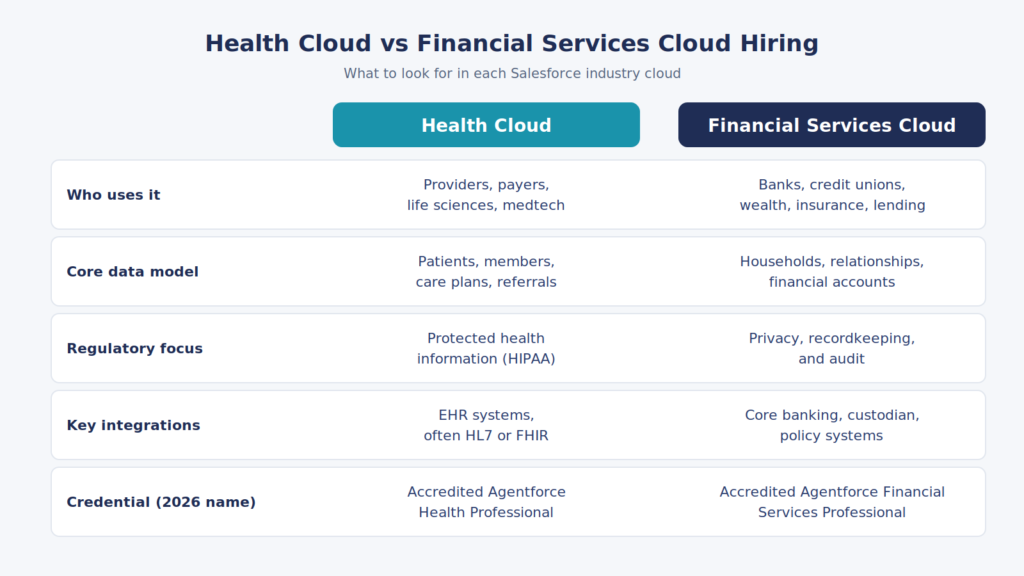
Health Cloud is used by healthcare providers, health insurers, life sciences companies, and medical device makers. The right specialist depends on which of those you are, because a payer’s member services team and a hospital’s care coordinators use Health Cloud very differently.
| Role | What they own | Skills to look for |
|---|---|---|
| Health Cloud consultant | Discovery, solution design, and configuration for clinical or member workflows | Patient and member data models, care plans and care coordination, referral and provider network processes |
| Health Cloud developer | Custom logic, integrations, and portals | Apex and LWC, integration with electronic health record systems, often using HL7 or FHIR standards, Experience Cloud patient or member portals |
| Health Cloud admin | Day-to-day configuration, security, and data quality | Permission design for sensitive data, consent tracking, reporting for care and operations teams |
| Health Cloud architect | Overall design, data access, and compliance controls | Healthcare data architecture, encryption and audit strategy, integration architecture across clinical systems |
The skill that separates strong Health Cloud candidates is how they handle protected health information. In the US, that means HIPAA. Ask how they have designed access so only the right people see clinical data, how they have handled data in sandboxes, and which tools they used for encryption and audit trails, such as Salesforce Shield. A candidate who answers in specifics has done this in production.
Prior experience inside healthcare counts as much as Health Cloud experience. A Health Cloud consultant who has worked at a hospital, a payer, or a healthcare consulting practice already speaks the language of your stakeholders.
Hiring a Financial Services Cloud Consultant or Developer
Financial Services Cloud is used across banking, credit unions, wealth management, insurance, and lending. Salesforce’s Financial Services Cloud partner guide highlights tools such as Financial Accounts, Goals, and Action Plans, built to give advisors and bankers a complete view of each client’s financial life.
| Role | What they own | Skills to look for |
|---|---|---|
| Financial Services Cloud consultant | Discovery and design for advisor, banker, or agent workflows | Household and relationship modeling, financial accounts, client onboarding and servicing processes |
| Financial Services Cloud developer | Custom logic, integrations, and client-facing experiences | Apex and LWC, integration with core banking, custodian, or policy systems, data loads at volume |
| Financial Services Cloud admin | Configuration, security, and reporting | Role and sharing design for advisors and teams, compliance-friendly reporting, data quality |
| Financial Services Cloud architect | Overall design and controls | Large data volumes, integration architecture, audit and data retention strategy |
The subsegment matters as much as the cloud. A Financial Services Cloud consultant who has spent five years in wealth management may struggle in retail banking, and insurance has its own processes again. Hire for the closest match to your business, and ask candidates to describe the client relationships they modeled, not just the features they configured.
Financial data brings its own compliance expectations, from privacy rules to recordkeeping and audit requirements. Strong candidates can explain how they designed sharing so advisors see only their own clients, how they handled sensitive fields, and how changes were tracked for audit.
Salesforce Industry Cloud Credentials, Including the 2026 Name Changes
The main credentials for these clouds are Accredited Professional certifications, and their names changed this year. According to Salesforce’s certification name changes FAQ, effective July 24, 2026:
| Old name | New name |
|---|---|
| Health Cloud Accredited Professional | Salesforce Accredited Agentforce Health Professional |
| Financial Services Cloud Accredited Professional | Salesforce Accredited Agentforce Financial Services Professional |
Salesforce’s Accredited Professional credentials page describes accredited Health Cloud professionals as having shown they can implement Health Cloud with its industry-specific data models, and accredited Financial Services Cloud professionals as able to implement Financial Services Cloud.
Three things matter for hiring:
- Expect both names on resumes. Candidates who earned the credential before July 2026 may still list the old name. It is the same credential.
- Look for the platform credentials too. Industry credentials sit on top of core certifications such as Administrator, Platform App Builder, or the Sales and Service consultant certifications, several of which were also renamed in 2026.
- Verify, then go deeper. Check any credential on Salesforce’s credential verification page. Then remember that an accreditation proves study, not production experience. Ask about real implementations.
Our guide to the Salesforce certifications that matter when hiring covers the rest of the credential landscape by role.
What to Pay Salesforce Industry Cloud Specialists
Start from the generalist ranges in our 2027 Salesforce salary guide, then add the 10% to 15% industry cloud premium. The adjusted figures below are estimates that apply that premium, rounded to the nearest $5,000.
| Senior-level role | Generalist US base | Estimated base with industry cloud premium |
|---|---|---|
| Senior administrator (5 to 8 years) | $105,000 to $140,000 | About $115,000 to $160,000 |
| Senior functional consultant (5 to 10 years) | $125,000 to $160,000 | About $140,000 to $185,000 |
| Senior technical consultant (5 to 10 years) | $140,000 to $175,000 | About $155,000 to $200,000 |
| Senior developer (5 to 8 years) | $135,000 to $175,000 | About $150,000 to $200,000 |
| Solution architect (5 to 8 years) | $145,000 to $170,000 | About $160,000 to $195,000 |
The premium is largest when the candidate brings both the cloud and the right industry segment, such as a Financial Services Cloud consultant from wealth management for a wealth management firm, or a Health Cloud developer who has integrated with your type of clinical system. Expect less of a premium for candidates who hold the accreditation but have not delivered it in production.
Budget toward the top of the range if your role also needs Agentforce or Data 360 experience. The 2026 credential names now carry the Agentforce brand, a clear signal of where both clouds are heading. Candidates with shipped AI work in a regulated industry are rare.
How to Assess and Hire Salesforce Industry Cloud Talent
Test the industry, not just the platform
Use a scenario from your world and ask the candidate to talk it through.
- For Health Cloud: “Care coordinators should see only the patients on their panel. Billing needs claims data but must never see clinical notes. A new partner clinic is joining next quarter. How would you design access?”
- For Financial Services Cloud: “A household has two adults, a joint account, a trust, and two different advisors. Each advisor should see only their own clients. How would you model and share this?”
Strong candidates ask about the business before they answer, use the industry’s language naturally, and raise compliance and audit questions without being prompted.
Put them in front of a business stakeholder
A 30-minute conversation with a care manager, a compliance lead, or a senior advisor shows quickly whether the candidate understands how your business works. This is where generalists usually fall short.
Check references from the same industry
Ask a former client or manager from a similar organization how the candidate handled regulated data and demanding stakeholders.
Know where to look
The best Salesforce industry cloud candidates often come from consulting partners with dedicated healthcare or financial services practices, or from in-house Salesforce teams at hospitals, payers, banks, and wealth firms. Searches take longer than for generalist roles, so plan for it. If you cannot wait, a contract specialist can lead the build while a permanent search runs, as our Salesforce implementation staffing guide explains.
For role-specific advice, see our guides to hiring Salesforce developers and how to hire Salesforce architects. For senior industry roles, our comparison of a Salesforce headhunter vs staffing vs placement agency explains when a retained search makes sense.
Frequently Asked Questions
What is a Salesforce industry cloud?
A Salesforce industry cloud is a version of Salesforce built for a specific sector, with its own data model, processes, and terminology. Health Cloud serves healthcare and life sciences, and Financial Services Cloud serves banking, wealth management, insurance, and lending.
What does a Health Cloud consultant do?
A Health Cloud consultant designs and configures Health Cloud for clinical, care coordination, or member services workflows. They work with the patient and member data model, care plans, referrals, and access controls for protected health information.
What does a Financial Services Cloud consultant do?
A Financial Services Cloud consultant designs and configures Financial Services Cloud for advisors, bankers, or insurance agents. They model households and client relationships, financial accounts, and onboarding and servicing processes, with sharing designed for compliance.
What happened to the Health Cloud and Financial Services Cloud Accredited Professional credentials?
Salesforce renamed them on July 24, 2026. Health Cloud Accredited Professional became Salesforce Accredited Agentforce Health Professional, and Financial Services Cloud Accredited Professional became Salesforce Accredited Agentforce Financial Services Professional. Candidates may list either name.
How much more do industry cloud specialists earn?
Our 2027 salary guide found that Health Cloud, Financial Services Cloud, and Manufacturing Cloud specialists typically earn 10% to 15% more than generalists at the same level.
Can a generalist Salesforce consultant learn an industry cloud?
Yes, but it takes time. The platform side can be learned in weeks. The industry knowledge, including regulations and how the business really works, usually takes much longer. For time-sensitive implementations, hire someone who already has both.
Hire for the Platform and the Industry
Salesforce industry cloud roles need people who understand the platform, the industry data model, and the regulations behind them. Define which segment you are in, look past the accreditation to real implementations, test candidates with scenarios from your own business, and budget for the premium that this combination commands.
Hiring for Health Cloud or Financial Services Cloud? Talk to our Salesforce recruiters. We find the industry cloud consultants, developers, and architects who already know your industry, so your project does not wait while someone learns it.