
The job title said “Salesforce Consultant.” One candidate had spent six years running discovery workshops and redesigning sales processes. Another had spent six years building integrations and writing Apex. Both were strong. Both were called consultants. Only one of them could do the job you actually had.
That is the first problem when companies hire Salesforce consultants: the title covers two different jobs. Functional consultants shape how the business uses Salesforce. Technical consultants build what the design requires. Hiring the wrong one costs months.
This guide explains how to hire Salesforce consultants well: the difference between functional and technical consultants, which one you need, the skills and credentials to look for, including the certification renames Salesforce made in 2026, what to pay, how partner and in-house backgrounds differ, and how to assess candidates before you make an offer.
Table of Contents
Salesforce Functional Consultant vs Technical Consultant
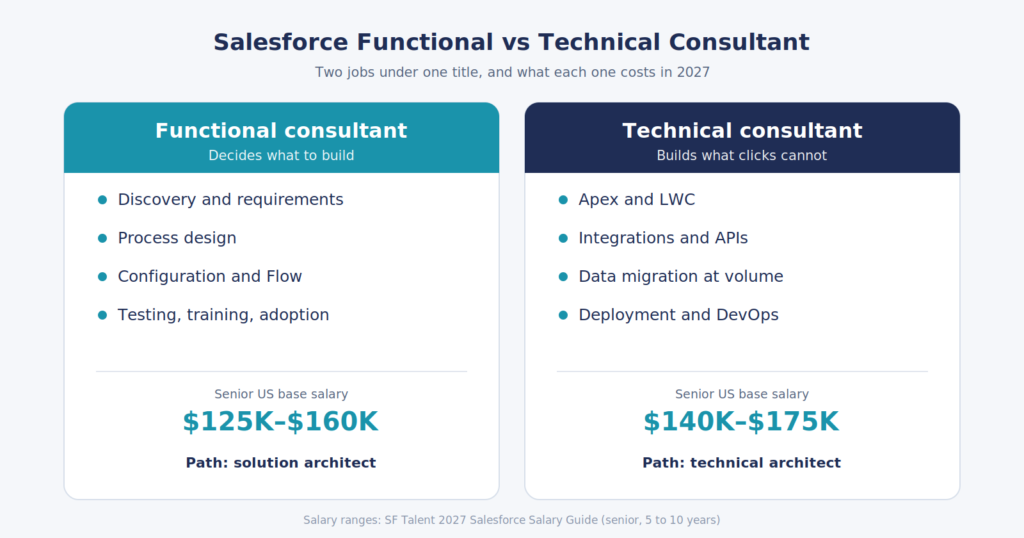
Both roles sit between the business and the platform, but they face different directions.
| Salesforce functional consultant | Salesforce technical consultant | |
|---|---|---|
| Core focus | Translating business processes into Salesforce design and configuration | Building the custom code, integrations, and data work the design requires |
| Day-to-day work | Discovery workshops, requirements, process design, configuration, user acceptance testing, training | Apex and Lightning Web Components, integrations, data migration, deployment, performance |
| Works most with | Business stakeholders, end users, project managers | Developers, architects, IT and integration teams |
| Typical background | Business analyst, senior admin, or industry operations | Developer or integration specialist |
| Typical path | Solution architect | Technical architect |
A Salesforce functional consultant spends most of their time asking how the business works and deciding how Salesforce should support it, mostly with configuration. A Salesforce technical consultant takes over where configuration ends, building what clicks cannot.
The best consultants of either type understand the other side. A functional consultant who knows where code is needed writes better requirements. A technical consultant who understands the business process builds the right thing the first time.
Which Salesforce Consultant Do You Need?
Before you hire Salesforce consultants, match the role to the problem in front of you.
| Your situation | Hire |
|---|---|
| Rolling out Sales or Service Cloud, or redesigning how teams use it | Functional consultant |
| Business teams unhappy with Salesforce, but no clear requirements | Functional consultant |
| Connecting Salesforce to ERP, billing, or other systems | Technical consultant |
| Data migration from another CRM | Technical consultant, with functional support for mapping |
| Complex automation that has outgrown Flow | Technical consultant |
| Revenue Cloud, Field Service, or an industry cloud rollout | Functional consultant with product depth, plus technical support |
| A small team that needs one person to do both | A hybrid consultant, usually functional-leaning with light technical skills |
If the job is mostly figuring out what to build, hire functional. If the job is mostly building something already defined, hire technical. If you are not sure, that is usually a sign you need a functional consultant first.
Also decide whether this should be a permanent hire at all. For a defined implementation, a consulting partner or a contract consultant may fit better than an employee. Our comparison of Salesforce consultant vs in-house hire covers that decision, and our implementation staffing guide shows which consultant roles each project phase needs.
Salesforce Consultant Skills and Credentials, Including the 2026 Renames
Skills to look for
For a Salesforce functional consultant:
- Running discovery workshops and turning conversations into clear requirements and user stories
- Process mapping, current and future state
- Deep configuration skill: data model, security, Flow, page design, and reporting
- Product depth in one or more clouds, such as Sales, Service, Experience, or Revenue
- User acceptance testing, training, and change management
For a Salesforce technical consultant:
- Apex, Lightning Web Components, and test strategy
- Integration patterns, APIs, and middleware such as MuleSoft
- Data migration and data quality at volume
- Deployment, source control, and Salesforce DevOps
- Increasingly, building the actions Agentforce agents call
Credentials, old and new names
Salesforce renamed several consultant certifications on July 24, 2026, mostly adding Agentforce to the title, according to its certification name changes FAQ and Salesforce Time’s summary:
| Old name | New name |
|---|---|
| Sales Cloud Consultant | Agentforce Sales Consultant |
| Service Cloud Consultant | Agentforce Service Consultant |
| Field Service Consultant | Agentforce Field Service and Operations Consultant |
| Revenue Cloud Consultant | Revenue Management Consultant |
Several others, including the CPQ Administrator, Education Cloud Consultant, MuleSoft Catalyst Consultant, and Nonprofit Success Pack Consultant certifications, retire on February 1, 2027. As Salesforce Ben notes, a retired certification is still a valid certification. It simply cannot be earned anymore.
Three hiring rules follow. Accept old and new names, since they are the same credentials. Do not discount a retiring credential, since it still shows real knowledge. And verify every credential on Salesforce’s credential verification page. Our guide to the Salesforce certifications that matter when hiring covers the rest.
Salesforce Consultant Salary: What to Pay in 2027
These US base ranges come from our 2027 Salesforce salary guide.
| Level | Functional consultant | Technical consultant |
|---|---|---|
| Associate (0 to 2 years) | $75,000 to $95,000 | $85,000 to $105,000 |
| Mid-level (3 to 5 years) | $100,000 to $125,000 | $105,000 to $135,000 |
| Senior (5 to 10 years) | $125,000 to $160,000 | $140,000 to $175,000 |
| Principal (10+ years) | $155,000 to $195,000 | $170,000 to $210,000 |
At the senior level, technical consultants typically earn 10% to 15% more than functional consultants, and the gap is wider in the top quartile. Contract rates follow the same pattern: roughly $105 to $160 an hour for functional consultants and $120 to $185 an hour for technical consultants.
Several factors push an offer toward the top of the band:
- Industry cloud depth, such as Health Cloud or Financial Services Cloud, typically adds 10% to 15%
- Shipped Agentforce or Data 360 work
- Revenue Cloud, CPQ, or Field Service expertise, which remain specialist skills
- Experience leading delivery or client relationships, not just doing the work
Location still matters too. The Bay Area, New York, and Seattle carry a 10% to 25% premium, while remote roles cluster near national medians.
Partner Background vs In-House Background
Where a consultant has worked shapes how they work. Neither background is better. They are different.
| Consulting partner background | In-house background | |
|---|---|---|
| Strengths | Breadth across many orgs and industries, fast ramp-up, strong certifications, delivery discipline | Depth in one org, long-term ownership, strong stakeholder relationships |
| Watch for | Less experience living with a design after go-live | Narrower exposure to different approaches |
| Why they move | Stability, ownership, less travel, fewer billable-hour targets | Broader experience, faster growth, higher pay |
Pay structures differ too. Our salary guide found that consulting partners often pay a lower base with utilization bonuses and faster title progression, while end-client companies pay a higher base with better benefits and equity. When you hire Salesforce consultants away from a partner, a higher base and a clearer ownership role are usually what make the move worthwhile for them.
For an in-house role, a former partner consultant brings speed and breadth. Probe whether they have ever owned an org for more than a year, and how they handled the consequences of their own designs. For a consulting role, an in-house consultant brings depth and realism. Probe how they handle multiple clients, deadlines, and billable work.
How to Assess and Hire Salesforce Consultants
For functional consultants: run a mock discovery
Play a business stakeholder for 30 minutes. Describe a messy, realistic problem, such as a sales team that forecasts in spreadsheets because they do not trust pipeline data. Let the candidate lead the conversation.
Strong functional consultants ask about the process before the system, find the real cause, and summarize what they heard back to you. Then ask them to turn the conversation into three user stories with acceptance criteria. That one exercise tests discovery, listening, and requirements skills together. Our business analyst hiring guide covers related skills in more depth.
For technical consultants: review code and design an integration
Show a short piece of Apex with common problems and ask the candidate to review it out loud. Then give an integration scenario, such as syncing orders to an ERP that sometimes goes offline, and listen for error handling, retries, and monitoring. Our guide to hiring Salesforce developers covers the technical assessment in detail.
For both: test with a real stakeholder and real references
Have the candidate spend 30 minutes with someone from the business who will work with them. Then check references from former clients or business partners, not just managers. They know whether the consultant listened, communicated, and delivered.
Close quickly
Good consultants, especially those leaving partners, often have more than one offer. Keep the process to three conversations, make the offer within days of the final round, and expect a counteroffer. Our 30-day hiring plan lays out the timeline, and our Salesforce interview questions cover more questions by role.
Frequently Asked Questions
What is the difference between a Salesforce functional consultant and a technical consultant?
A functional consultant translates business processes into Salesforce design and configuration, working closely with business stakeholders. A technical consultant builds the custom code, integrations, and data work that configuration cannot handle, working closely with developers and IT.
How much does it cost to hire Salesforce consultants?
In the US, functional consultants earn roughly $75,000 to $195,000 in base salary depending on seniority, and technical consultants roughly $85,000 to $210,000. Contract rates run about $105 to $160 an hour for functional consultants and $120 to $185 for technical consultants.
What certifications should a Salesforce consultant have?
It depends on the cloud. Common consultant credentials include Agentforce Sales Consultant and Agentforce Service Consultant, formerly Sales Cloud Consultant and Service Cloud Consultant, along with Platform App Builder for functional roles and Platform Developer certifications for technical roles.
What happened to the Sales Cloud Consultant certification?
Salesforce renamed it Agentforce Sales Consultant on July 24, 2026. Service Cloud Consultant became Agentforce Service Consultant on the same date. Candidates may list either name.
Should I hire a consultant from a consulting partner?
Partner consultants bring breadth, speed, and strong certifications. Check that they have experience living with a design after go-live, and expect to offer a higher base and a clear ownership role to attract them in-house.
Do I need a functional or a technical Salesforce consultant?
Hire functional if the main challenge is deciding what to build and how the business should use Salesforce. Hire technical if the main challenge is building integrations, custom code, or data migrations that are already defined.
Hire the Consultant Your Problem Needs
The Salesforce consultant title covers two jobs. Decide whether you need someone to work out what to build or someone to build it, then test for that skill directly, accept both the old and new certification names, and pay for the depth the role requires. Teams that hire Salesforce consultants this way get the right person on the first try.
Need to hire Salesforce consultants? Talk to our Salesforce recruiters. We will help you decide whether the role is functional, technical, or both, then find consultants who have delivered that work before. Hiring for other roles too? See our guides for Salesforce admin recruiters, Salesforce developers, and Salesforce architects.