Your partner portal was built five years ago on an older template. Partners complain it is slow on mobile, deal registration takes six clicks, and last month a sharing mistake briefly showed one distributor another distributor’s pricing. Now leadership wants an AI agent on the customer help site by spring.
That is the moment companies start looking for an Experience Cloud developer. Experience Cloud, formerly Community Cloud, is how Salesforce customers build portals and sites for people outside the company: customers, partners, dealers, patients, and members. Getting it right takes a mix of front-end skill, Salesforce platform knowledge, and very careful security design.
This guide explains what Experience Cloud is used for, the difference between LWR and Aura sites, how agents fit on portals, which role you need, the five skills that matter most, certification and pay, and how to assess candidates.
Table of Contents
What Experience Cloud Is Used For
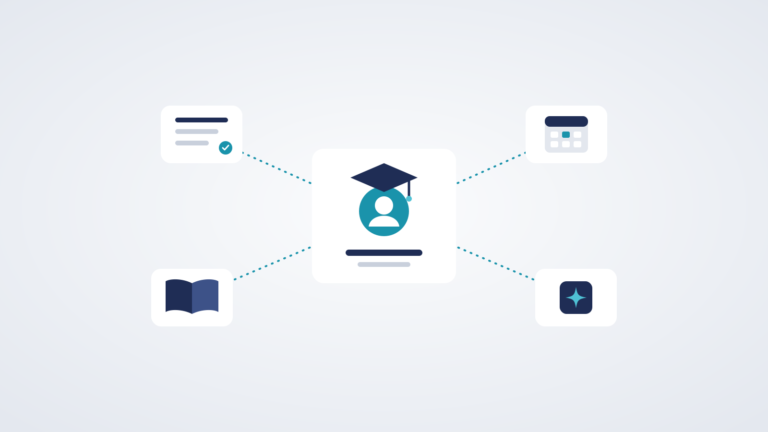
Salesforce’s Experience Cloud overview describes sites that connect a company with distributors, resellers, and suppliers, give customers one place to get answers, and support events and content. In practice, most projects fall into four groups:
| Site type | Who uses it | Typical features |
|---|---|---|
| Customer help center | Customers | Knowledge articles, case submission, chat, and increasingly AI agents |
| Customer account portal | Customers, members, patients | Account details, orders, billing, appointments, documents |
| Partner portal | Resellers, distributors, dealers | Deal registration, lead sharing, pricing, training, co-marketing |
| Employee or public site | Employees or the public | Intranet content, events, microsites, forms |
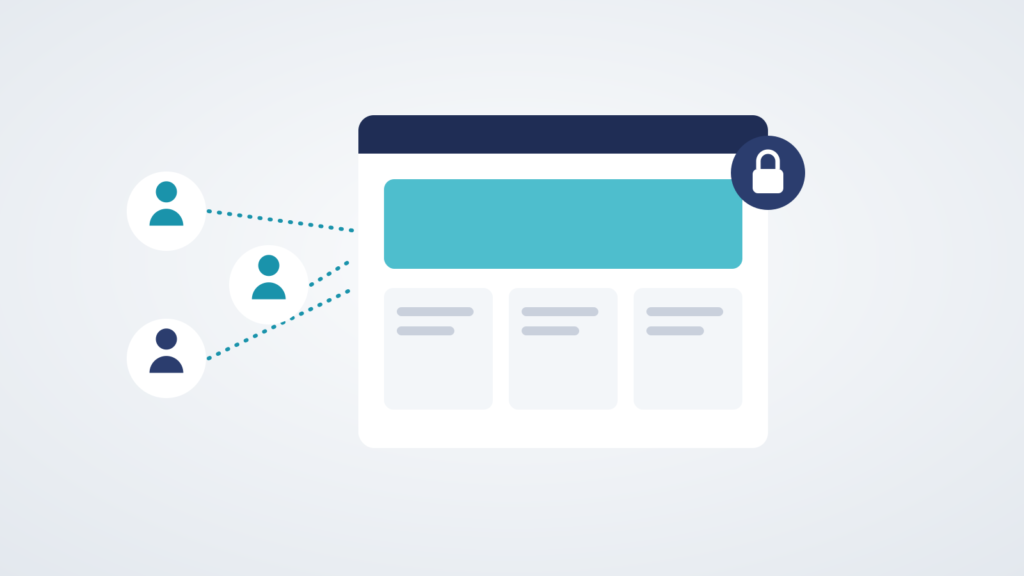
Every one of these exposes your Salesforce data to people outside your company. That is why security and licensing knowledge matter as much as front-end skill. A Salesforce portal developer who builds a beautiful site with a loose sharing model has created a risk, not a feature.
Experience Cloud is also the front end for several industry clouds, such as patient portals in Health Cloud and client portals in Financial Services Cloud. Our guide to Salesforce industry cloud hiring covers those specialist pools.
LWR vs Aura Sites, and Agents on Portals
Experience Cloud sites run on one of two frameworks, and candidates usually know one far better than the other.
| Aura sites | LWR sites | |
|---|---|---|
| Framework | Older Aura component framework | Lightning Web Runtime, built for Lightning Web Components |
| Strengths | Mature templates, including some partner and service features | Faster pages, better search visibility, modern development |
| Typical use today | Existing sites, and features only Aura supports | New sites and redesigns |
Salesforce Dictionary’s 2026 Experience Cloud guide sums up the practical rule: build new sites on LWR unless you need a feature only Aura supports, and plan migration windows for existing Aura sites, especially public ones where search ranking matters. Salesforce has also been consolidating its LWR templates into enhanced LWR sites.
For hiring, that means two things. If you run Aura today, you need someone who can maintain it and plan a migration. If you are building new, Lightning Web Components depth matters most.
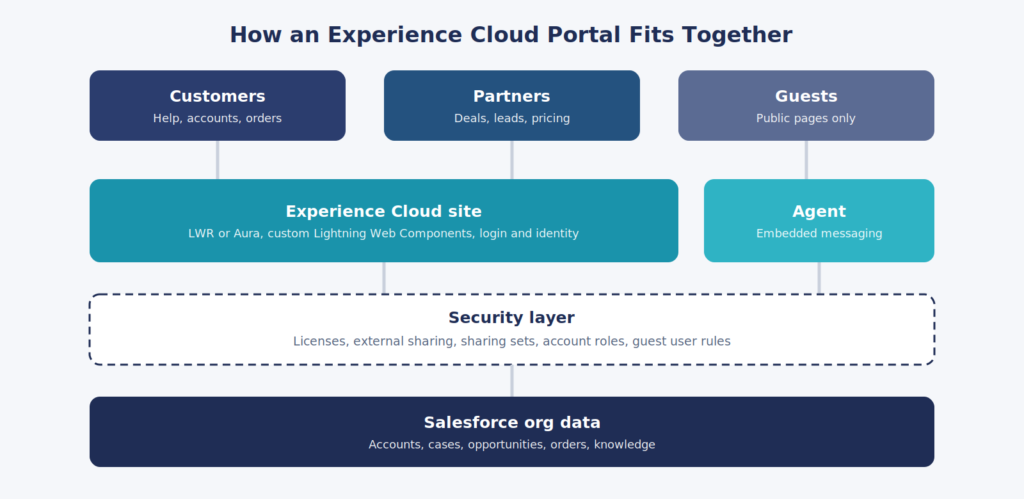
Agents on Experience Cloud sites
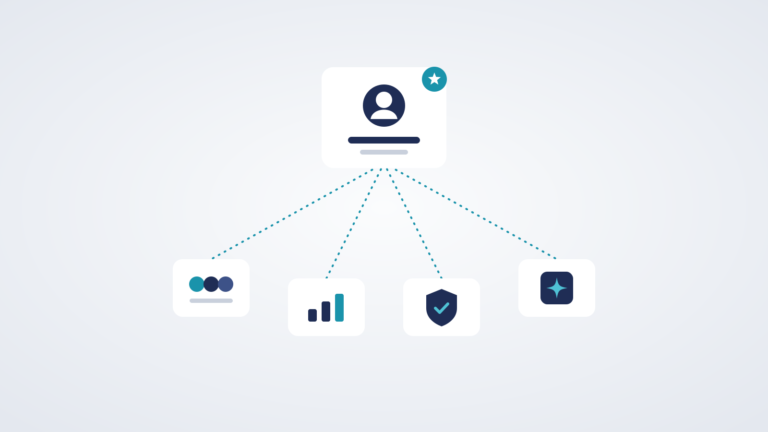
AI agents now appear on portals through embedded messaging and Agentforce service components, so customers can get answers and take actions without opening a case. Agentforce Service capabilities for Experience Cloud are now part of the Experience Cloud Consultant exam outline.
One detail can confuse candidates and hiring managers alike. Salesforce Help notes that a separate beta feature, an Agentforce assistant inside Experience Builder for enhanced LWR sites, is discontinued as of Winter ’27. That was a tool for building sites, not the agents that serve customers on them, which continue to grow.
Experience Cloud Developer vs Experience Cloud Consultant
Most portal projects need both kinds of skill, and smaller teams often hire one person who covers both.
| Role | Focus | Typical work |
|---|---|---|
| Experience Cloud consultant | Design and configuration | Choosing templates, licensing, sharing sets and external user access, user provisioning, branding, content management, adoption |
| Experience Cloud developer | Custom build | Lightning Web Components for LWR sites, Apex, custom themes, integrations, identity and single sign-on, guest user security, performance |
Hire an Experience Cloud consultant when you are designing a new portal, fixing a confusing one, or choosing licenses. Hire a developer when the site needs custom components, deep integration, or a migration from Aura to LWR. For large public sites, add a front-end or UX specialist who understands accessibility and design systems.
If you are hiring a general Salesforce developer who will also work on portals, our guide to hiring Salesforce developers covers the core skills, and our guide to how to hire a Salesforce consultant covers the design side.
5 Proven Skills of a Strong Experience Cloud Developer
1. External user security and sharing
This is the most important skill on the list. Strong candidates understand external sharing settings, sharing sets, account and partner roles, guest user access, and how to test what each type of user can actually see. Ask them to explain how they would stop one partner from seeing another partner’s records.
2. Licensing judgment
Customer Community, Customer Community Plus, and Partner Community licenses unlock different features at very different costs. A developer or consultant who picks the right license can save a company a lot of money, and one who picks the wrong one can force a painful rebuild.
3. Lightning Web Components for LWR sites
Custom components for LWR sites, built for performance, accessibility, and mobile, are the heart of modern Experience Cloud development. Look for clean components that admins can configure in Experience Builder without code changes.
4. Identity and login
Portals live or die on the login experience: self-registration, single sign-on with an existing customer identity system, social login, and password resets. Candidates should be comfortable with identity setup and its security trade-offs.
5. Agents and service on the portal
Adding an agent to a help center means connecting embedded messaging, choosing what the agent can do for logged-in versus guest users, and handing off to a person cleanly. Candidates who have done this are still uncommon.
Useful extras include Salesforce CMS, search and SEO for public sites, analytics for adoption, and Aura-to-LWR migration experience. Our Salesforce skills list covers the broader platform skills, and our guide to the Agentforce specialist role covers agent configuration in more depth.
Experience Cloud Certification and Pay
The certification
The main credential is the Salesforce Certified Experience Cloud Consultant, described on Trailhead’s credential page as validating skill in implementing and consulting on Experience Cloud in a customer-facing role. According to K2U’s summary of the exam, the Salesforce Administrator certification is a prerequisite, and the outline now includes Agentforce Service capabilities for Experience Cloud alongside sharing, visibility, and licensing.
For developer roles, look for Platform Developer I or II as well. The Experience Cloud Consultant credential shows platform judgment, and the developer credentials show coding depth. Verify any credential on Salesforce’s credential verification page.
Pay
Our 2027 Salesforce salary guide does not break out Experience Cloud as its own band, so use these benchmarks:
| Role | Closest benchmark | US base range (2027) |
|---|---|---|
| Experience Cloud consultant | Mid-level to senior functional consultant | $100,000 to $160,000 |
| Experience Cloud developer | Mid-level to senior Salesforce developer | $110,000 to $175,000 |
| Portal or digital experience architect | Solution or technical architect | $145,000 to $230,000 |
Candidates with large partner portal experience, regulated-industry portals, or Aura-to-LWR migrations sit toward the top of these ranges. For contract work, our guide to Salesforce contractor rates puts functional consultants at $105 to $160 an hour and developers at $100 to $170.
How to Hire an Experience Cloud Developer
Start with a security scenario
Ask: “We have 400 partner companies on one portal. Each should see only its own deals, plus shared marketing content. Guest users can browse products but nothing else. How would you set that up, and how would you test it?” Strong candidates talk through licenses, account roles, sharing sets or sharing rules, guest user restrictions, and testing as each type of user. This one question separates strong candidates faster than any other.
Review a component they built
Ask for a Lightning Web Component built for an Experience Cloud site and have them explain it. Look for configurable properties, accessibility, mobile behavior, and how it fetches data securely for external users.
Ask about a migration or a launch
Ask for an Aura-to-LWR migration, a portal launch, or a login redesign they led. Listen for how they planned it, what broke, and how they protected users during the change.
Include a business stakeholder
Portals serve partners and customers, so have someone from the partner or service team spend 20 minutes with the candidate. Good Experience Cloud people think about the external user’s day, not just the configuration.
Know where to look
Strong candidates often come from Salesforce partners that build portals, from in-house teams running large partner or customer portals, and from front-end developers who moved into Salesforce. Our comparison of a Salesforce headhunter vs staffing vs placement agency explains which approach fits, and our guide to Salesforce technical debt is worth reading if your existing portal needs cleanup before a redesign.
Frequently Asked Questions
What does a Salesforce Experience Cloud developer do?
A Salesforce Experience Cloud developer builds portals and sites for customers, partners, and other external users: custom Lightning Web Components, integrations, login and identity, and the security that controls what each external user can see.
What is the difference between LWR and Aura sites?
Aura sites use Salesforce’s older component framework and mature templates. LWR sites use the Lightning Web Runtime, are faster, and support modern Lightning Web Components. New sites are generally built on LWR unless they need a feature only Aura supports.
What certification should an Experience Cloud developer have?
The Salesforce Certified Experience Cloud Consultant credential is the main portal certification, and it requires the Administrator certification first. Developers should also hold Platform Developer I or II.
Can you add AI agents to Experience Cloud sites?
Yes. Agents can be added to help centers and portals through embedded messaging and Agentforce service components, so customers can get answers and complete tasks without opening a case. A separate beta assistant inside Experience Builder was discontinued as of Winter ’27.
How much does an Experience Cloud developer earn?
There is no separate market band. Experience Cloud developers generally benchmark against Salesforce developers, roughly $110,000 to $175,000 in US base salary from mid to senior level, with consultants at about $100,000 to $160,000.
What is the most important skill for an Experience Cloud developer?
External user security. Portals expose company data to outside users, so a developer must understand sharing, licensing, guest access, and how to test exactly what each type of user can see.
Build Portals Outsiders Love, and Can Only See What They Should
A strong Experience Cloud developer gives customers and partners a fast, useful site while keeping every external user inside the right boundaries. Decide whether you need design, development, or both, test security judgment first, and favor LWR and agent experience for new builds.
Need to hire an Experience Cloud developer or consultant? Talk to our Salesforce recruiters. We find portal specialists who have built secure, fast sites for real partners and customers, and we can tell you what the role costs in today’s market.