
Nobody decided to build a messy org. It happened one reasonable request at a time. A field for a one-off campaign. A Process Builder that a consultant left behind. Three flows on the Opportunity object, built by three different people, that now fire in an order nobody can explain. Ten years later, every change takes twice as long as it should, and the new AI agent keeps giving answers based on fields nobody has updated since 2019.
That is Salesforce technical debt. It is the challenge Salesforce admins name most often, and it has become more urgent. Salesforce ended support for Workflow Rules and Process Builder at the end of 2025, and AI agents are only as reliable as the org they run on.
This guide explains what Salesforce technical debt looks like, why it matters more now, seven warning signs your org needs cleanup, who to hire to fix it, what a cleanup costs, and how to keep the org clean afterward.
Table of Contents
What Salesforce Technical Debt Looks Like
Salesforce technical debt is the accumulated cost of shortcuts, outdated builds, and unowned changes that make an org harder and riskier to change. In Salesforce Ben’s 2026 survey of admins, 56.3% named technical debt as their biggest challenge.
It usually shows up in six places:
| Area | What the debt looks like |
|---|---|
| Automation | Overlapping flows, triggers, and legacy Workflow Rules or Process Builder on the same objects, firing in an unclear order |
| Data model | Hundreds of unused fields, duplicate objects, and picklists nobody maintains |
| Code | Apex with low test coverage, hard-coded IDs, and logic only one departed developer understood |
| Security | Dozens of profiles, over-permissioned users, and access nobody can explain |
| Data quality | Duplicate records, stale accounts, and fields filled in inconsistently |
| Integrations and packages | Unused managed packages, dead integrations, and connected apps nobody owns |
Some debt is a reasonable trade-off. Teams take shortcuts to hit deadlines, and that is fine if someone goes back later. The problem is debt that nobody tracks, nobody owns, and nobody has time to fix.
Why Salesforce Technical Debt Matters More Now
Three changes have turned technical debt from a nuisance into a business risk.
Legacy automation is out of support
Salesforce ended support for Workflow Rules and Process Builder on December 31, 2025. As Salesforce Ben reported, existing automation keeps running, but Salesforce no longer provides support or bug fixes for it. Any org still relying on these tools is running business processes on software nobody will fix. A Process Builder migration to Flow is now overdue maintenance, not optional modernization.
AI agents expose every shortcut
Agentforce agents ground their answers in your data and act through your automation. Stale fields, duplicate records, and unclear automation that people learned to work around will confuse an agent, which cannot see the history behind them. Companies that want agents to work reliably usually have to clean up the data and automation underneath first. Our Data 360 hiring guide covers the data side of that work.
Teams build faster than ever
AI-assisted building in Flow, Apex, and Agentforce means more gets built in less time. Without standards and review, technical debt now accumulates faster too. A clear release process helps, as our guide to hiring a Salesforce DevOps engineer explains.
7 Warning Signs Your Org Needs a Salesforce Org Cleanup
- Simple changes take weeks. Adding a field or changing a validation rule requires investigation, because nobody is sure what else it will break.
- Nobody can explain the automation. Several flows, triggers, and legacy processes act on the same object, and nobody can say in which order they run.
- Workflow Rules or Process Builder are still running. That automation is now out of support.
- Releases are stressful. Deployments fail, changes are made directly in production, and the team avoids releasing on busy days.
- Users have stopped trusting the data. Sales exports reports to spreadsheets, and leaders ask for numbers from outside Salesforce.
- You are hitting platform limits. CPU timeouts, too many SOQL queries, or field limits on key objects show up more often.
- AI pilots keep stalling. Agents give answers based on outdated fields or trigger automation nobody expected.
One more sign is worth watching even if everything else looks fine: only one person understands how the org works. If that person leaves, the debt becomes a crisis overnight.
If three or more of these sound familiar, start with a Salesforce health check, sometimes called a Salesforce org audit. It is a short, structured review of automation, data model, code, security, and data quality that produces a prioritized list of what to fix first.
Who Fixes Salesforce Technical Debt
Cleanup is rarely one person’s job. The right mix depends on where the debt sits.
| Role | What they fix | Usual engagement |
|---|---|---|
| Solution or technical architect | Runs the health check, sets standards, and decides what to rebuild, retire, or leave alone | Contract, for the assessment and design |
| Senior admin or platform owner | Consolidates automation, retires unused fields and profiles, migrates Process Builder to Flow | Permanent, to own the org afterward |
| Salesforce developer | Refactors Apex, removes hard-coded logic, and raises test coverage | Contract or permanent, depending on code volume |
| Data specialist | Deduplicates records, fixes data quality, and prepares data for agents | Contract, often alongside a Data 360 project |
| DevOps engineer | Puts a pipeline and standards in place so debt does not return | Contract to set up, permanent in larger teams |
A common pattern works well for mid-sized orgs: bring in a contract architect for a short assessment, use a small contract team for the heaviest cleanup, and hire or develop a permanent platform owner to keep the org clean afterward. The last step matters most. Without an owner, a cleaned-up org can slide back quickly.
If your org has no clear owner today, our guide for Salesforce admin recruiters explains how to hire one, and our guides to how to hire Salesforce architects and hire Salesforce developers cover the specialist roles. Smaller orgs that need senior judgment but not a full-time hire can use a fractional Salesforce admin.
What a Salesforce Org Cleanup Costs
Every org is different, but contract rates give a useful way to estimate. Using the ranges in our guide to Salesforce contractor rates, here are illustrative costs for common pieces of work:
| Work | Typical effort | Illustrative cost |
|---|---|---|
| Health check by a contract architect | 2 to 3 weeks, about 80 to 120 hours at $130 to $210 an hour | About $10,000 to $25,000 |
| Automation and configuration cleanup by a senior admin contractor | About 3 months full time at $75 to $135 an hour | About $40,000 to $70,000 |
| Apex refactoring and test coverage by a contract developer | Depends on code volume, at $100 to $170 an hour | Varies widely |
These are estimates for planning, not quotes. Large or regulated orgs, heavy custom code, and integrations push costs higher.
The better comparison is the cost of leaving debt in place. Every change takes longer, so you pay for it in every project. Failed deployments cost time and trust. And AI projects stall or deliver poor results, which can cost far more than the cleanup itself. Our guide for Salesforce admin recruiters includes a short case in which the bill for untangling ungoverned automation ended up larger than the salary difference between hiring the right admin and the wrong one.
How to Run a Cleanup and Keep the Org Clean
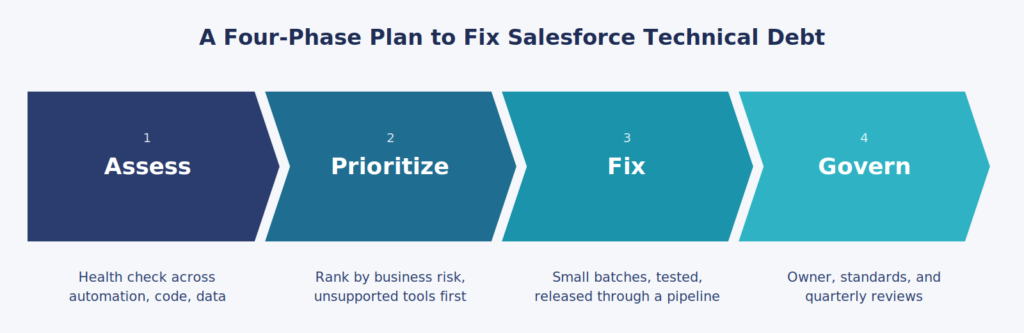
A successful cleanup follows four phases.
- Assess. Run a Salesforce health check across automation, data model, code, security, data quality, and integrations. Record what exists, who uses it, and what it touches.
- Prioritize. Rank problems by business risk, not by how annoying they are. Unsupported Process Builder and Workflow Rules, automation on the objects your agents rely on, and over-permissioned access usually come first.
- Fix. Work in small batches in sandboxes, test every change, and release through a proper pipeline. Retire what nobody uses, consolidate what overlaps, and document what stays.
- Govern. Put standards in place so the debt does not return: one automation approach per object, naming conventions, documentation for every change, peer review, and a quarterly review of unused fields, flows, and permissions.
The fourth phase is often where cleanups succeed or fail. Assign a named owner for the org, give that person the authority to say no to requests that add debt, and make the standards part of how every new feature and agent gets built. Our guide to structuring your Salesforce team shows where that ownership sits as a team grows.
Frequently Asked Questions
What is Salesforce technical debt?
Salesforce technical debt is the accumulated cost of shortcuts, outdated builds, and unowned changes that make an org harder and riskier to change. It includes overlapping automation, unused fields, untested code, excess permissions, poor data quality, and unused packages or integrations.
What happened to Workflow Rules and Process Builder?
Salesforce ended support for Workflow Rules and Process Builder on December 31, 2025. Existing automation still runs, but Salesforce no longer provides support or bug fixes, so orgs should migrate that automation to Flow.
What is a Salesforce health check?
A Salesforce health check, sometimes called an org audit, is a structured review of an org’s automation, data model, code, security, data quality, and integrations. It produces a prioritized list of what to fix, retire, or leave alone.
Who should run a Salesforce org cleanup?
A contract solution or technical architect usually runs the assessment, a senior admin or platform owner handles most configuration and automation cleanup, and developers refactor code. A permanent owner should keep the org clean afterward.
How much does a Salesforce org cleanup cost?
It depends on the size and complexity of the org. As a rough guide, a contract architect’s health check might cost about $10,000 to $25,000, and three months of cleanup by a senior admin contractor about $40,000 to $70,000.
Why does technical debt matter for Agentforce?
Agents ground their answers in your data and act through your automation. Stale fields, duplicate records, and unclear automation lead to wrong answers and unexpected actions, so cleanup is often a prerequisite for reliable agents.
Pay Down the Debt Before It Charges Interest
Salesforce technical debt never stays still. It grows with every unowned change, and it now blocks the AI projects most companies are counting on. Assess the org, fix what carries the most risk first, and put a named owner and clear standards in place so the work lasts.
Need help with a Salesforce org cleanup? Talk to our Salesforce recruiters. We can find a contract architect for your health check, a cleanup team for the heavy lifting, and the permanent platform owner who keeps it clean.