
It is 9 p.m. on a Thursday. The change set failed for the third time because of a missing dependency, two developers overwrote each other’s work in the same sandbox, and the sales team is waiting for a fix that was promised on Monday. Nobody on the team owns how changes get from a sandbox to production. Everyone just hopes it works.
That is the moment companies start looking for a Salesforce DevOps engineer. As teams ship more often, and now ship AI agents as well as code and configuration, the way changes move to production has become a job in its own right.
This guide explains what a Salesforce DevOps engineer does, how the role relates to a Salesforce release manager, the signs you need one, the tools and five skills that matter, what to pay, and how to hire one.
Table of Contents
What a Salesforce DevOps Engineer Does
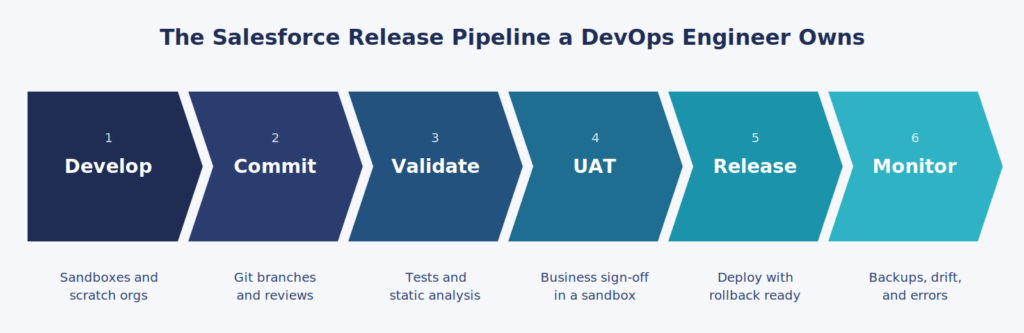
A Salesforce DevOps engineer owns how changes move from development to production safely, quickly, and repeatably. That covers code, configuration, Flow, and increasingly agent definitions and prompt templates.
The core responsibilities:
- Source control. Keeping the org’s metadata in Git so every change is tracked, reviewed, and reversible.
- Environments. Managing sandboxes, scratch orgs, and data so developers and admins work in realistic, isolated spaces.
- Pipelines. Building continuous integration and deployment pipelines that validate, test, and deploy changes automatically.
- Testing. Running Apex tests, static code analysis, and automated UI or agent tests before anything reaches production.
- Releases. Planning release windows, coordinating teams, and handling rollback when something goes wrong.
- Backup and monitoring. Protecting data and metadata, and spotting failed deployments, drift between orgs, and errors after release.
Salesforce release management is the planning side of that work: deciding what goes into each release, when, and with what approvals. In smaller teams one person does both. In larger organizations a Salesforce release manager owns the release calendar and approvals, while a DevOps engineer builds and runs the pipeline.
The role matters more now because of AI. Gearset’s analysis of teams succeeding with AI, based on its State of Salesforce DevOps 2026 survey, found that strong DevOps practice was the clearest predictor of using AI confidently, and that Agentforce agents tend to reach production where a working pipeline already exists.
Do You Need a Salesforce DevOps Engineer?
Many teams still deploy the old way. In Salesforce Ben’s Real State of DevOps in Salesforce 2026, 41.8% of admins said change sets were their primary deployment method, and only 8% of developers had adopted Salesforce’s own DevOps Center. Change sets work for small, occasional changes. They break down as teams grow.
Watch for these signals:
- Deployments regularly fail because of missing dependencies, or take hours to troubleshoot.
- Developers and admins overwrite each other’s work.
- Nobody can say with confidence what is different between a sandbox and production.
- Releases happen late at night because nobody trusts them during the day.
- Several teams, or a consulting partner, now build in the same org.
- Auditors or compliance teams ask who changed what, and when.
- You are starting to release Agentforce agents, prompts, and Flow changes on a regular cadence.
A useful rule of thumb: once three or more people regularly build in the same org, or you release more than once or twice a month, someone needs to own the pipeline. In a small team that might be a senior developer with DevOps as part of the role. In a larger one it is a dedicated Salesforce DevOps engineer.
If you are not sure the role is full time, a contract DevOps engineer can set up source control, a pipeline, and a release process, then hand it over to your team. Our guide to Salesforce contractor rates covers what that costs, and our guide to structuring your Salesforce team shows where the role fits as a team grows.
Salesforce DevOps Tools and 5 Skills to Look For
The tools candidates will know
Most candidates have deep experience with one or two Salesforce DevOps tools. Clientell’s 2026 buyer’s guide summarizes the main options:
| Tool | Known for | Typical fit |
|---|---|---|
| Salesforce DevOps Center | Free and native to Salesforce | Teams moving off change sets with simple pipelines |
| Gearset | Metadata comparison and deployment reliability | Growing and mid-market teams |
| Copado | Enterprise pipelines, user stories, and governance | Large, multi-team, compliance-heavy orgs |
| AutoRABIT | Compliance and static code analysis | Regulated industries |
| Flosum | Fully native to the Salesforce platform | Teams that want everything inside Salesforce |
Beneath all of them sit the same foundations: Git, the Salesforce CLI, and a CI service such as GitHub Actions, GitLab, or Azure DevOps. Tool experience transfers well when those foundations are strong, so do not rule out a candidate just because they used a different product.
Five skills that matter more than the tool
- Salesforce metadata depth. Understanding how metadata types, dependencies, and profiles and permission sets behave in deployments, which is where most failures come from.
- Source control discipline. A clear branching strategy, pull request reviews, and merge conflict resolution that keeps several teams from colliding.
- Pipeline and test automation. Building pipelines that validate every change, run Apex tests and static analysis, and block bad deployments before they reach production.
- Environment and data management. Keeping sandboxes in sync, seeding test data, and masking sensitive data in lower environments.
- Release coordination. Running a release calendar, communicating with business teams, and handling rollback calmly. Increasingly, that includes releasing agents and prompts with the same rigor as code.
Our guide to hiring Salesforce developers covers the development skills that sit alongside these.
Credentials for a Salesforce DevOps Engineer
There is no single Salesforce DevOps certification, so read a combination of signals:
- Platform Developer I and II. Show the candidate understands Apex, testing, and the platform they are deploying.
- Salesforce’s development lifecycle and deployment credential. Part of the System Architect path, it covers environments, governance, and release strategy, and is a strong signal for senior DevOps and release manager roles.
- Tool vendor certifications. Vendors run their own training and credentials, such as Copado’s certification program and Gearset’s DevOps Launchpad. These show depth in a specific product.
- General DevOps experience. Git, CI services, and scripting from outside Salesforce transfer well and are worth as much as a badge.
As with any credential, verify Salesforce certifications on the credential verification page, then focus the interview on pipelines the candidate has actually built and run. Our guide to the Salesforce certifications that matter when hiring covers the wider landscape, including the 2026 renames.
What to Pay a Salesforce DevOps Engineer
Our 2027 Salesforce salary guide does not break out DevOps as its own band, so use the closest developer and architect ranges as benchmarks:
| Role | Closest benchmark | US base range (2027) |
|---|---|---|
| Mid-level Salesforce DevOps engineer | Mid-level developer | $110,000 to $140,000 |
| Senior Salesforce DevOps engineer | Senior developer or technical consultant | $135,000 to $175,000 |
| Lead DevOps engineer or Salesforce release manager | Lead developer or technical architect | $160,000 to $200,000 |
Three things push an offer toward the top: experience building pipelines for large, multi-team orgs, regulated-industry experience with audit and compliance controls, and experience releasing Agentforce agents through the same pipeline as code.
Contract DevOps engineers are common for initial pipeline setup. Our guide to Salesforce contractor rates puts experienced developers at $100 to $170 an hour and technical consultants at $120 to $185, which are reasonable benchmarks for DevOps contractors.
How to Hire a Salesforce DevOps Engineer
Diagnose a failed deployment
Show the candidate a real-looking deployment error, such as a validation failure caused by a missing field dependency and a profile permission. Ask them to walk through how they would find and fix it. Strong candidates read the error carefully, explain the root cause, and describe how they would prevent it next time.
Design a pipeline
Give a scenario: “Three internal teams and one consulting partner build in the same org. We need a UAT sandbox, a way to ship urgent fixes, and an audit trail.” Listen for a clear branching strategy, environments that match the workflow, automated validation and tests, a hotfix path, and who approves what.
Test Git and metadata skills
Ask how they would resolve a merge conflict in a Flow or a page layout’s metadata file. This is where Salesforce DevOps differs most from general DevOps, and strong candidates will have scars to show for it.
Ask about agents
For teams starting with Agentforce, ask how they would version, test, and release an agent’s topics, instructions, and prompt templates. Candidates who treat agents like any other change, with testing and rollback, are ahead of many teams.
Know where to look
Strong candidates often come from Salesforce partners and ISVs with mature release processes, from developers who became the person their team relied on for deployments, and from general DevOps engineers who have moved into Salesforce. A specialist recruiter can tell the difference between someone who has run a pipeline and someone who has only used one. Our comparison of a Salesforce headhunter vs staffing vs placement agency explains which approach fits, and our Salesforce interview questions cover more technical questions.
Frequently Asked Questions
What does a Salesforce DevOps engineer do?
A Salesforce DevOps engineer owns how changes move from development to production: source control, sandboxes and environments, automated pipelines, testing, releases, rollback, and backup. Increasingly, that includes releasing Agentforce agents and prompt templates as well as code and configuration.
What is the difference between a Salesforce DevOps engineer and a Salesforce release manager?
A Salesforce release manager plans and coordinates releases: what goes in, when, and with what approvals. A DevOps engineer builds and runs the pipeline that delivers them. Smaller teams often combine the two roles.
Which Salesforce DevOps tools should candidates know?
Common tools include Salesforce DevOps Center, Gearset, Copado, AutoRABIT, and Flosum, built on Git, the Salesforce CLI, and a CI service. Strong foundations matter more than any single product, because experience transfers between tools.
Is there a Salesforce DevOps certification?
There is no single Salesforce DevOps certification. Useful signals include Platform Developer I and II, Salesforce’s development lifecycle and deployment credential on the architect path, and certifications from DevOps tool vendors.
How much does a Salesforce DevOps engineer earn?
There is no separate market band yet. Salesforce DevOps engineers generally benchmark against Salesforce developers, roughly $110,000 to $175,000 in US base salary from mid to senior level, with leads and release managers at about $160,000 to $200,000.
When should I hire a Salesforce DevOps engineer?
When three or more people regularly build in the same org, when you release more than once or twice a month, when deployments often fail, or when auditors need a clear record of changes. A contract engineer can set up the pipeline first if the need is not yet full time.
Ship Changes Without Holding Your Breath
A good Salesforce DevOps engineer turns releases from a late-night gamble into a routine. As teams grow and start shipping agents alongside code, that routine becomes the foundation everything else depends on. Hire for metadata depth, source control discipline, and pipelines the candidate has actually run, and do not let tool preferences rule out someone with strong foundations.
Need to hire a Salesforce DevOps engineer or release manager? Talk to our Salesforce recruiters. We find DevOps specialists who have built and run real Salesforce pipelines, and we can tell you what the role costs in your market.