You know the platform. You have the certifications. Then the interviewer says, “Walk me through how you would handle this,” describes a messy org you have never seen, and waits. Ten minutes later you have listed every feature you know and still not answered the question.
That is how many Salesforce technical interviews are lost: on how candidates show their knowledge rather than on the knowledge itself. Many hiring managers now favor scenarios, working sessions, and questions about what you have owned over trivia. Increasingly, they also ask about AI and Agentforce.
This guide explains what a Salesforce technical interview looks like now, how to prepare, how to answer scenario questions, what to expect for admin, developer, consultant, and architect roles, how to handle AI questions, and seven costly mistakes to avoid.
Table of Contents
What a Salesforce Technical Interview Looks Like Now
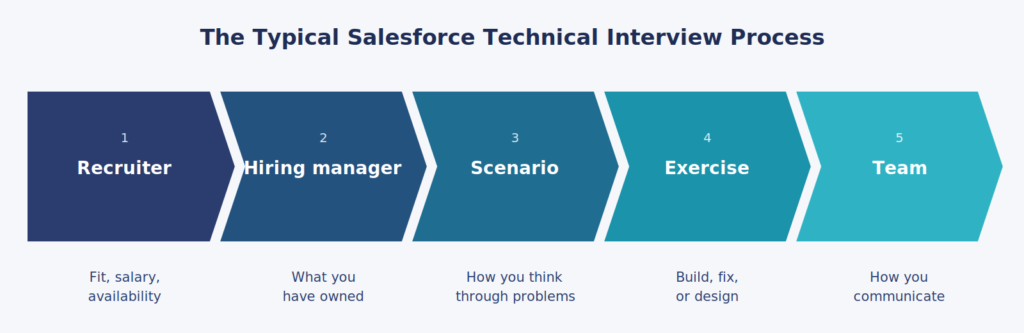
Most Salesforce hiring processes follow a similar shape, though the number of rounds varies by company and seniority.
| Round | What it tests | Typical length |
|---|---|---|
| Recruiter screen | Fit, salary expectations, availability, and basic experience | 20 to 30 minutes |
| Hiring manager conversation | What you have owned, how you work, and why this role | 45 to 60 minutes |
| Technical or scenario round | How you think through real problems on the platform | 45 to 90 minutes |
| Practical exercise | Building, fixing, or designing something, live or as a short take-home | 45 minutes to a few hours |
| Stakeholder or team round | How you communicate with business users and colleagues | 30 to 45 minutes |
The technical and scenario rounds often decide the offer. Interviewers want to see three things: that you understand the platform deeply enough to choose the right tool, that you think about consequences before you build, and that you can explain your reasoning to someone who is not technical.
It helps to know what interviewers are told to look for. Our guide for hiring managers, 20+ Salesforce interview questions every hiring manager should ask, shows the questions and the answers that separate strong candidates. Read it from the other side of the table.
Salesforce Interview Preparation: Before the Day
Good Salesforce interview preparation is mostly about evidence, not memorization. Start a few days before any Salesforce technical interview with these steps.
Read the job description like a requirements document
List every cloud, tool, and responsibility it mentions. Those are the topics the technical round will cover. If it mentions Agentforce, Data 360, CPQ, or a specific industry cloud, expect at least one question on each.
Prepare five or six ownership stories
Pick real projects where you made decisions, not just completed tasks: something you built, something you fixed, something you removed, a time you pushed back, and a release that went wrong. Structure each one using the STAR method, which the University of Washington Career Center describes as situation, task, action, and result. Spend most of the time on the action and the result.
Know your numbers
Interviewers trust specifics. Know roughly how many users your org has, which clouds and integrations it runs, how often you release, and what changed because of your work, such as hours saved, errors reduced, or adoption gained.
Bring proof
A developer org with something you built, a GitHub repository, or your Trailhead profile makes claims concrete. Check that your certifications are current and listed under their latest names, since several were renamed in 2026. Interviewers may check them on Salesforce’s credential verification page.
Know your range
Decide your salary range before the recruiter screen, using current market data such as our 2027 Salesforce salary guide. And be wary of any “interview” that skips straight to an offer or asks you to pay for equipment or training. Our guide to Salesforce recruiter scams covers the warning signs.
How to Answer Scenario Questions
Scenario questions are the heart of a Salesforce technical interview. A simple five-step structure keeps your answer focused.
- Clarify. Ask two or three questions before proposing anything: who uses it, how much data, what already exists, and what “done” looks like.
- Constrain. State the limits you are working within, such as data volumes, governor limits, security requirements, and the deadline.
- Choose. Offer an approach and at least one alternative, and explain why you prefer one. Lean toward declarative tools unless there is a clear reason for code.
- Consider consequences. Cover testing, security and sharing, the release process, and how you would roll back if it broke.
- Communicate. Summarize the recommendation in plain language, as if speaking to the business stakeholder.
A worked example
Suppose the interviewer says: “Our sales VP wants an approval step for discounts over 20%, live by Friday. There are already three automations on the Opportunity object.”
A weak answer jumps straight to building an approval process. A strong answer starts with questions: who approves, what happens if the approver is out, and what do those three automations do? It then proposes a solution, flags the risk of adding a fourth automation to an object nobody fully understands, suggests consolidating, explains how it would be tested in a sandbox, and tells the VP honestly whether Friday is realistic.
The interviewer is rarely grading the final design. They are grading whether you would be safe to give their org to.
For coding and design exercises, think aloud. Silence makes it impossible for the interviewer to give you credit for good reasoning, even when the final answer is incomplete.
Role-Specific Preparation
Every Salesforce technical interview is shaped by the role. Here is what to expect for the four most common ones.
Salesforce admin interview
Expect questions on the security and sharing model, Flow design and automation order, data quality, reports and dashboards, and release management. Senior admin interviews focus on ownership: what you standardized, what you retired, and when you said no. A common exercise is a 45-minute working session on a messy org scenario. Our guide for Salesforce admin recruiters shows exactly how employers screen for ownership.
Salesforce developer interview
Expect Apex fundamentals, bulkification and governor limits, trigger frameworks, asynchronous processing, Lightning Web Components, testing, and integration patterns. Many companies include a live coding task or a code review of flawed Apex. Explain why the code would fail at scale before you fix it. Our guide to hiring Salesforce developers covers the skills employers test.
Salesforce consultant interview
Expect discovery and requirements questions, solution design for a business problem, and a role-play with a stakeholder. Functional consultants are judged on how they turn vague goals into clear requirements. Technical consultants are also tested on configuration depth and integration. Our guide to hiring Salesforce consultants explains the difference.
Salesforce architect interview
Expect a design exercise: a multi-cloud or multi-org scenario with integration, data volume, security, and governance requirements. You will be asked to present, defend trade-offs, and adjust when the interviewer changes a requirement. Practice drawing a clear architecture diagram and explaining it in ten minutes. Our guide to how to hire Salesforce architects covers what employers look for, including how they weigh the CTA credential.
How to Handle AI and Agentforce Questions
AI questions are becoming common in Salesforce interviews across roles, even where the job description does not mention Agentforce. Expect at least one of these:
- How would you decide whether a process should be handled by an agent or a person?
- How would you stop an agent from taking an action it should not take?
- How would you test an agent before and after launch?
- What data would the agent need, and is that data clean enough to trust?
- How do you use AI tools in your own work, and how do you check their output?
You do not need production agent experience to answer well. Interviewers mainly want to hear good judgment: grounding agents in reliable data, limiting what they can do, adding human handoffs for sensitive cases, testing with realistic and awkward questions, and monitoring results after launch.
If you have built an agent, even in a developer org, describe it specifically: the use case, the topics and actions, what went wrong in testing, and what you changed. That kind of detail stands out because many candidates can only describe Agentforce in general terms.
Our guide to the Agentforce specialist role covers the skills behind these questions, and our article on whether AI will replace Salesforce admins explains how the work is changing.
7 Costly Mistakes That Sink a Salesforce Technical Interview
- Answering before asking. Jumping straight into a solution signals that you would build first and understand later. Ask clarifying questions first.
- Listing features instead of making decisions. Naming every tool that could work is not an answer. Pick one, explain why, and say what you would avoid.
- Saying “we” for everything. Interviewers need to know what you personally did. Use “we” for the team’s goal and “I” for your part.
- Leaning on certifications. Certifications get you into the room. Production experience gets you the offer. Talk about what you built, not what you passed.
- Overengineering. Reaching for Apex when Flow would do, or designing for a scale the scenario never mentioned, suggests poor judgment.
- Forgetting the boring parts. Security, testing, documentation, and release planning are where real projects fail. Mention them without being asked.
- Bluffing. Saying “I have not worked with that, but here is how I would approach it” earns more trust than a confident wrong answer.
One more habit costs offers late in the process: having no questions of your own. Ask about the org’s biggest technical debt, how releases work, who sets priorities, and how the team is using AI. The answers will also tell you whether the job is right for you.
Frequently Asked Questions
How do I prepare for a Salesforce technical interview?
Study the job description for the clouds and tools it mentions, prepare five or six specific stories about work you owned using the STAR method, know the numbers behind your experience, refresh the fundamentals for your role, and bring proof such as a developer org, GitHub, or Trailhead profile.
What questions are asked in a Salesforce technical interview?
Expect scenario questions about real org problems, role-specific technical questions on topics such as security, Flow, Apex, or integration, a practical exercise, and increasingly questions about AI and Agentforce, such as how you would test or limit an agent.
How should I answer Salesforce scenario-based questions?
Clarify the requirements first, state the constraints, choose an approach and explain the trade-offs, cover testing, security, and release, and finish with a plain-language summary for the business stakeholder.
What does a Salesforce developer interview include?
Usually Apex fundamentals, bulkification and governor limits, triggers, asynchronous processing, Lightning Web Components, testing, and integration, often with a live coding task or a review of flawed code.
Do I need Agentforce experience to pass a Salesforce technical interview?
Not always, but you should be ready to discuss AI. Interviewers want good judgment about data, guardrails, human handoffs, and testing. Building even a simple agent in a developer org gives you a concrete example to discuss.
How many interview rounds does a Salesforce job have?
Typically three to five: a recruiter screen, a hiring manager conversation, a technical or scenario round, sometimes a practical exercise, and a stakeholder or team round. Senior and architect roles often include a design presentation.
Show the Work, Not Just the Knowledge
A Salesforce technical interview rewards candidates who think before they build, speak in specifics, and are honest about what they do not know. Prepare stories about work you owned, practice answering scenarios out loud, and be ready to talk about AI with good judgment. The knowledge you already have will do the rest.
Looking for your next Salesforce role? Get in touch with our Salesforce recruiters. We prepare every candidate for the interview ahead, including what the hiring manager will focus on, and we can tell you what your experience is worth in today’s market.