The LinkedIn message looked real. A recruiter with a polished profile, a logo you recognized, and a Salesforce developer contract at $140 an hour, fully remote. The interview happened over chat. The offer came the next day. Then came the request: buy your own equipment through their approved vendor, and they will reimburse you on your first paycheck.
There was no paycheck. There was no job.
Job scams are growing fast, and Salesforce professionals are exactly who scammers want: well paid, often remote, used to hearing from recruiters, and comfortable installing tools and running code. This guide covers how Salesforce recruiter scams work, nine red flags of a fake Salesforce recruiter, how to verify a real one in a few minutes, and what to do if you have already been targeted.
Table of Contents
Why Salesforce Recruiter Scams Target Salesforce Professionals
Job scams have grown sharply. According to the FTC’s 2024 fraud data, reports of job and employment agency scams tripled from 2020 to 2024, and reported losses rose from $90 million to $501 million. Social media is a common starting point: the FTC’s 2026 Data Spotlight found that one in three people who lost money to a job or business opportunity scam in 2025 said it began on social media.
Salesforce professionals make attractive targets for four reasons:
- Recruiter contact is normal. Experienced Salesforce people hear from recruiters every week, so one more message does not raise suspicion.
- Remote and contract roles are common. Contract Salesforce work is a normal part of the market, so scammers can skip in-person meetings without it seeming strange.
- Pay is high. A fake $140-an-hour contract sounds plausible for a Salesforce developer, so the offer does not seem too good to be true.
- Technical people run code and install tools. That makes developers and architects targets for scams that hide malware in a coding test.
None of this means you should ignore recruiters. Most Salesforce recruiters are legitimate. Salesforce recruiter scams are the exception, which is why you need a quick, reliable way to tell the difference.
How Salesforce Recruiter Scams Work
Most Salesforce recruiter scams fall into five patterns. Some combine two or three.
| Scam type | How it works | What the scammer wants |
|---|---|---|
| Equipment or check scam | You get an offer fast, then a check to buy a laptop from their vendor. The check bounces after you have paid. | Your money |
| Malicious coding test | A fake recruiter sends a technical test or a video-call app that installs malware when you run it. | Access to your device, accounts, and crypto |
| Identity harvesting | You are asked for your Social Security number, bank details, or ID scans before any real interview. | Your identity |
| Pay-to-play | You are told you need paid training, a paid certification course, or a placement fee to qualify. | Your money |
| Impersonation | A scammer copies a real recruiter’s profile or a real company’s name, using a lookalike email domain. | Trust they can turn into any of the above |
The malicious coding test is the most dangerous of the Salesforce recruiter scams for developers. A North Korean hacking group known as WaterPlum, or “Contagious Interview,” poses as recruiters for AI and cryptocurrency companies and gets developers to run a malicious file during the hiring process, often presented as a coding test. Voice of America reported that the group also transferred at least $10.71 million in cryptocurrency to North Korea, based on an advisory from the FBI and Japan’s National Police Agency. Stolen identity documents from these fake interviews can also be used to impersonate real developers when applying for remote jobs.
9 Red Flags of a Fake Salesforce Recruiter
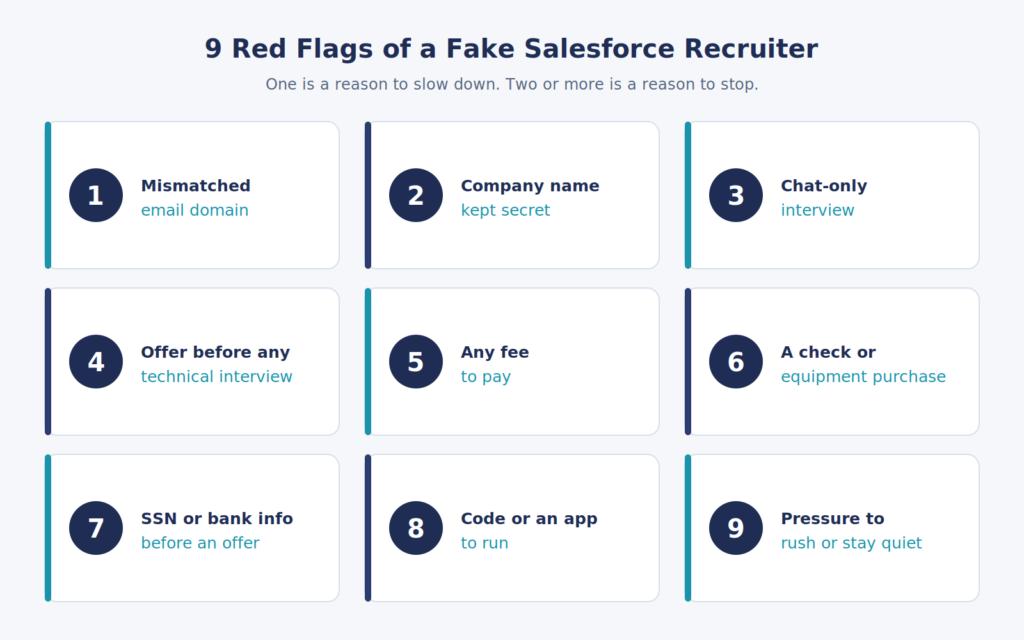
These recruiter scam red flags apply to every Salesforce role, from admin to architect. One red flag is a reason to slow down. Two or more is a reason to stop.
1. The email domain does not match the firm
Most real Salesforce recruiters write from their firm’s domain. Watch for Gmail or Outlook addresses, or lookalike domains with an extra letter, a hyphen, or a different ending.
2. They will not name the company, even after you agree to proceed
Recruiters sometimes hold back a client name in a first message. Once you agree to be considered, a legitimate recruiter tells you who the employer is before submitting you.
3. The interview happens only over chat or text
Real Salesforce hiring involves live conversations, usually on video, with people who can discuss the platform in depth. An interview conducted entirely in a messaging app is a strong warning sign.
4. The offer arrives before anyone technical has spoken to you
No legitimate employer hires a Salesforce developer or admin without testing their platform knowledge, usually with questions like these. An offer after one short conversation is not a lucky break.
5. They ask you to pay for anything
Training fees, certification courses, background check fees, placement fees, or software licenses. Legitimate Salesforce recruiters are paid by employers, never by candidates, whether they work as a placement agency, headhunter, or staffing firm. Real Salesforce certifications are earned through Salesforce’s own exams, not bought through a recruiter, as our guide to the certifications that matter when hiring explains.
6. They send a check or ask you to buy equipment
Any request to deposit a check and use part of it to buy a laptop, or to buy equipment from a specific vendor for later reimbursement, is a known scam pattern.
7. They want sensitive information before a written offer
Your Social Security number, bank account details, and ID scans belong in a real onboarding process after a signed offer, not in an early conversation.
8. They ask you to run code or install an app
A coding test in a private repository, an unfamiliar video-call app, or a script to fix your camera or audio. If a test genuinely needs code to run, ask for a known assessment platform, or run it in a virtual machine on a device that holds nothing sensitive. Never run it on a work laptop.
9. They push you to move fast or keep it quiet
Deadlines measured in hours, pressure to accept before you have seen a contract, or requests not to discuss the role with anyone are pressure tactics designed to stop you from checking.
How to Verify a Salesforce Recruiter in 10 Minutes
Before you share personal details or run anything a recruiter sends, take these steps. They stop most Salesforce recruiter scams before they start:
- Find the firm yourself. Search for the recruiting firm or employer independently, not through links in the message, and confirm the website, phone number, and email domain match.
- Check the recruiter’s history. Look for a LinkedIn profile with a work history, real connections in the Salesforce ecosystem, and activity that goes back more than a few weeks.
- Confirm the person works there. Call or email the firm through its published contact details and ask whether the recruiter is on staff.
- Confirm the job exists. Look for the role on the employer’s own careers page, or ask the recruiter for the hiring manager’s name and verify it.
- Ask a platform question. A real Salesforce recruiter can tell you which clouds the org uses, roughly how many users it has, and who the role reports to.
- Insist on a live conversation. Ask for a video call with the recruiter and, later, with someone technical on the hiring team.
A legitimate recruiter will not be bothered by any of this. Our guide to working with a Salesforce recruiter covers the questions that separate a specialist from a generalist, which doubles as a screen for fakes.
Real vs Fake: What Legitimate Salesforce Recruiting Looks Like
| Stage | Legitimate Salesforce recruiting | Salesforce recruiter scam |
|---|---|---|
| First contact | Firm email or verified LinkedIn profile, specific role details | Personal email, new profile, vague role |
| Company name | Shared before you are submitted | Withheld, or a big name used without detail |
| Interviews | Live video calls with technical interviewers | Chat only, or one brief call |
| Assessment | Known platform, or a discussion-based exercise | Private repository, unfamiliar app, or script to run |
| Offer | Written offer after several rounds | Instant offer, sometimes the same day |
| Money | You never pay anything | Fees, equipment purchases, or checks to deposit |
| Personal data | Collected by the employer after a signed offer | Requested early, often over chat |
A real Salesforce recruitment process takes a few weeks and involves people who know the platform. Anything that skips those steps deserves a second look.
What to Do if a Fake Salesforce Recruiter Targeted You
If one of these Salesforce recruiter scams already reached you, act quickly. The order matters.
- Stop responding. Do not send more money or information, and do not confront the scammer.
- Protect your money. If you paid anything or shared bank details, call your bank immediately. If you deposited a check, tell the bank before spending any of it.
- Protect your identity. If you shared your Social Security number or ID, place a fraud alert or credit freeze with the credit bureaus and follow the recovery steps at IdentityTheft.gov.
- Clean your device. If you ran a coding test or installed an app, disconnect the device from the internet, run a security scan, and change your passwords from a different, clean device. If it was a work laptop, tell your IT or security team right away.
- Report it. File a report with the FTC at ReportFraud.ftc.gov and with the FBI’s Internet Crime Complaint Center at ic3.gov. Report the profile to LinkedIn or whichever platform the scammer used.
- Warn the real company. If the scammer impersonated a real recruiting firm or employer, tell them. They can warn others and report the impersonation.
Reporting Salesforce recruiting scams feels pointless when the money is gone, but it helps investigators connect cases and helps platforms remove fake profiles faster.
Frequently Asked Questions
How can I tell if a Salesforce recruiter is fake?
Check whether the recruiter writes from a real firm’s email domain, has an established LinkedIn history, names the employer before submitting you, and arranges live interviews with technical people. Requests for payment, equipment purchases, sensitive personal information before an offer, or running unfamiliar code are strong signs of Salesforce recruiter scams.
Do real Salesforce recruiters ever ask for money?
No. Legitimate Salesforce recruiters are paid by the hiring company. Any request to pay for training, certification, background checks, placement, or equipment is a sign of a scam.
Is it safe to run a coding test a recruiter sends me?
Only if you have verified the recruiter and the employer first. Prefer known assessment platforms. If a test requires running code, use a virtual machine on a device that holds nothing sensitive, and never run it on a work laptop.
What are the most common Salesforce job scams?
The most common Salesforce job scams are fake checks for equipment purchases, malicious coding tests that install malware, requests for identity documents before a real offer, pay-to-play training or placement fees, and impersonation of real recruiters or companies.
Where do I report a fake Salesforce recruiter?
Report it to the FTC at ReportFraud.ftc.gov, to the FBI’s Internet Crime Complaint Center at ic3.gov, and to the platform where the scammer contacted you, such as LinkedIn. If they impersonated a real firm, tell that firm as well.
Can scammers impersonate a real Salesforce recruiting firm?
Yes. Scammers copy real recruiters’ profiles and use lookalike email domains. Always contact the firm through its published website or phone number to confirm the recruiter works there.
Trust the Process, Then Verify It
Most Salesforce recruiters are exactly who they say they are. Salesforce recruiter scams give themselves away by skipping the steps a real process requires: a named employer, live interviews with people who know the platform, a written offer, and no money changing hands from you. Slow down when something feels rushed, verify through channels you find yourself, and never run code you cannot trust.
Want to work with recruiters you can verify? Talk to our Salesforce recruiters. Every recruiter on our team is Salesforce certified, and you can confirm who you are speaking with through our published contact details at any time. Planning your next move? Our Salesforce skills list and 2027 salary guide show what employers are hiring for and paying right now.