A hiring manager opens a requisition for a “Salesforce person.” Ten days later, the shortlist includes an admin, a developer, a marketing automation specialist, and a consultant who has only worked for partners. Each is strong. None is right, because nobody decided which Salesforce role the team actually needed.
Salesforce roles have multiplied as the platform has grown. There are now admins, developers, architects, consultants, analysts, industry specialists, AI roles, and leaders, and many have several titles for the same job. Picking the right one is the first hiring decision, and the one that shapes every later step.
This guide maps the main Salesforce roles by group, explains what each does, shows which are growing, gives pay benchmarks, and links to our detailed hiring guide for each role.
Table of Contents
How Salesforce Roles Are Grouped
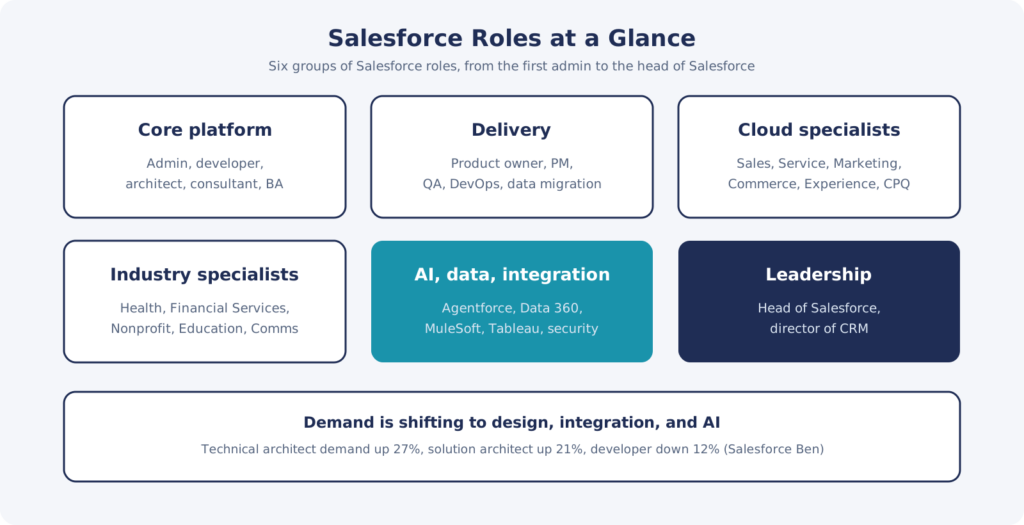
Salesforce’s own Salesforce career paths on Trailhead start with six platform roles: admin, developer, architect, consultant, designer, and analyst. Trailhead describes the admin as the expert who configures, automates, and optimizes Salesforce, and the architect as the leader who maps how systems, data, and AI agents work together. In practice, hiring managers also deal with delivery roles, specialists for individual clouds and industries, AI and data roles, and leadership.
| Group | Salesforce roles in the group | Typical question it answers |
|---|---|---|
| Core platform | Admin, developer, architect, consultant, business analyst | Who runs, builds, and designs the org? |
| Delivery | Product owner, project manager, QA tester, DevOps engineer, data migration specialist | Who plans, tests, and ships the work? |
| Cloud specialists | Sales, Service, Marketing, Commerce, Experience Cloud, CPQ | Who knows a specific product deeply? |
| Industry specialists | Health, Financial Services, Nonprofit, Education, Communications, OmniStudio | Who knows the industry data model and rules? |
| AI, data, and integration | Agentforce specialist and architect, Data 360, Tableau, MuleSoft, forward deployed engineer | Who connects data and puts AI agents to work? |
| Leadership | Head of Salesforce, director of CRM | Who owns the platform, budget, and roadmap? |
Core Platform Salesforce Roles
Almost every Salesforce team starts with these five Salesforce roles. Many job titles map back to them.
- Salesforce administrator. Configures the org, manages users and security, builds Flows and reports, and supports the business day to day. See our guide to hiring Salesforce admins, or our guide to the fractional Salesforce admin for part-time help.
- Salesforce developer. Writes Apex and Lightning Web Components, builds integrations, and handles logic configuration cannot. See how to hire a Salesforce developer.
- Salesforce architect. Designs the data model, integrations, security, and multi-cloud structure. See how to hire a Salesforce architect.
- Salesforce consultant. Turns business goals into a Salesforce design and delivers it, in functional or technical flavors. See how to hire a Salesforce consultant.
- Salesforce business analyst. Gathers requirements, maps processes, and writes user stories. See our Salesforce business analyst hiring guide.
Delivery Salesforce Roles
As projects grow, these Salesforce roles keep work planned, tested, and released safely.
- Product owner. Owns the ordered backlog and decides what gets built next. See our guide to the Salesforce product owner.
- Project manager. Owns schedule, budget, risks, and partners. See our guide to the Salesforce project manager.
- QA tester. Runs functional, regression, and agent testing. See our guide to the Salesforce QA tester.
- DevOps engineer. Builds the pipeline that moves changes safely to production. See how to hire a Salesforce DevOps engineer.
- Data migration specialist. Moves and cleans data during implementations and mergers. See our guide to the Salesforce data migration specialist.
Cloud Specialist Salesforce Roles
Each Salesforce cloud has its own data model and features, and large teams hire specialists for the clouds they rely on most.
- Sales Cloud consultant. Leads, opportunities, forecasting, and sales agents. See hiring a Sales Cloud consultant.
- Service Cloud consultant. Cases, contact centers, and service agents. See hiring a Service Cloud consultant.
- Field Service consultant. Scheduling, dispatch, and mobile workers. See our guide to the Salesforce Field Service consultant.
- Marketing Cloud developer. Email, journeys, and AMPscript. See hiring a Marketing Cloud developer.
- Account Engagement (Pardot) consultant. B2B marketing automation. See hiring a Pardot consultant.
- Commerce Cloud developer. Online storefronts. See hiring a Commerce Cloud developer.
- Experience Cloud developer. Portals and self-service sites. See hiring an Experience Cloud developer.
- CPQ and Revenue Cloud specialist. Quoting, pricing, and billing. See our guide to CPQ and Revenue Cloud hiring.
Industry Specialist Salesforce Roles
Industry clouds add data models and rules for specific sectors. Our 2027 salary guide found that industry cloud specialists earn 10% to 15% more than generalists, and our overview of Salesforce industry cloud hiring explains why.
- Health Cloud consultant. See hiring a Health Cloud consultant.
- Financial Services Cloud consultant. See hiring a Financial Services Cloud consultant.
- Nonprofit Cloud consultant. See our guide to the Nonprofit Cloud consultant.
- Education Cloud consultant. See hiring an Education Cloud consultant.
- Communications Cloud consultant. See hiring a Communications Cloud consultant.
- OmniStudio developer. Builds guided processes across industry clouds. See hiring an OmniStudio developer.
AI, Data, and Integration Salesforce Roles
These are the fastest-changing Salesforce roles, driven by AI agents and the need to connect data across systems.
- Agentforce specialist. Configures, grounds, and tests AI agents. See our guide to the Agentforce specialist.
- Agentforce architect. Designs agent systems across data and integrations. See hiring an Agentforce architect.
- Forward deployed engineer. Builds AI solutions on site with customers. See our guide to the forward deployed engineer.
- Data 360 consultant. Unifies customer data across systems. See hiring a Data 360 consultant.
- MuleSoft developer. Builds integrations between Salesforce and other systems. See hiring a MuleSoft developer.
- Tableau developer. Builds dashboards and analytics. See hiring a Tableau developer.
- Security consultant. Protects the org, its data, and its connected apps. See our guide to the Salesforce security consultant.
Leadership and Advisory Salesforce Roles
- Head of Salesforce. Owns strategy, team, budget, and results. Also called director of CRM or Salesforce platform owner. See hiring a head of Salesforce.
- Solution engineer. Shows prospects how Salesforce solves their problems, usually at Salesforce or a partner. See our guide to the Salesforce solution engineer.
If you need a firm to deliver a project instead of a hire, our guide to choosing a Salesforce consulting partner covers that route.
Common Salesforce Job Titles and What They Mean
Salesforce job titles vary by company, so the same work often appears under different names. When you write a posting or read resumes, map the title back to the role:
| Title you may see | Usually means |
|---|---|
| CRM administrator, Salesforce specialist | Salesforce administrator |
| Salesforce engineer, software engineer (Salesforce) | Salesforce developer |
| Business systems analyst, CRM analyst | Salesforce business analyst |
| Solution designer, platform architect | Salesforce solution architect |
| Salesforce platform owner, director of CRM | Head of Salesforce |
| Release manager, Salesforce DevOps specialist | Salesforce DevOps engineer |
Listing Salesforce positions under the title candidates search for, with the real role in the description, brings in more qualified applicants. Our Salesforce job description guide shows how to write one.
Which Salesforce Roles Are Growing
Demand is shifting toward design and away from routine build work. Salesforce Ben’s analysis of Salesforce roles with too much supply and too little demand, based on its salary report and 10K job data, found:
| Role | Change |
|---|---|
| Technical architect | Demand up 27% |
| Solution architect | Demand up 21% |
| Developer | Demand down 12% |
| Admin | Supply up 47% |
| Business analyst | Supply up 33% |
The same analysis found overall Salesforce demand up 8% in 2025. For hiring managers, the message is that senior design, integration, and AI skills are scarce, while entry-level admin and analyst candidates are plentiful. Our Salesforce job market 2027 guide covers the trend in more depth.
Salesforce Roles Pay Benchmarks
These senior-level US base ranges come from our 2027 Salesforce salary guide, which has full bands for every level.
| Role | Senior base salary |
|---|---|
| Administrator (5 to 8 years) | $105,000 to $140,000 |
| Business analyst (5 to 8 years) | $110,000 to $145,000 |
| Functional consultant (5 to 10 years) | $125,000 to $160,000 |
| Developer (5 to 8 years) | $135,000 to $175,000 |
| Technical consultant (5 to 10 years) | $140,000 to $175,000 |
| Solution architect (5 to 8 years) | $145,000 to $170,000 |
Contract rates follow a similar order, and our Salesforce contractor rates guide lists them by role.
Which Salesforce Role to Hire First
The right first hire depends on where your team is today.
- One team using Salesforce, few customizations. Start with an admin, full time or fractional.
- Several departments and growing complexity. Add a developer and a business analyst, then an architect when integrations multiply.
- Large implementation or new cloud. Add a product owner, project manager, and the cloud specialist, often alongside a consulting partner.
- AI agents on the roadmap. Add an Agentforce specialist, and make sure data and testing roles are covered.
- Salesforce runs a large part of the business. Hire a head of Salesforce to own the platform.
Our guide to Salesforce team structure shows common team designs, and our Salesforce career path guide shows how people move between these Salesforce roles over time.
Frequently Asked Questions
What are the main Salesforce roles?
The core Salesforce roles are administrator, developer, architect, consultant, and business analyst. Larger teams add delivery roles, cloud and industry specialists, AI and data roles, and a head of Salesforce.
What is the difference between a Salesforce admin and a developer?
An admin configures Salesforce with clicks: users, security, Flows, and reports. A developer writes code, such as Apex and Lightning Web Components, for logic and integrations that configuration cannot handle.
Which Salesforce roles are most in demand?
Salesforce Ben’s job data shows demand for technical architects up 27% and solution architects up 21%, while developer demand fell 12%. AI, integration, and data skills are also scarce.
What does a Salesforce specialist do?
“Salesforce specialist” is a loose title. It can mean an admin, a cloud specialist such as a Marketing Cloud expert, or an Agentforce specialist. Check the job description for the actual work before comparing candidates.
How many Salesforce job titles are there?
There is no fixed list. Trailhead lists six core platform career paths, and companies use dozens of titles on top of them. This guide covers more than 30 of the most common.
Which Salesforce role should I hire first?
Most companies start with an administrator. Add developers, analysts, and architects as complexity grows, and specialist or leadership roles as Salesforce supports more of the business.
Find the Right Salesforce Roles for Your Team
Choosing the right role is the first hiring decision. Map the work, pick the role that fits, and use the linked guides to hire well.
Not sure which Salesforce role you need? Talk to our Salesforce recruiters.