
A technician arrives at a job without the right part. Another drives past three customers to reach a fourth. The dispatcher spends the morning moving appointments by hand because a crew called in sick, and the customer who was promised a window between 8 and 10 is still waiting at noon.
Those are scheduling, mobile, and data problems, and they are why companies hire a Salesforce field service consultant. Salesforce’s field service product has also changed name twice, and its certification was renamed in 2026, so resumes and job posts now use several different names for the same skills.
This guide explains what Salesforce Field Service is now, how to read the renamed certification, which roles you need, the five skills that matter most, what to pay, and how to assess candidates.
Table of Contents
What Salesforce Field Service Is Now
The product started as Field Service Lightning, became Salesforce Field Service, and is now officially Agentforce Field Service and Operations. Salesforce Help’s overview describes it as a customizable, mobile-friendly field service hub in Salesforce, made up of core features, a managed package, and an offline-friendly mobile app for iOS and Android.
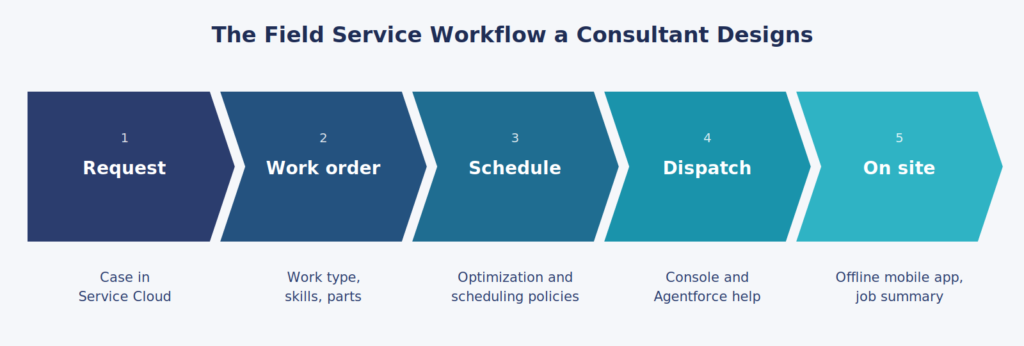
It covers the full life of a field job:
- Work orders and service appointments, usually created from cases in Service Cloud.
- Scheduling and optimization that match jobs to technicians by skill, location, availability, and service-level agreements.
- A dispatcher console for managing the day and handling exceptions.
- The mobile app technicians use on site, including offline.
- Assets, inventory, and parts on vehicles and in warehouses.
AI is now part of the daily work. Salesforce’s Field Service and Operations product page describes Agentforce for mobile workers inside the mobile app and Agentforce for dispatchers inside the dispatch console, where dispatchers can use natural language to find appointments that need attention and fill gaps in the schedule. The same page notes that Enhanced Scheduling and Optimization runs on Hyperforce.
Field service usually sits on top of Service Cloud, so strong candidates understand both. Our guide to how to hire a Salesforce consultant covers the Service Cloud side.
The 2026 Certification Rename
The Salesforce Field Service Consultant certification was renamed Salesforce Certified Agentforce Field Service and Operations Consultant on July 24, 2026, as part of the wider change listed in Salesforce’s certification name changes FAQ. It is the same credential under a new name.
That means resumes will show at least three versions of the same skill:
| What you may see | What it means |
|---|---|
| Field Service Lightning Consultant | The credential under its older product name |
| Field Service Consultant | The credential before July 2026 |
| Agentforce Field Service and Operations Consultant | The current name |
Treat all three as equivalent, and check that the credential is current on Salesforce’s credential verification page. Our guide to the Salesforce certifications that matter when hiring covers the rest of the 2026 renames, which changed several Service and Sales Cloud credentials in the same way.
The certification shows a candidate understands the data model, scheduling, and mobile setup. It does not show they have tuned scheduling for a real operation with hundreds of technicians, which is the harder skill.
Which Field Service Role Do You Need?
| Role | What they own | Right for |
|---|---|---|
| Field service consultant | Designs the setup: service territories, work types, skills, operating hours, scheduling policies, mobile flows | New implementations, redesigns, or a broken scheduling model |
| Scheduling and optimization specialist | Tunes scheduling policies, rules, and objectives against real operating results | Large operations where travel time, SLAs, and overtime drive costs |
| Field Service Lightning developer | Builds custom mobile experiences, Apex, scheduling extensions, and integrations with ERP, inventory, and asset systems | Complex operations, connected assets, or heavy integration |
| Field service admin | Runs the platform day to day: users, territories, mobile settings, reports | Steady operations after go-live |
Many companies start with a field service consultant for the implementation, often on contract, and keep an admin and a developer afterward. Large utilities, telecom, manufacturing, and home services operations often add a dedicated scheduling specialist, because small scheduling gains add up across thousands of jobs.
“Field Service Lightning developer” is still a common search term and job title, even though the product name has changed. Use it in job posts alongside the current name so the right candidates find you.
5 Proven Skills of a Strong Field Service Consultant
1. Data model and setup
Service territories, operating hours, work types, skills, service resources, and crews are the foundation. A strong field service consultant designs them around how the operation really works, not how the demo org was set up.
2. Scheduling and optimization
Scheduling policies, work rules, and service objectives decide whether technicians drive less, hit SLAs, and avoid overtime. Strong candidates can explain how they tuned a policy, what they measured, and what changed in the results.
3. Mobile experience
Technicians often work with poor connectivity, so the offline-first mobile app has to be set up carefully: what data is cached, which flows run on the device, and how forms, photos, and signatures sync back. Ask candidates how they tested the mobile experience in the field, not just in the office.
4. Assets, inventory, and integration
Most field operations depend on parts, assets, warranties, and an ERP or inventory system. Strong candidates have connected those systems so the right part is on the right van, and so asset history is visible on every job. Our guide to how to hire MuleSoft developers covers the integration specialists who often help here.
5. Agentforce for dispatchers and technicians
Agents can now help dispatchers handle exceptions such as absences, and help technicians find information or write job summaries. Candidates who have configured these use cases, and know where a human still needs to approve changes, are still uncommon.
Useful extras include Service Cloud depth, Appointment Assistant for customer arrival updates, and reporting on first-time fix rate and travel time. Our Salesforce skills list covers the broader platform skills, and our guide to the Agentforce specialist role covers agent configuration.
What to Pay for Salesforce Field Service Skills
Our 2027 Salesforce salary guide does not break out field service as its own band, so use the closest consultant, developer, and architect ranges as benchmarks:
| Role | Closest benchmark | US base range (2027) |
|---|---|---|
| Field service admin | Mid-level to senior administrator | $90,000 to $140,000 |
| Field service consultant | Senior functional or technical consultant | $125,000 to $175,000 |
| Field Service Lightning developer | Mid-level to senior Salesforce developer | $110,000 to $175,000 |
| Field service architect or lead | Solution or technical architect | $145,000 to $230,000 |
Candidates who have tuned scheduling for large, complex operations, integrated field service with ERP and asset systems, or configured Agentforce for dispatchers sit toward the top of these ranges. Industry experience in utilities, telecom, manufacturing, medical devices, or home services also commands a premium, because the operational knowledge takes years to build.
Field service implementations are often staffed on contract. Our guide to Salesforce contractor rates puts functional consultants at $105 to $160 an hour and technical consultants at $120 to $185, which are reasonable benchmarks for field service contractors.
How to Hire a Field Service Consultant
Run a scheduling scenario
Try: “We have 300 technicians across four regions. Average travel time is 70 minutes a day, emergency jobs keep breaking the schedule, and we miss our SLA on about one job in eight. Where would you start?” Strong candidates ask about territories, skills, job durations, and how emergencies are handled today, then talk about scheduling policies and how they would measure improvement before changing anything.
Ask about a mobile rollout
Ask for a mobile rollout they led: how they decided what technicians needed offline, how they trained crews, and what went wrong in the first weeks. Field adoption is where many implementations struggle.
Test integration thinking
Ask how they would make sure the right part is available before a technician is dispatched. Listen for inventory, ERP integration, and how the scheduling engine can account for parts.
Include operations
Have a dispatcher or field operations leader spend 20 minutes with the candidate. A Salesforce field service consultant who cannot talk comfortably about routes, crews, and SLAs will struggle on a real project.
Know where to look
Strong candidates often come from Salesforce partners with field service practices, from in-house teams at utilities, telecom, manufacturing, and service companies, and from consultants who moved over from other field service platforms. Our comparison of a Salesforce headhunter vs staffing vs placement agency explains which approach fits, and our guide to Salesforce industry cloud hiring covers other specialist pools.
Frequently Asked Questions
What does a Salesforce field service consultant do?
A Salesforce field service consultant designs and implements field service on Salesforce: service territories, work types, skills, scheduling policies, the dispatcher console, the technician mobile app, and integrations with inventory and asset systems.
What is Agentforce Field Service and Operations?
It is the current name for Salesforce Field Service, formerly Field Service Lightning. It manages work orders, scheduling and optimization, dispatch, the offline-first mobile app for technicians, and assets and inventory, with Agentforce for dispatchers and mobile workers.
Was the Field Service Consultant certification renamed?
Yes. On July 24, 2026, it was renamed Salesforce Certified Agentforce Field Service and Operations Consultant. It is the same credential, so treat the old and new names as equivalent.
What is a Field Service Lightning developer?
The term comes from the product’s earlier name. A Field Service Lightning developer builds custom mobile experiences, Apex, scheduling extensions, and integrations for Salesforce field service. Many job posts and resumes still use the older name.
How much does a Salesforce field service consultant earn?
There is no separate market band. Field service consultants generally benchmark against senior functional and technical consultants, roughly $125,000 to $175,000 in US base salary, with architects and leads at about $145,000 to $230,000.
What is the most important skill for a field service consultant?
Scheduling and optimization. The way territories, skills, and scheduling policies are designed decides travel time, SLA performance, and overtime, which is where most of the business value of field service comes from.
Hire for the Schedule, the Van, and the Phone
A strong field service consultant makes every technician’s day shorter and every customer’s wait more predictable. Read old and new certification names as the same credential, test scheduling and mobile judgment with real scenarios, and favor candidates who know your industry’s operations as well as the platform.
Need to hire a Salesforce field service consultant or developer? Talk to our Salesforce recruiters. We find field service specialists who have tuned real schedules and rolled out mobile apps to real crews, and we can tell you what the role costs in today’s market.