Your holiday season is ten weeks away. The product detail page takes four seconds to load on mobile, the checkout breaks whenever a promotion stacks with a gift card, and the developer who built your storefront left in the spring. You post a job for a Salesforce developer and get dozens of applicants who know Apex and Flow. None of them have touched a cartridge.
That is the first thing to understand about hiring a Commerce Cloud developer: it is a different talent pool from the rest of Salesforce. Salesforce B2C Commerce, now branded Agentforce Commerce, runs on its own platform with its own languages, tools, and certifications. B2B Commerce runs on core Salesforce and needs different skills again.
This guide explains the two talent pools, the storefront architectures candidates will know, the five skills that matter most, the certifications, what to pay, and how to assess candidates before peak season arrives.
Table of Contents
B2C vs B2B Commerce: Two Different Talent Pools
Salesforce sells two commerce products, and they need different developers. As eLogic’s 2026 guide to Salesforce Commerce Cloud puts it, B2C storefronts need JavaScript skills, while B2B needs Salesforce platform developers.
| B2C Commerce (Agentforce Commerce) | B2B Commerce | |
|---|---|---|
| Built for | High-volume consumer storefronts | Business buyers: accounts, contract pricing, reorders |
| Runs on | Its own commerce platform | Core Salesforce |
| Developer languages | Server-side JavaScript and ISML templates, or React for headless storefronts | Apex, Lightning Web Components, and Flow |
| Typical background | Ecommerce and front-end engineers, often from agencies | Salesforce platform developers |
The distinction matters more than any other in this search. A strong B2C Commerce developer may never have written Apex, and a strong Salesforce developer may never have deployed a cartridge. When people search for a Salesforce Commerce Cloud developer, they usually mean B2C, so the rest of this guide focuses there, with notes on B2B where it differs.
If you are hiring for B2B Commerce, most of the advice in our guide to hiring Salesforce developers applies, plus commerce-specific experience with catalogs, pricing, and checkout.
SFRA vs Headless: Know Which Storefront You Run
The next question is which kind of B2C storefront you have, because it decides which skills you need.
| Storefront | How it works | Skills needed |
|---|---|---|
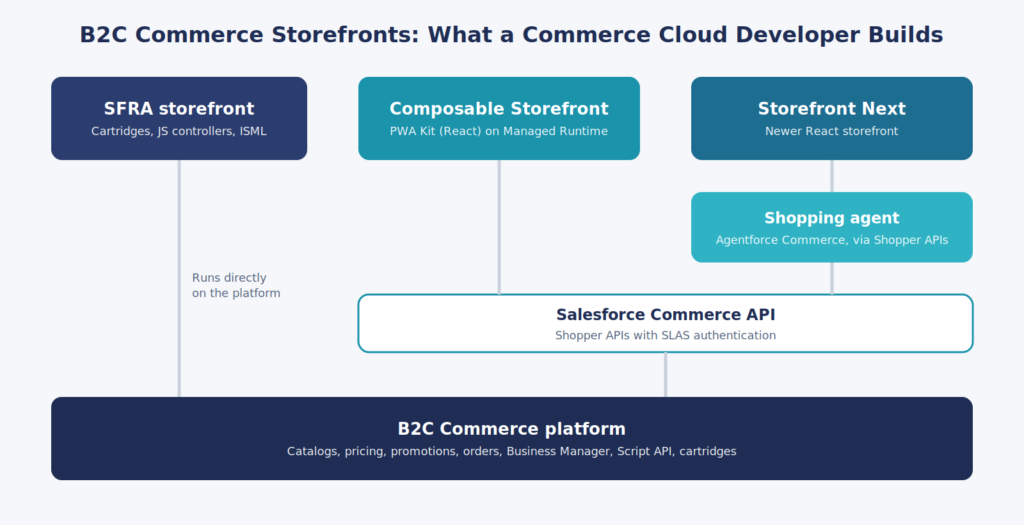
| SFRA (Storefront Reference Architecture) | Salesforce’s templated storefront since 2018, built from cartridges on the commerce platform | Server-side JavaScript controllers, ISML templates, cartridge structure |
| Composable Storefront | A headless storefront built with PWA Kit and hosted on Managed Runtime, talking to the platform through the Salesforce Commerce API | React, modern JavaScript tooling, APIs, performance tuning |
| Storefront Next | Salesforce’s newer React-based storefront option | React and headless commerce patterns |
| Hybrid | Some pages on a headless storefront, others still on SFRA, often during a migration | Both, plus migration planning |
Salesforce’s documentation on headless commerce with the Salesforce Commerce API shows how the pieces fit: headless storefronts call the commerce platform through APIs, while an SFRA storefront runs directly on it.
Direction matters for hiring. NovaCloud’s comparison of SFRA and headless notes that SFRA is not deprecated, but Salesforce’s main product investment has shifted to Composable Storefront. If you run SFRA today and plan to go headless, an SFRA developer with React experience is worth more than one without it. If you are already headless, React depth and API skills come first.
5 Essential Skills for a Commerce Cloud Developer
1. Storefront development
For SFRA, that means server-side JavaScript controllers, ISML templates, and a clean cartridge structure that does not modify the base. For headless storefronts, it means React, PWA Kit, and modern front-end tooling. Ask which one candidates have shipped to production, not just studied.
2. APIs and integrations
Every storefront connects to payment, tax, shipping, order management, and ERP systems. A strong B2C Commerce developer knows the Salesforce Commerce API and the older Open Commerce API, Shopper Login and API Access Service authentication, and how to build integrations that fail gracefully.
3. Performance at peak
Commerce sites live or die on page speed and holiday traffic. Look for experience with caching strategy, content delivery networks, image optimization, and load testing before peak season.
4. Business Manager and merchandising
Developers who understand catalogs, pricing, promotions, Page Designer, and multi-site or multi-locale setups build features merchandisers can actually use without filing a ticket.
5. Agentforce Commerce and Data 360
AI is now part of the commerce stack. Trailhead’s Spring ’26 B2C Commerce Developer certification maintenance covers the Guided Shopping Agent template, which developers connect to the storefront through the Shopper APIs, and how commerce data flows into Data 360 for near real-time segmentation. Candidates who have set up a shopping agent are still rare.
Useful extras include CI/CD for cartridges and PWA Kit apps, automated testing, accessibility, and an understanding of payment security requirements. Our Salesforce skills list covers the broader platform skills, and our guide to how to hire MuleSoft developers covers the integration specialists who often work alongside commerce teams.
Commerce Cloud Certifications
Commerce credentials are separate from the core Salesforce developer certifications.
- Salesforce Certified B2C Commerce Developer. The core credential for B2C work. It is kept current through maintenance modules, and the Spring ’26 update added the Guided Shopping Agent and Data 360 topics.
- Salesforce Certified B2C Commerce Architect. The senior credential. Salesforce’s B2C Commerce Architect exam guide requires the B2C Commerce Developer certification first and describes candidates as generally having five or more years of ecommerce experience.
- B2B Commerce credentials. B2B developers typically hold core credentials such as Platform Developer I and II, alongside Salesforce’s B2B Commerce accreditations. Note that the B2B Solution Architect certification is on the list of credentials retiring on February 1, 2027. It stays valid for current holders.
As with any role, certifications are a filter. Production storefronts, peak seasons survived, and integrations built tell you more. Verify credentials on Salesforce’s credential verification page, and see our guide to the Salesforce certifications that matter when hiring for the wider picture.
What to Pay a Commerce Cloud Developer
Our 2027 Salesforce salary guide does not break out commerce as its own band, so use the closest developer and architect ranges as benchmarks:
| Role | Closest benchmark | US base range (2027) |
|---|---|---|
| Mid-level B2C Commerce developer | Mid-level Salesforce developer | $110,000 to $140,000 |
| Senior B2C Commerce developer | Senior Salesforce developer | $135,000 to $175,000 |
| Commerce architect or lead | Technical architect | $160,000 to $230,000 |
Three things push an offer up: production experience with headless storefronts, which is newer and scarcer than SFRA experience; a record of keeping large storefronts fast through peak season; and early experience with Agentforce Commerce shopping agents.
Commerce work is also common on contract and through agencies, both onshore and offshore. Our guide to Salesforce contractor rates puts experienced developers at $100 to $170 an hour, and our guide to offshore Salesforce developers explains when offshore delivery works and when it does not.
How to Hire a Commerce Cloud Developer
Match the candidate to your storefront
Start the search by stating which storefront you run, SFRA, Composable Storefront, Storefront Next, or a hybrid, and what you plan to run in two years. It filters candidates faster than any other requirement.
Review real code
Ask for a cartridge, a React component, or an integration the candidate wrote, or review a short, flawed controller together. Strong candidates explain how they would keep customizations out of the base code so future upgrades stay easy.
Test a peak-season scenario
Try: “Two weeks before Black Friday, product detail pages slow to four seconds under load. Walk me through what you check.” Listen for caching, third-party scripts, image weight, API calls on page load, and load testing, in a sensible order.
Ask about an integration that failed
Payments, tax, and order management integrations break in production. Ask for a time one did, how they found it, and how they protected orders while it was fixed.
Know where to look
Strong B2C Commerce developers often come from ecommerce agencies and Salesforce partners with commerce practices, and from front-end engineers at retail and consumer brands. Many have never worked in core Salesforce, so do not filter on Apex. Our comparison of a Salesforce headhunter vs staffing vs placement agency explains which approach fits a specialist search like this one, and our guide to Salesforce industry cloud hiring covers other specialist talent pools.
Frequently Asked Questions
What does a Salesforce Commerce Cloud developer do?
A Salesforce Commerce Cloud developer builds and maintains online storefronts on Salesforce’s commerce platform: storefront pages and features, integrations with payment, tax, shipping, and order systems, performance tuning for peak traffic, and increasingly AI shopping agents.
What is the difference between a B2C and B2B Commerce developer?
B2C Commerce runs on its own platform and uses server-side JavaScript, ISML templates, or React for headless storefronts. B2B Commerce runs on core Salesforce and uses Apex, Lightning Web Components, and Flow. They are usually different people with different backgrounds.
What is SFRA in Salesforce Commerce Cloud?
SFRA, the Storefront Reference Architecture, is Salesforce’s templated B2C storefront built from cartridges with JavaScript controllers and ISML templates. It remains supported, though Salesforce’s main investment has shifted to headless storefronts such as Composable Storefront.
Is Commerce Cloud now called Agentforce Commerce?
Salesforce now brands B2C Commerce as Agentforce Commerce, reflecting its AI shopping agent features. The underlying B2C Commerce platform and its storefront architectures continue, and many developers still use the B2C Commerce name.
What certifications should a Commerce Cloud developer have?
For B2C work, the Salesforce Certified B2C Commerce Developer, with the B2C Commerce Architect credential for senior roles. B2B Commerce developers typically hold Platform Developer certifications plus B2B Commerce accreditations.
How much does a Commerce Cloud developer earn?
There is no separate market band. Commerce Cloud developers generally benchmark against Salesforce developers, roughly $110,000 to $175,000 in US base salary from mid to senior level, with commerce architects at about $160,000 to $230,000.
Hire for Your Storefront, and for Peak Season
A Commerce Cloud developer is an ecommerce engineer first and a Salesforce specialist second. Know whether you need B2C or B2B skills, match candidates to the storefront you run and the one you are moving to, and test performance and integration judgment before the season that matters most.
Need to hire a Commerce Cloud developer? Talk to our Salesforce recruiters. We find commerce developers who have kept real storefronts fast and stable through peak traffic, and we can tell you what the role costs in today’s market.