Leadership wants one number for pipeline, but sales, finance, and marketing each have their own dashboard and none of them agree. The analyst who built most of the reports left last year. And someone has asked whether the new AI agents can answer data questions directly, without waiting a week for a report.
That is usually when a company starts looking for a Tableau developer, or a CRM Analytics developer, and discovers the two are not the same job. Salesforce now sells three different analytics products: Tableau, CRM Analytics, and the newer Tableau Next. Each needs different skills, and job posts often blur them together.
This guide explains the three products, which role you actually need, the five skills that matter most, the certifications, what to pay, and how to assess candidates.
Table of Contents
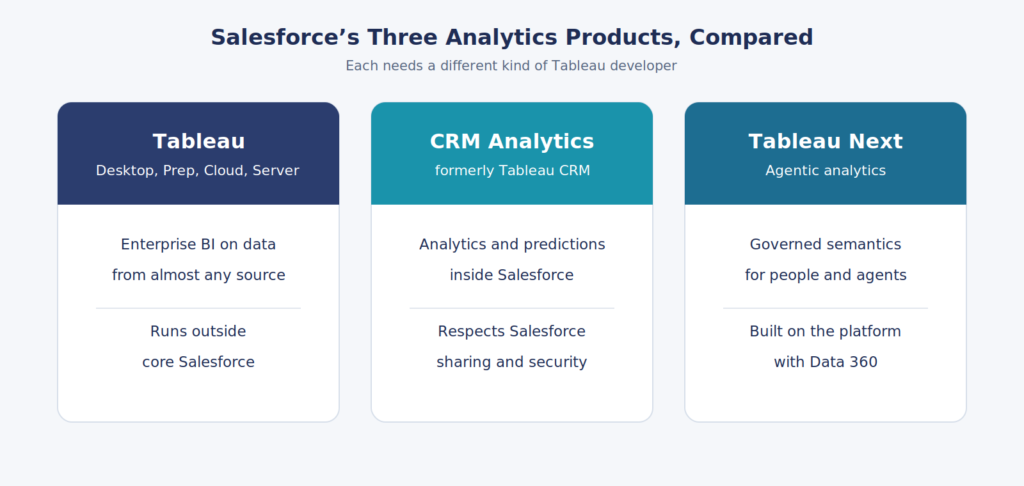
Three Analytics Products: Tableau, CRM Analytics, and Tableau Next
| Product | What it is | Where it runs | Typical user |
|---|---|---|---|
| Tableau (Desktop, Prep, Cloud, Server) | The established business intelligence platform for analyzing data from almost any source | Tableau Cloud or Tableau Server, separate from core Salesforce | Analysts and BI teams across the business |
| CRM Analytics | Salesforce-native analytics and predictions, formerly called Tableau CRM and Einstein Analytics | Inside Salesforce, on Salesforce data | Sales, service, and operations teams working in Salesforce |
| Tableau Next | Salesforce’s newer agentic analytics platform | Built on the Salesforce platform, with Data 360 as the data layer | Teams that want AI agents to work with governed business data |
Salesforce made Tableau Next generally available in April 2025. According to Salesforce’s Tableau Next page, it uses Data 360 as its unified data layer and Tableau Semantics, an AI-infused semantic layer, to give both people and agents consistent business definitions.
The older products are not going away. Tableau’s own FAQ says customers on Tableau Cloud, Tableau Server, or CRM Analytics will continue to be invested in, and Tableau Next can use data from all three.
For hiring, that means three overlapping but distinct talent pools. A classic Tableau developer may never have worked inside Salesforce. A CRM Analytics developer knows Salesforce data and security deeply but may not know Tableau Desktop. And Tableau Next experience is still new and scarce. Our Data 360 hiring guide covers the data layer underneath Tableau Next.
Which Analytics Role Do You Need?
| Your situation | Role to hire | What they do |
|---|---|---|
| Company-wide reporting from many data sources | Tableau developer | Build dashboards, prepare data with Tableau Prep, publish and govern content on Tableau Cloud or Server |
| Analytics inside Salesforce records and apps | CRM Analytics developer or CRM Analytics consultant | Build datasets and recipes from Salesforce data, design dashboards embedded in Salesforce, set up row-level security and predictions |
| Agentic analytics on governed data | Tableau Next developer | Build semantic models, metrics, and dashboards on Data 360, and connect insights to agents and Slack |
| A strategy across all three | Analytics architect | Decide which product serves which need, design the data layer, and set governance |
Many companies run more than one of these at once, so the strongest candidates can work across two. A common combination is classic Tableau for enterprise reporting plus CRM Analytics for dashboards inside Salesforce, with Tableau Next pilots on top.
If you are not sure which product your team will use in two years, an analytics architect or consultant on contract can help you decide before you commit to a permanent hire. Our guide to how to hire Salesforce architects covers the architect side.
5 Proven Skills of a Strong Tableau Developer
The same core skills apply whether a candidate works in Tableau, CRM Analytics, or Tableau Next. The tools differ, the judgment does not.
1. Data modeling and preparation
Good dashboards start with good data. Strong candidates can explain how they joined, cleaned, and shaped data, whether in Tableau Prep, CRM Analytics recipes, or Data 360, and why they made each choice.
2. Metric definitions and semantics
When sales and finance disagree on pipeline, the problem is usually definitions, not charts. Strong candidates have built governed, shared metrics, and in Tableau Next that means working with the semantic layer that agents rely on.
3. Dashboard design for decisions
The best dashboards answer a specific question for a specific person in a few seconds. Look for candidates who start from the decision, keep layouts simple, and remove anything that does not help.
4. Security and governance
Row-level security, permissions, certified data sources, and content governance keep the wrong people from seeing the wrong data. This is especially important for CRM Analytics, which must respect Salesforce sharing.
5. Performance and adoption
Slow dashboards do not get used. Strong candidates tune extracts, datasets, and queries, and they track whether people actually open what they built.
Useful extras include SQL, Python for data preparation, Einstein Discovery for predictions, Data 360, and experience surfacing insights through Agentforce or Slack. Our Salesforce skills list covers the broader platform skills.
Analytics Certifications
Each product has its own credentials, so read them by product:
| Product | Credential | What it signals |
|---|---|---|
| Tableau | Salesforce Certified Tableau Desktop Foundations | Entry-level Tableau Desktop skills |
| Tableau | Salesforce Certified Tableau Data Analyst | Working analyst skills across Tableau Desktop, Tableau Prep, and Tableau Cloud or Server |
| Tableau | Salesforce Certified Tableau Consultant | Turning business requirements into governed Tableau solutions |
| CRM Analytics | Salesforce Certified CRM Analytics and Einstein Discovery Consultant | Data, security, dashboards, and predictions in CRM Analytics |
| Tableau Next | No dedicated credential yet | Look for Data 360 Consultant and Agentforce Specialist alongside Tableau experience |
According to Salesforce Tutorial’s 2026 Tableau certification guide, the Tableau Data Analyst exam has no formal prerequisite but recommends at least six months of hands-on Tableau experience.
The CRM Analytics credential has gone by several names. As BigDataRise explains, its current name is Salesforce Certified CRM Analytics and Einstein Discovery Consultant, exam Analytics-Con-201, and older resumes may list it as the Tableau CRM and Einstein Discovery Consultant or the Einstein Analytics and Discovery Consultant. Treat those as the same credential. The same source notes that dashboards are only about a third of the exam, with the rest covering data, security, setup, and Einstein Discovery.
Verify Salesforce credentials on the credential verification page, and see our guide to the Salesforce certifications that matter when hiring for the wider picture.
What to Pay a Tableau or CRM Analytics Developer
Our 2027 Salesforce salary guide does not break out analytics as its own band, so use the closest Salesforce benchmarks as a guide:
| Role | Closest benchmark | US base range (2027) |
|---|---|---|
| CRM Analytics consultant | Mid-level to senior functional consultant | $100,000 to $160,000 |
| Tableau or CRM Analytics developer | Mid-level to senior developer or technical consultant | $110,000 to $175,000 |
| Analytics architect | Solution architect | $145,000 to $240,000 |
Classic Tableau developers who work outside the Salesforce ecosystem are often paid in line with general business intelligence roles, which vary widely by company and region. Candidates who combine Tableau with Salesforce data and security, or who have early Tableau Next and Data 360 experience, sit toward the top of these ranges because that combination is still uncommon.
Analytics work is often done on contract, especially for dashboard rebuilds and migrations. Our guide to Salesforce contractor rates puts developers at $100 to $170 an hour and technical consultants at $120 to $185.
How to Hire a Tableau Developer
Start with the product
State clearly which product the role uses today and which one you expect in two years. It is the fastest way to filter candidates and avoids hiring a classic Tableau expert into a CRM Analytics role, or the reverse.
Run a metric definition exercise
Give the candidate two conflicting definitions of the same metric, such as pipeline as sales defines it and as finance defines it. Ask how they would resolve the difference and build one trusted number. Strong candidates talk to both teams, document the definition, and build it once in a shared data source or semantic model.
Review a dashboard
Show a cluttered dashboard and ask what they would change. Strong candidates ask who uses it and for what decision, then remove more than they add.
Test security thinking
For CRM Analytics roles especially, ask how they would make sure a regional manager only sees their own region’s numbers. Listen for row-level security and testing as different users.
Ask about agents
For Tableau Next roles, ask how they would prepare data and definitions so an AI agent gives trustworthy answers. Candidates who understand that the semantic layer decides answer quality are ahead of many candidates.
Know where to look
Tableau developers often come from business intelligence teams across every industry. CRM Analytics developers usually come from Salesforce partners and in-house Salesforce teams. Our comparison of a Salesforce headhunter vs staffing vs placement agency explains which approach fits, and our guide to Salesforce digital labor shows how analytics fits into teams planning for AI agents.
Frequently Asked Questions
What does a Tableau developer do?
A Tableau developer prepares data, builds dashboards and reports in Tableau, and publishes and governs that content on Tableau Cloud or Tableau Server so people across the business can make decisions from trusted numbers.
What is the difference between Tableau and CRM Analytics?
Tableau is a business intelligence platform for analyzing data from almost any source, running on Tableau Cloud or Server. CRM Analytics is Salesforce-native analytics that runs inside Salesforce on Salesforce data, with built-in predictions. They need different skills.
What is Tableau Next?
Tableau Next is Salesforce’s agentic analytics platform, generally available since April 2025. It is built on the Salesforce platform, uses Data 360 as its data layer, and relies on a semantic layer called Tableau Semantics to give people and AI agents consistent business definitions.
What certification should a CRM Analytics developer have?
The Salesforce Certified CRM Analytics and Einstein Discovery Consultant credential, exam Analytics-Con-201. Older resumes may list it as Tableau CRM and Einstein Discovery Consultant or Einstein Analytics and Discovery Consultant.
How much does a Tableau developer earn?
It depends on whether the role sits inside the Salesforce ecosystem. Salesforce-focused Tableau and CRM Analytics developers generally benchmark at roughly $110,000 to $175,000 in US base salary from mid to senior level, while general business intelligence roles vary more widely.
Are Tableau and CRM Analytics being replaced by Tableau Next?
No. Tableau says it continues to invest in Tableau Cloud, Tableau Server, and CRM Analytics, and Tableau Next can use data from all three. Many companies will run more than one product for years.
Hire for Trusted Numbers
The best analytics hire is the person who makes everyone agree on the number, then makes it easy to see and act on. Know which product you run, test metric definitions and security judgment before chart design, and look ahead to Tableau Next and AI agents, which reward clean data and clear definitions above everything else.
Need to hire a Tableau developer or CRM Analytics consultant? Talk to our Salesforce recruiters. We find analytics specialists who build trusted metrics and dashboards people use, and we can tell you what the role costs in today’s market.