Marketing says the leads are good. Sales says they are not. Nobody can explain why a prospect who downloaded three whitepapers never reached a rep, the scoring model was built by someone who left two years ago, and half the Engagement Studio programs are still running for products you no longer sell.
That is usually the moment a company starts looking for a Pardot consultant. Pardot, now officially Marketing Cloud Account Engagement, is Salesforce’s B2B marketing automation platform, and when it is set up well it is the bridge between marketing activity and sales pipeline.
Hiring for it has become more confusing. The product has a new name, a newer sibling called Marketing Cloud Next, and a consultant certification that retires in February 2027. This guide explains where the product stands, which role you need, how to read the certifications, the five skills that matter most, what to pay, and how to assess candidates.
Table of Contents
Pardot, Account Engagement, and Marketing Cloud Next
Salesforce renamed Pardot to Marketing Cloud Account Engagement in 2022, as Salesforce Ben reported at the time. Most people still call it Pardot, and job seekers and hiring managers search for both names.
The product is still very much alive. Couch & Associates’ explainer on Pardot in 2026 notes that Marketing Cloud Account Engagement remains fully supported, with no announced end of life or forced migration.
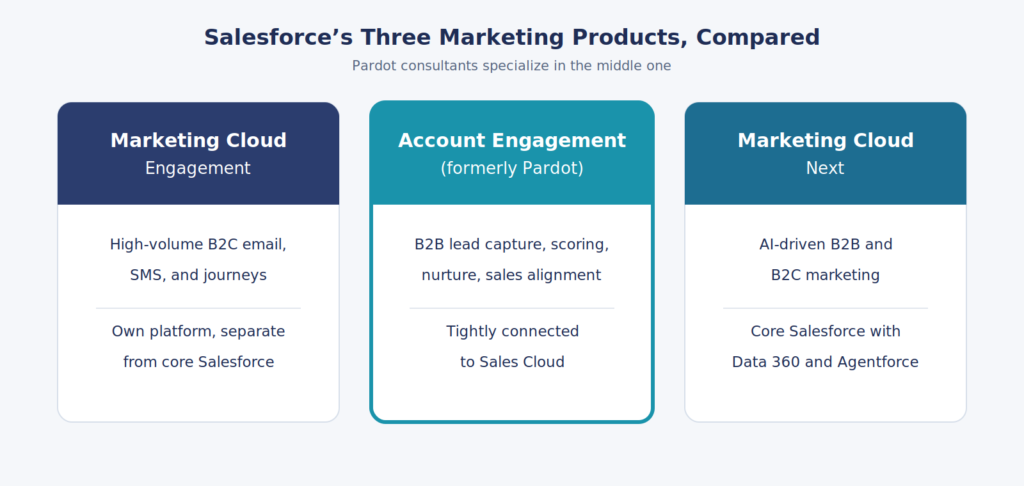
What has changed is the product around it. Salesforce now sells three different marketing products, and candidates often specialize in one:
| Product | Built for | Runs on |
|---|---|---|
| Marketing Cloud Engagement | High-volume B2C email, SMS, and journeys | Its own platform, separate from core Salesforce |
| Marketing Cloud Account Engagement (formerly Pardot) | B2B lead capture, scoring, nurture, and sales alignment | Tightly connected to Sales Cloud |
| Marketing Cloud Next | AI-driven marketing for B2B and B2C | Core Salesforce, with Data 360 and Agentforce |
According to Minuscule Technologies’ 2026 comparison, Account Engagement’s newer plus editions include Marketing Cloud Next features and Agentforce campaign creation, so many Pardot customers can adopt the newer tools without a full migration.
For hiring, this means a strong Pardot consultant today needs deep Account Engagement skills and at least a working understanding of where Marketing Cloud Next fits. If you are hiring for the B2C product instead, our guide to how to hire a Marketing Cloud developer covers that role.
Pardot Admin vs Pardot Consultant vs Pardot Developer
Three roles cover most Account Engagement work. Companies often say “Pardot consultant” when they mean one of the other two, so be clear about which one you need.
| Role | What they do | Right for |
|---|---|---|
| Pardot admin or specialist | Runs the platform day to day: emails, forms, lists, Engagement Studio programs, campaigns, and reporting | Marketing teams that need steady, hands-on execution |
| Pardot consultant | Designs or redesigns the lead lifecycle, scoring and grading, the Salesforce connector, and reporting; runs implementations and audits | New implementations, broken setups, or a move toward Marketing Cloud Next |
| Pardot developer | Builds email and landing page templates with HTML, CSS, and Handlebars merge language, form handlers, and API integrations | Teams with heavy design, template, or integration needs |
Many companies need a skilled Pardot admin for daily work and a Pardot consultant for design projects, often on contract. A dedicated developer is usually only worth hiring when you have a high volume of custom templates or integrations with other systems.
When you search to hire a Pardot developer, look closely at what candidates have built. The title covers everyone from template builders to engineers who integrate Account Engagement with data warehouses and other marketing tools.
Account Engagement Certifications and the 2027 Retirement
Two credentials have traditionally signaled Pardot skill:
- Marketing Cloud Account Engagement Specialist, aimed at hands-on admins who build emails, forms, automation, and reports.
- Marketing Cloud Account Engagement Consultant, aimed at people who design and implement the platform for a business.
The Account Engagement Consultant certification is on Salesforce’s list of credentials retiring on February 1, 2027, as Salesforce Time’s summary of the 2026 changes shows. Retired certifications stay valid. They simply cannot be earned after that date. MarCloud Consulting, a Pardot specialist firm, points out that the retirement does not mean the skill set or the demand has disappeared.
Three practical points for hiring:
- A candidate with the Account Engagement Consultant certification still holds a valid, meaningful credential. Do not discount it.
- New consultants entering the field cannot earn it after February 2027, so for future hires you will lean more on project history.
- Check the current status of the Account Engagement Specialist credential on Trailhead before you make it a hard requirement, and consider the Agentforce Specialist certification as a useful extra for candidates who will work with Marketing Cloud Next or Agentforce campaign tools.
Verify any credential on Salesforce’s credential verification page. Our guide to the Salesforce certifications that matter when hiring covers the rest of the 2026 changes.
5 Essential Skills in a Strong Pardot Consultant
1. Lead lifecycle design
The best Pardot consultants start with the lifecycle, not the tool: how a prospect becomes a marketing qualified lead, when it goes to sales, and what happens if sales rejects it. Ask candidates to draw one they designed.
2. Scoring and grading that sales trusts
Scoring measures interest. Grading measures fit. Strong candidates can explain how they set thresholds, how they checked the model against closed deals, and how they changed it when sales pushed back.
3. Engagement Studio and nurture programs
Look for people who build nurture programs around buyer stages, test them, and retire them when they stop working. A long list of programs is not a skill. A clean, measured set is.
4. Salesforce connector and data hygiene
Many Pardot problems are really sync problems. A strong consultant understands the Salesforce connector, field sync behavior, lead and contact matching, duplicates, and campaign influence reporting so marketing gets credit for pipeline.
5. Compliance and deliverability
Consent management, unsubscribe handling, email authentication, and sending reputation all affect whether emails reach inboxes. Candidates should be comfortable with privacy rules such as GDPR and CAN-SPAM and know how Account Engagement supports them.
Useful extras include HTML and CSS for templates, Handlebars merge language, B2B Marketing Analytics, and familiarity with Marketing Cloud Next and Agentforce campaign tools. Our Salesforce skills list covers the broader platform skills that sit alongside these.
What to Pay a Pardot Consultant or Admin
Our 2027 Salesforce salary guide does not break out Account Engagement as its own band, so use the closest admin and consultant ranges as benchmarks:
| Role | Closest benchmark | US base range (2027) |
|---|---|---|
| Pardot admin or specialist | Mid-level to senior Salesforce administrator | $90,000 to $140,000 |
| Pardot consultant | Senior functional consultant | $125,000 to $160,000 |
| Lead consultant or marketing operations architect | Principal functional consultant | $155,000 to $195,000 |
Two things move an offer. Candidates who have connected Pardot activity to closed revenue, through clean campaign influence and attribution reporting, are worth more than those who only run campaigns. And candidates with Marketing Cloud Next or Agentforce marketing experience are still scarce.
Be aware that some companies place Pardot roles in marketing pay bands rather than Salesforce bands. Those offers often land lower, which can push experienced Pardot consultants toward consulting partners.
Contract work is common for implementations and audits. Our guide to Salesforce contractor rates puts administrators at $75 to $135 an hour and functional consultants at $105 to $160, which are reasonable benchmarks for Pardot contractors.
How to Assess and Hire a Pardot Consultant
Run an audit scenario
Describe a real problem: “Sales says marketing leads are poor quality. Our scoring model is three years old, and about 30% of prospects never sync to Salesforce.” Ask how the candidate would investigate. Strong candidates check the lifecycle definitions, the scoring and grading rules, connector settings and sync errors, and what sales actually means by “poor quality” before changing anything.
Ask them to draw a lead lifecycle
Give five minutes and a whiteboard. A clear lifecycle with stages, handoff rules, and a recycle path for rejected leads tells you more than an hour of questions.
Test a sync problem
Ask why a prospect might not appear in Salesforce, or why a field value keeps reverting. Candidates who know the connector, sync behavior, and field-level rules answer quickly. Others guess.
Include sales
Have a sales leader spend 20 minutes with the candidate. A Pardot consultant who cannot talk comfortably with sales will struggle to fix the alignment problem you are hiring them for.
Know where to look
Strong candidates often come from Salesforce partners with marketing practices, from marketing operations teams at B2B software and services companies, and from experienced admins who specialized in marketing. Many are employed and not applying, so a targeted search usually works better than a posting. Our comparison of a Salesforce headhunter vs staffing vs placement agency explains which approach fits, and our guide to how to hire a Salesforce consultant covers consultant hiring more broadly.
Frequently Asked Questions
Is Pardot still a Salesforce product?
Yes. Pardot was renamed Marketing Cloud Account Engagement in 2022 and remains Salesforce’s supported B2B marketing automation platform, with no announced end of life.
What does a Pardot consultant do?
A Pardot consultant designs and implements Marketing Cloud Account Engagement for a business: the lead lifecycle, scoring and grading, nurture programs, the Salesforce connector, and reporting that ties marketing activity to pipeline.
What is the difference between Pardot and Marketing Cloud Next?
Pardot, now Account Engagement, is the established B2B marketing automation product tightly connected to Sales Cloud. Marketing Cloud Next is Salesforce’s newer AI-driven marketing product built on the core platform with Data 360 and Agentforce. Some Account Engagement editions now include Marketing Cloud Next features.
Is the Pardot consultant certification being retired?
Yes. The Marketing Cloud Account Engagement Consultant certification retires on February 1, 2027. Holders keep a valid credential, but it can no longer be earned after that date.
How much does a Pardot consultant earn?
There is no separate market band. Pardot consultants generally benchmark against senior functional consultants, roughly $125,000 to $160,000 in US base salary, with Pardot admins at about $90,000 to $140,000.
Should I hire a Pardot admin or a Pardot consultant?
Hire an admin for steady, day-to-day execution. Bring in a consultant, often on contract, to design or fix the lead lifecycle, scoring, sync, and reporting, or to plan a move toward Marketing Cloud Next.
Hire for the Pipeline, Not Just the Platform
A good Pardot consultant makes marketing and sales agree on what a good lead is, and then proves it in the numbers. The product has a new name and a new sibling, and its consultant certification is retiring, but the skills behind a well-run Account Engagement org are as valuable as ever. Hire for lifecycle design, scoring that sales trusts, clean sync, and reporting tied to revenue.
Need to hire a Pardot consultant or Account Engagement admin? Talk to our Salesforce recruiters. We find marketing automation specialists who have connected campaigns to closed deals, and we can tell you what the role costs in today’s market.