The VP of Marketing needed someone to fix a broken welcome journey and stand up a new preference center before the holiday campaigns. IT sent over a strong Salesforce developer from the sales operations team. He knew Apex and Lightning Web Components. He had never written AMPscript, never queried a data extension, and never heard of a sender authentication package. The holiday campaigns went out late.
Marketing Cloud looks like part of Salesforce, and in many ways it runs as its own platform, with its own languages, data model, and deliverability rules. The skills that make someone a great core Salesforce developer do not transfer automatically.
This guide explains how to hire a Marketing Cloud developer or consultant: which Marketing Cloud you actually run, the roles and skills to look for, the certification changes Salesforce made in 2026, what to pay, and how to test candidates before you make an offer.
Table of Contents
Why Hiring a Marketing Cloud Developer Is Different
“Marketing Cloud” covers several different products, and the right candidate depends on which one you run. Confirm this before you write the job description.
| Product | What it does | Who usually runs it |
|---|---|---|
| Marketing Cloud Engagement | Email, SMS, and mobile messaging, Journey Builder, Automation Studio, and Contact Builder | B2C marketing teams sending at scale |
| Marketing Cloud Account Engagement (formerly Pardot) | B2B marketing automation, lead scoring and grading, sync with Sales Cloud | B2B marketing and sales operations teams |
| Marketing Cloud Next | Salesforce’s newer marketing offering, built on Data 360 and Agentforce | Teams consolidating marketing data on the core platform |
| Personalization and Intelligence | Real-time web personalization and marketing analytics | Digital and analytics teams |
Most searches for Marketing Cloud help are really about Marketing Cloud Engagement, the long-established platform behind most large email programs. It has its own scripting language (AMPscript), its own server-side JavaScript, SQL-based data handling, and its own way of identifying subscribers. A core Salesforce developer can learn it, but not in the first month of a project.
The buyer is often different too. Marketing Cloud roles are frequently owned by marketing leaders rather than IT, which means the hiring manager may not know what to test for. The rest of this guide is written so a marketing leader and a Salesforce owner can run the search together.
Marketing Cloud Developer vs Consultant vs Specialist
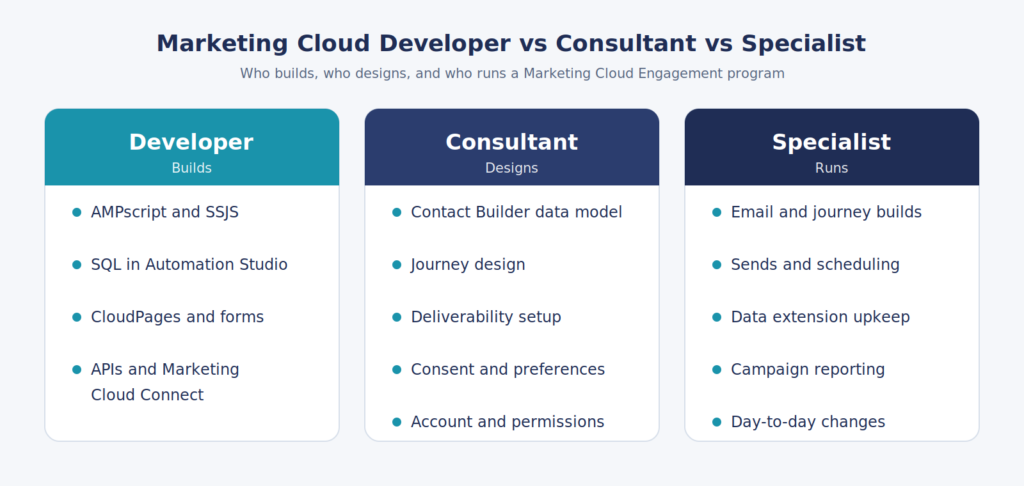
Three roles cover most Marketing Cloud Engagement work. Many small teams need one person who blends two of them, so decide which is primary.
Marketing Cloud developer
This role builds the dynamic, data-driven parts of the program.
- AMPscript for personalized email, SMS, and landing page content. An AMPscript developer is the most common request.
- Server-side JavaScript for more complex logic and API calls.
- SQL queries in Automation Studio to build segments and transform data in data extensions.
- CloudPages for preference centers, forms, and landing pages.
- APIs and integrations, including Marketing Cloud Connect with Sales or Service Cloud and custom Journey Builder activities.
Marketing Cloud consultant
A Marketing Cloud consultant designs how the platform should work for your business.
- Data model design in Contact Builder, including how subscribers are identified across channels.
- Journey design that matches the customer lifecycle.
- Account setup, business units, roles, and permissions.
- Deliverability setup, including sender authentication and IP warming plans.
- Consent and preference management that meets privacy rules such as CAN-SPAM and GDPR.
Marketing Cloud specialist or admin
A specialist runs the program day to day: building emails and journeys, managing sends, maintaining data extensions, and reporting on results. This is usually the first Marketing Cloud hire for a smaller team.
If you run Account Engagement instead, look for B2B experience: lead scoring and grading, engagement programs, and a clean sync with Sales Cloud. Our Salesforce skills list covers the core platform skills that sit alongside these.
Marketing Cloud Certifications in 2026 and 2027
Salesforce made significant changes to Marketing Cloud credentials this year, and resumes will show a mix of old and new names for a while.
| Credential | Status | What it means for hiring |
|---|---|---|
| Marketing Cloud Email Specialist | Renamed Marketing Cloud Engagement Specialist on July 24, 2026 | Same credential. Accept either name |
| Marketing Cloud Developer | Continuing | Still the main signal for developer roles |
| Marketing Cloud Consultant | Continuing | Still the main signal for consultant roles |
| Marketing Cloud Account Engagement Consultant | Retiring February 1, 2027 | Still valid until then. Weigh B2B project experience more heavily |
| Marketing Cloud Advanced Cross Channel, Intelligence, and Personalization Accredited Professionals | Retiring February 1, 2027 | Rely on demonstrated project work instead |
The rename is confirmed in Salesforce’s certification name changes FAQ. Salesforce Time’s summary of the changes explains the retirement timeline: registration for retiring exams closed on July 24, 2026, the last exams were taken by August 31, 2026, and the credentials remain valid until February 1, 2027.
For hiring, the practical rule is simple. A current Marketing Cloud Developer or Consultant certification is a useful filter. A retiring credential still shows real study, so do not discount it. In every case, verify credentials on Salesforce’s credential verification page, then test the skills directly. Our guide to the Salesforce certifications that matter when hiring covers the wider credential landscape.
What to Pay a Marketing Cloud Developer or Consultant
Our 2027 Salesforce salary guide does not break out Marketing Cloud separately, so use the closest core Salesforce bands as your benchmark:
| Marketing Cloud role | Closest benchmark | US base range (2027) |
|---|---|---|
| Marketing Cloud specialist or admin | Salesforce administrator, mid to senior | $90,000 to $140,000 |
| Marketing Cloud developer | Salesforce developer, mid to senior | $110,000 to $175,000 |
| Marketing Cloud consultant | Functional consultant, mid to senior | $100,000 to $160,000 |
| Senior Marketing Cloud consultant or architect | Senior consultant or solution architect | $125,000 to $170,000+ |
Within those bands, a few things push an offer higher: a developer who handles both AMPscript and SQL at volume, real deliverability experience on large sending programs, Marketing Cloud Connect integration work with Sales or Service Cloud, and experience with Data 360 or Marketing Cloud Next as companies consolidate marketing data onto the core platform.
Contract Marketing Cloud work is common for migrations, re-platforming, and seasonal peaks. Salesforce developer contract rates in the guide run $100 to $170 an hour, which is a reasonable starting point for experienced Marketing Cloud contractors. Our comparison of contract vs full-time Salesforce hires helps you decide which fits.
How to Assess a Marketing Cloud Developer or Consultant
Marketing Cloud skills are easy to claim and easy to test. Use short, practical questions drawn from your own program.
For developers
- AMPscript review. Show a short personalized email block and ask what happens when a field is empty, and how they would make lookups efficient at high volume.
- SQL segmentation. Ask how they would build a segment of subscribers who opened in the last 90 days but have not purchased. Strong candidates mention the right data extensions and Marketing Cloud’s system data views for opens and sends.
- Integration. Ask how Marketing Cloud Connect syncs data with Sales or Service Cloud, and what breaks most often.
For consultants
- Subscriber identity. Ask how they would define the subscriber key across email and SMS. A strong answer uses a stable unique ID rather than the email address, and explains why.
- Deliverability. Ask how they would set up a new sending domain and a new IP. Listen for sender authentication, SPF, DKIM, and DMARC, and a gradual IP warming plan.
- Journey design. Give a scenario, such as a welcome series or abandoned cart journey, and ask about entry and exit rules, suppression, and how they would measure success.
For everyone
Have the candidate spend 30 minutes with someone from marketing who will use their work. Marketing Cloud people who can talk about campaigns and customers, not only data extensions, are the ones who make programs better.
For broader interview structure, see our Salesforce interview questions. For core platform developer roles, our guide to hiring Salesforce developers covers the Apex and LWC side.
Where to Find Marketing Cloud Talent and Who Should Run the Hire
Run the search as a pair
The strongest Marketing Cloud hires come from searches run jointly by a marketing leader and whoever owns Salesforce. Marketing knows the campaigns, customers, and results that matter. The Salesforce owner knows the data, integrations, and security standards. A search run by only one side usually misses half the job.
Look where Marketing Cloud work happens
- Consulting partners and agencies with dedicated Marketing Cloud practices, where developers and consultants see many programs.
- In-house teams at large B2C senders, such as retail, travel, media, financial services, and consumer brands.
- The Salesforce community, including marketer-focused groups and events.
- A specialist Salesforce recruiter who can separate true Marketing Cloud specialists from core Salesforce developers with Marketing Cloud on their resume.
Choose the right engagement
Permanent hires suit ongoing programs. Contract work fits migrations, re-platforming, and peak seasons. Template and email builds are often well-defined enough for a nearshore or offshore team, while strategy, data model, and deliverability are better kept close to the business, as our guide to offshore Salesforce developers explains. For senior or hard-to-fill roles, our comparison of a Salesforce headhunter vs staffing vs placement agency shows which recruiting model fits.
Frequently Asked Questions
What does a Marketing Cloud developer do?
A Marketing Cloud developer builds the dynamic parts of a Marketing Cloud program: AMPscript and server-side JavaScript for personalized content, SQL queries for segmentation, CloudPages such as preference centers, and integrations including Marketing Cloud Connect and custom journey activities.
What is the difference between a Marketing Cloud developer and a Marketing Cloud consultant?
A Marketing Cloud consultant designs how the platform should work, including the data model, journeys, account setup, deliverability, and consent. The developer builds the code and data logic that makes that design work. Smaller teams often need one person who can do some of both.
Can a regular Salesforce developer work on Marketing Cloud?
They can learn it, but Marketing Cloud Engagement uses different languages and a different data model from core Salesforce. Expect a ramp-up period, and hire someone with direct Marketing Cloud experience if you have deadlines.
What happened to the Marketing Cloud Email Specialist certification?
Salesforce renamed it Marketing Cloud Engagement Specialist on July 24, 2026. It is the same credential, so accept either name on a resume.
Which Marketing Cloud certifications are retiring?
The Marketing Cloud Account Engagement Consultant certification and the Marketing Cloud Advanced Cross Channel, Intelligence, and Personalization Accredited Professional credentials retire on February 1, 2027. They remain valid until then.
How much does a Marketing Cloud developer cost?
Marketing Cloud developers generally benchmark against Salesforce developer pay, roughly $110,000 to $175,000 in US base salary at mid to senior levels in 2027, with contract rates of about $100 to $170 an hour.
Hire for the Marketing Cloud You Actually Run
A strong Marketing Cloud developer or consultant speaks two languages: the technical one of AMPscript, SQL, and data extensions, and the marketing one of journeys, audiences, and results. Confirm which Marketing Cloud you run, accept both old and new certification names, test the skills that matter for your program, and run the search with marketing and your Salesforce owner side by side.
Need a Marketing Cloud developer or consultant? Talk to our Salesforce recruiters. We separate true Marketing Cloud specialists from core Salesforce candidates before you see a resume.