
Your account executive has a great relationship with the buyer. Then the buyer’s architect joins the call, asks how your product handles data residency and whether it can run an agent across two orgs, and the deal stalls while everyone waits for “someone technical” to follow up next week.
That someone is a Salesforce solution engineer, or at a consulting partner, often a Salesforce solution consultant. Pre-sales is one of the most valuable and most confusing hiring areas in the Salesforce ecosystem, because the same titles mean different jobs at different companies.
This guide explains what each title usually means, how pre-sales roles differ from delivery consultants and forward deployed engineers, the five skills that win deals, how pay works with base and variable compensation, and how to assess candidates with a demo round.
Table of Contents
What the Titles Mean, and Why They Get Confused
The confusion comes from who is doing the hiring.
- At Salesforce itself, and at many software companies selling on the AppExchange, a Salesforce solution engineer is a pre-sales role. They partner with account executives to understand a prospect’s needs, build and deliver tailored demos, answer technical questions, and secure the “technical win” that lets the deal close. Salesforce also hires specialist solution engineers for products such as Agentforce, Data 360, and industry clouds, and partner solution engineers who work with consulting firms.
- At consulting partners, a Salesforce solution consultant is often also pre-sales: scoping a project, designing a high-level solution, estimating effort, and helping write the statement of work. But some partners use “solution consultant” for a delivery role that builds the solution after the sale.
- At end customers, the titles are rarer, and “solution consultant” usually means an internal consultant or business analyst, not pre-sales.
The practical rule: before you post a job or read a resume, check whether the role sits before or after the contract is signed. Salesforce presales roles are measured on deals won. Delivery roles are measured on projects delivered.
Solution Engineer vs Solution Consultant vs Delivery Consultant vs Forward Deployed Engineer
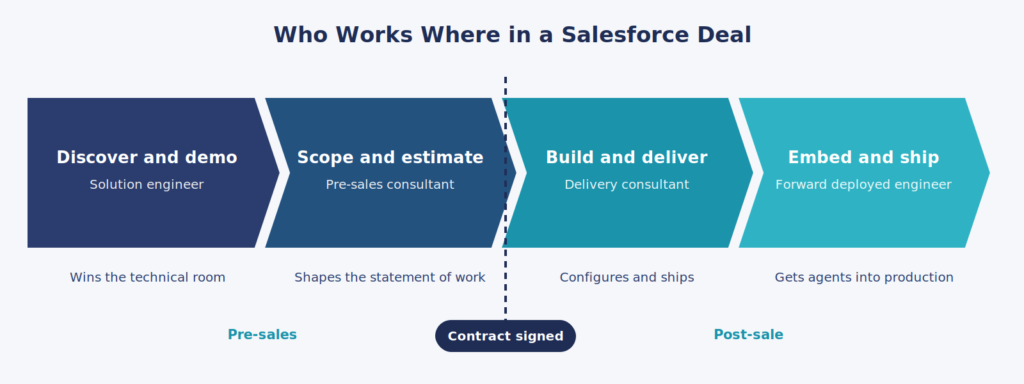
Four roles cover the life of a Salesforce deal. Each is measured on something different.
| Role | When they work | What they do | Measured on |
|---|---|---|---|
| Salesforce solution engineer (vendor or ISV) | Before the sale | Discovery, tailored demos, technical questions, security reviews | Deals won and the technical win |
| Pre-sales solution consultant (partner) | Before the contract | Scoping, high-level design, estimates, statement of work | Projects won at a healthy margin |
| Delivery consultant | After the contract | Requirements, configuration, and delivery | Projects delivered on time and on budget |
| Forward deployed engineer | After the sale, embedded with the customer | Building and shipping the production solution, often AI agents | A working solution in production |
The roles share skills, and people move between them. Strong delivery consultants often become excellent pre-sales consultants because they know what is realistic to promise. Solution engineers who want to build more hands-on often move toward forward deployed engineering, which our guide to the forward deployed engineer explains. For the delivery side, see our guide to how to hire a Salesforce consultant.
5 Proven Skills of a Strong Salesforce Solution Engineer
1. Discovery
The best solution engineers spend the first meeting asking, not showing. They uncover the business problem, who feels it, what it costs, and what success looks like. Every later demo is built on that discovery.
2. Demo storytelling
A strong demo follows the buyer’s day, not the product menu. Look for candidates who build a short story around two or three of the prospect’s real pains and show only what solves them.
3. Building demos fast
Solution engineers build their own demo environments: custom objects, sample data, flows, dashboards, and increasingly working Agentforce agents. Speed and breadth across the platform matter more than depth in any single feature.
4. Handling technical objections
Security questionnaires, integration questions, data residency, and “how does this scale” all land on the solution engineer. Strong candidates answer honestly, know when to bring in an architect, and never promise what the product cannot do.
5. Commercial judgment
Great solution engineers understand how the deal works: who signs, what the competition is offering, and when to stop demoing and start closing. They work as a true partner to the account executive.
Platform credentials help. Many solution engineers hold the Salesforce Administrator, Platform App Builder, and Agentforce Specialist certifications, and some hold architect credentials. Our Salesforce skills list covers the broader platform skills, and our guide to the Agentforce specialist role covers the AI skills solution engineers now need to demo.
Salesforce Solution Engineer Salary: Base, Variable, and OTE
Salesforce solutions engineer pay, like other pre-sales pay, works differently from delivery pay. Most solution engineers earn a base salary plus variable pay tied to sales results. The total at 100% of target is called on-target earnings, or OTE.
Across the wider market, SalesEngineerSalary.com’s 2026 data puts the median US solutions engineer base at $155,000, with modeled median OTE of about $219,000, and describes a typical pre-sales split of about 70% base and 30% variable.
Salesforce’s own postings give useful anchors for base pay alone:
| Salesforce role | Typical US base range | California, New York, and select metros |
|---|---|---|
| Solution Engineer Specialist, Agentforce | $134,750 to $180,250 | $148,190 to $198,170 |
| Senior Partner Solution Engineer | $150,100 to $227,000 | $180,200 to $247,900 in select San Francisco and New York areas |
Both postings note that the range excludes bonus, sales incentives, and equity.
At consulting partners, pre-sales solution consultants are usually paid more like senior consultants or solution architects, with a larger base and a smaller bonus. Our 2027 Salesforce salary guide puts solution architects at $145,000 to $240,000 in base salary, and notes that architects with pre-sales responsibility earn materially more than those without.
When you hire, be clear about the split, how the variable part is measured, and whether it is tied to individual deals or team results. Vague variable plans can lead strong candidates to turn down pre-sales offers.
How to Hire a Salesforce Solution Engineer: The Demo Round
The single best assessment for pre-sales is a realistic demo round. Here is a format that works.
Send a short brief a few days ahead
Describe a fictional prospect: industry, size, two or three business problems, the systems they use today, and who will attend the meeting. Keep it to a page.
Run a 15-minute discovery call first
Have someone play the buyer. Strong candidates use this time to confirm priorities, uncover a problem the brief did not mention, and adjust their plan. Weak candidates skip discovery and go straight to slides.
Then a 30-minute demo
Ask the candidate to show how Salesforce, or your product, solves the problems they heard. Judge whether the story follows the buyer’s day, whether they show only what matters, and how they recover when something does not work.
Throw in two objections
Halfway through, have the “buyer’s architect” ask a hard technical question and the “CFO” question the cost. Listen for honest answers, clear next steps, and no overpromising.
Check references with account executives
Ask former sales partners how the candidate helped them win, and what happened when a deal went badly. Solution engineers are only as good as their partnership with sales.
Our Salesforce interview questions cover more technical questions you can add to the loop.
Where to Find Salesforce Presales Talent, and Where It Leads
Common backgrounds
Strong Salesforce solution engineers and pre-sales consultants usually come from one of four places:
- Delivery consultants who have scoped enough projects to know what is realistic, and who enjoy presenting.
- Senior admins and platform owners who can build demos quickly and explain business value.
- Solution architects who want more client-facing, deal-focused work.
- Pre-sales engineers from other enterprise software companies who learn the Salesforce platform.
Career paths
Pre-sales often leads to solution engineering leadership, enterprise or principal solution engineer roles, or back into architecture with a stronger commercial edge. Some solution engineers move into forward deployed engineering to build what they used to demo. Our guide to the Salesforce career path from admin to architect shows how these routes connect.
Searching for them
The best pre-sales people are rarely job hunting. They are usually employed, well paid, and in demand at vendors, ISVs, and partners. A targeted search with a recruiter who understands both the platform and the sales motion usually works better than a posting. Our comparison of a Salesforce headhunter vs staffing vs placement agency explains which approach fits.
Frequently Asked Questions
What does a Salesforce solution engineer do?
A Salesforce solution engineer is a pre-sales role. They work with account executives to understand a prospect’s business needs, build and deliver tailored demos, answer technical and security questions, and secure the technical win that helps a deal close.
What is the difference between a solution engineer and a solution consultant?
At Salesforce and software vendors, solution engineer usually means pre-sales demos and technical selling. At consulting partners, solution consultant often means pre-sales scoping, estimating, and solution design, though some partners use the title for delivery roles. Check whether the role works before or after the contract is signed.
How much does a Salesforce solution engineer make?
Base pay in Salesforce’s own postings ranges from roughly $135,000 to $227,000 depending on level, and higher in major metros, before bonus, sales incentives, and equity. Across the wider market, median solutions engineer base pay is about $155,000, with median on-target earnings of about $219,000.
What skills does a Salesforce solution engineer need?
Discovery, demo storytelling, building demo environments quickly, handling technical and security objections, and commercial judgment. Broad platform knowledge, including Agentforce, matters more than deep expertise in one feature.
How do you interview a Salesforce solution engineer?
Use a demo round: send a short prospect brief, run a brief discovery call, ask for a 30-minute tailored demo, introduce a technical and a commercial objection, and check references with account executives the candidate has worked with.
Is a solution engineer the same as a forward deployed engineer?
No. A solution engineer works before the sale to win the deal. A forward deployed engineer works after the sale, embedded with the customer, building the production solution.
Hire the Person Who Wins the Technical Room
A great Salesforce solution engineer turns a promising conversation into a signed deal by making the buyer’s technical team confident. Be clear whether the role is pre-sales or delivery, test it with a realistic demo round, and put a clear, fair variable plan in the offer.
Need to hire a Salesforce solution engineer or pre-sales consultant? Talk to our Salesforce recruiters. We find pre-sales talent who can build a demo, handle the architect in the room, and help your team close, and we can tell you what the role pays in today’s market.