
The job posting said “Salesforce Architect.” The hiring manager wanted someone to redesign a tangled org with four integrations and a looming Data 360 rollout. The recruiter sent a strong solution architect who had spent five years running discovery workshops. Two interviews in, both sides realized they were talking about different jobs.
That mismatch is common, and it is expensive. Architects are the hardest Salesforce roles to fill and the most costly to get wrong. Before you hire Salesforce architects, you need to know which kind you need: a solution architect, a technical architect, or, for the most complex orgs, a Certified Technical Architect.
To help you hire Salesforce architects well, this guide compares the three, shows which one fits your situation, explains the certifications behind them, sets out what to pay in 2027, and covers how to assess and close candidates in a market where they hold most of the leverage.
Table of Contents
Salesforce Solution Architect vs Technical Architect vs CTA
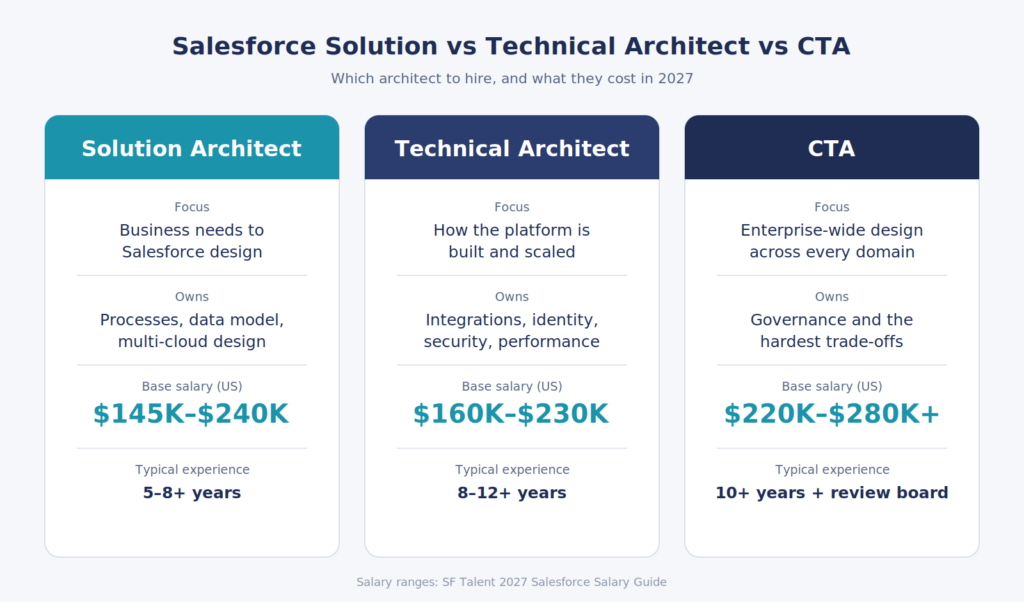
All three carry the architect title, but they solve different problems. Companies that hire Salesforce architects without separating them often end up with the wrong one.
| Solution architect | Technical architect | Certified Technical Architect (CTA) | |
|---|---|---|---|
| Core focus | Translating business needs into a Salesforce design | How the platform is built, secured, integrated, and scaled | Enterprise-wide design across every domain |
| Works most with | Business leaders, BAs, consultants | Developers, enterprise architects, security teams | Executives, other architects, the whole delivery team |
| Typical background | Senior consultant or BA, often from a consulting partner | Senior developer or integration specialist | Years as a technical architect on large, complex orgs |
| Owns | Multi-cloud solution design, data model, declarative vs code decisions | Integrations, identity, security, environments, performance at scale | Final architectural judgment, governance, and the hardest trade-offs |
| Typical experience | 5 to 8+ years | 8 to 12+ years | 10+ years, plus the CTA review board |
The simplest way to remember it: a solution architect designs what Salesforce should do for the business, a technical architect designs how it will work under real-world load and complexity, and a CTA has proved they can do both across an entire enterprise.
You will also see specialist titles, such as data architect, integration architect, and increasingly Agentforce or AI architect. These usually sit within technical architecture, focused on one domain.
Demand is strong across all three. In Salesforce Ben’s analysis of 10K’s ecosystem data, technical architect demand grew 27% and solution architect demand grew 21%, while technical architect supply grew only 4%.
Which Salesforce Architect Does Your Org Need?
Before you hire Salesforce architects, start from the problem you need solved.
| Your situation | Hire | Why |
|---|---|---|
| Rolling out a new cloud or redesigning sales and service processes | Solution architect | The hard part is fitting Salesforce to how the business works |
| Several integrations, an ERP connection, or performance problems | Technical architect | The hard part is how systems connect and scale |
| Data 360 or Agentforce program touching sensitive data | Technical architect, often with data or AI focus | Data access, identity, and trust controls drive the design |
| A consulting partner selling complex multi-cloud deals | Solution architect with pre-sales experience | They design during the sale, not just after it |
| Multiple orgs, thousands of users, regulated data, many teams shipping | CTA or senior technical architect | Enterprise governance and the toughest trade-offs |
| A mid-sized org with one admin and growing ambitions | Solution architect, or a senior admin growing into the role | A CTA would be underused and hard to keep |
Two mistakes come up most often. The first is hiring a solution architect for a technical problem, which leaves integrations and security designed by people who are not specialists. The second is hiring a CTA for a mid-sized org that does not need one. They will be bored within a year, and you will be paying top-of-market rates for work a strong solution architect could do.
If your org does not need a full-time architect yet, a contract architect for a defined design phase is often the better choice. Our comparison of contract vs full-time Salesforce hires covers when that makes sense, and our guide to structuring your Salesforce team shows when an org grows into needing one.
Salesforce Architect Certifications and the CTA Path
Salesforce’s architect credentials form a pyramid. Salesforce Ben’s architect certification guide describes it as specialist certifications at the base, domain architects in the middle, and the CTA at the top.
- Application Architect covers the business-facing side of the platform, including data architecture and sharing and visibility. It maps most closely to solution architect work.
- System Architect covers the technical foundations, including integration, identity and access management, and the development lifecycle. It maps most closely to technical architect work.
- Salesforce Certified Technical Architect sits on top. According to Salesforce’s CTA credential page, candidates need both the Application Architect and System Architect credentials, then must pass the Architect Review Board Evaluation followed by the Architect Review Board Exam, where they present a solution to a panel of existing CTAs.
What this means when you hire Salesforce architects: Application Architect or System Architect is a strong signal that a candidate has studied the right domain. It is not proof they have designed a large org. The Salesforce Certified Technical Architect credential is different, because the review board tests live judgment on a complex scenario. It is rare, and it commands a real premium.
Do not make CTA a requirement unless your org genuinely needs it. Many excellent technical architects hold Application Architect and System Architect without having sat the review board, and they got there by owning large, complex systems. Verify any credential a candidate lists on Salesforce’s credential verification page, and see our guide to the certifications that matter when hiring for the rest of the credential landscape.
Salesforce Architect Salary: What to Pay in 2027
Budget is where many attempts to hire Salesforce architects stall. These US ranges come from our 2027 Salesforce salary guide, which leans toward what it takes to hire in the active market.
| Level | Base salary | Typical total comp |
|---|---|---|
| Solution architect (5 to 8 years) | $145,000 to $170,000 | $165,000 to $200,000 |
| Senior or lead solution architect (8 to 12 years) | $165,000 to $210,000 | $190,000 to $250,000 |
| Principal solution architect (12+ years) | $195,000 to $240,000 | $230,000 to $300,000 |
| Technical architect (8 to 12 years) | $160,000 to $190,000 | $185,000 to $225,000 |
| Senior technical architect (12+ years) | $185,000 to $230,000 | $215,000 to $290,000 |
| Principal technical architect or CTA | $220,000 to $280,000+ | $270,000 to $380,000+ |
Contract rates run roughly $120 to $180 an hour for solution architects and $130 to $210 an hour for technical architects.
Three factors push an offer toward the top of these bands. Pre-sales responsibility at a consulting partner adds a material premium, because the architect helps win the work. Industry cloud depth, such as Health Cloud or Financial Services Cloud, typically adds 10% to 15%. And the Bay Area, New York, and Seattle carry a 10% to 25% location premium, while remote roles cluster closer to national medians.
If your budget sits below these ranges, expect the search to stall. Architect candidates are almost always employed, and they rarely move for less than a meaningful increase.
How to Assess a Salesforce Architect
When you hire Salesforce architects, you are hiring judgment, and judgment does not show up on a resume. A good assessment has three parts.
1. A design scenario
Give the candidate a realistic scenario from your world and 60 to 90 minutes to talk it through. For example: two business units on separate orgs need a single view of the customer, an ERP integration is due next year, and leadership wants an Agentforce pilot in service that touches personal data.
Strong candidates ask questions before they draw anything. They want to know data volumes, who owns which process, what the security requirements are, and what is already in place. Then they lay out options and explain the trade-offs, including what they would not build.
Weigh the answer differently by role:
- For a solution architect, look for clear thinking about business processes, data model, and when to use declarative tools versus code.
- For a technical architect, look for depth on integration patterns, identity, security, environments, and performance at scale.
2. A past design walkthrough
Ask the candidate to walk through an org they designed: the problem, the decisions, and one decision they would reverse now. Architects who can explain their own mistakes clearly are usually the ones who make fewer of them.
3. A stakeholder conversation
Have the candidate spend 30 minutes with a business leader who will rely on their work. Architects who cannot explain a design to a non-technical executive struggle to get it approved.
Finish with references from people who delivered the architect’s designs, not only the managers who hired them. Developers and consultants know whether a design held up in practice. Our bank of Salesforce interview questions includes architect-level questions to round out the process.
Where to Find and How to Hire Salesforce Architects
The Salesforce architects you want are employed, well paid, and not reading job boards. Posting the role and waiting rarely works. Plan for a different kind of search.
Set a realistic timeline. Expect 45 to 60 days to a signed offer for a solution architect and 60 to 90 days for a senior technical architect or CTA, plus a notice period that is often longer at this level. Our guide to hiring Salesforce professionals in 30 days explains why architect searches run longer than other roles.
Go to where architects are. Referrals from your own senior Salesforce people, architect peers met through community groups and events, and consulting partners where architects build their careers are the best sources. A specialist Salesforce architect recruiter running a retained search can map the market and approach people directly. Our comparison of a Salesforce headhunter vs staffing vs placement agency explains when retained search is worth it.
Sell the problem as well as the package. Strong architects move for hard, interesting problems and real authority over the design. Tell them what they will own, who they will work with, and what decisions are theirs to make.
Move fast once you find the one. Keep the process to three or four conversations, make the offer within days of the final interview, and be ready for a counteroffer from their current employer. Architects are the people companies fight hardest to keep.
Bridge the gap if you need to. If the design work cannot wait 90 days, bring in a contract architect for the initial design phase while the permanent search runs. Once your architect is in place, a deliberate plan to retain your Salesforce talent protects one of the most expensive hires you will make.
Frequently Asked Questions
What is the difference between a Salesforce solution architect and a technical architect?
A solution architect translates business needs into a Salesforce design, focusing on processes, the data model, and how clouds fit together. A technical architect focuses on how the platform is built and scaled, including integrations, identity, security, environments, and performance. Many complex orgs need both.
How much does it cost to hire Salesforce architects?
In the US, solution architects earn roughly $145,000 to $240,000 in base salary depending on seniority, and technical architects earn roughly $160,000 to $280,000 or more, with CTAs at the top. Contract architects typically bill $120 to $210 an hour.
What is a Salesforce Certified Technical Architect?
The Salesforce Certified Technical Architect, or CTA, is Salesforce’s highest credential. Candidates need the Application Architect and System Architect credentials, then must pass an Architect Review Board Evaluation and an Architect Review Board Exam, where they present a solution to a panel of existing CTAs.
Do I need a CTA?
Most organizations do not. A CTA is valuable for very large, complex, or regulated environments with multiple orgs and many teams. For most mid-sized orgs, an experienced solution or technical architect is a better fit and easier to retain.
How long does it take to hire Salesforce architects?
Plan for 45 to 60 days to a signed offer for a solution architect and 60 to 90 days for a senior technical architect or CTA, plus a notice period. A contract architect can cover urgent design work while the permanent search runs.
Should I use a recruiter to hire Salesforce architects?
For senior architect roles, usually yes. The best candidates are employed and not applying to postings. A specialist Salesforce architect recruiter, often working on a retained search, can identify and approach them directly.
Hire the Architect Your Problem Needs
The right Salesforce architect depends on the problem in front of you. Match solution architects to business design, technical architects to integration and scale, and reserve CTAs for the enterprises that genuinely need them. When you hire Salesforce architects, pay at market, assess for judgment, and move fast, because the architects you want have other options.
Need to hire Salesforce architects? Talk to our Salesforce architect recruiters. We will help you decide which architect your org needs, then find and approach the candidates who are not on the job boards.