Salesforce started as a sales tool. Eight years later, it runs service, marketing, partner portals, and quoting, and the company is rolling out AI agents to customers. Four teams own pieces of it. Two consulting partners have built in it. The admin team reports to IT, the roadmap is set by whoever escalates loudest, and nobody can tell the board what the platform costs or what it returns.
That is the moment companies decide to hire a head of Salesforce. The title varies: director of CRM, Salesforce platform owner, VP of business systems. The job is the same. One senior leader owns the platform strategy, the team, the budget, and the outcomes, and answers for all of it to the executive team.
This guide covers when you need the role, what the job involves, how it compares with architects and product owners, five skills to test, pay benchmarks, and how to run the search.
Table of Contents
When a Company Needs a Head of Salesforce
Most companies grow into the role. A few signs it is time:
- Salesforce supports more than one department, and their priorities collide
- Annual spend on licenses, partners, and staff has grown large enough that the CFO asks about return
- Several admins, developers, or partners work in the org with no single person directing them
- AI agents are on the roadmap, and nobody owns the decisions about what they may do
- A merger, a second org, or a major implementation is coming
Salesforce’s own guidance points the same way. Its Trailhead unit on defining a Center of Excellence describes the CoE as the steering committee and knowledge hub for all Salesforce initiatives, with executives and stakeholders working with architects on a roadmap that defines where the platform is going. Someone has to lead that group day to day, and in most companies that person is the head of Salesforce. Our guide to the Salesforce Center of Excellence explains how to set one up.
What a Head of Salesforce Does
The role combines strategy, people leadership, and financial ownership. A typical scope looks like this:
| Area | What the head of Salesforce owns |
|---|---|
| Strategy | The multi-year platform roadmap, tied to business goals and agreed with executives |
| Team | Hiring, structure, and development of admins, developers, architects, analysts, and product owners |
| Budget | Licenses, partner contracts, AppExchange apps, and staffing, plus the case for each |
| Governance | Intake, prioritization, release management, security, and data standards |
| Partners and vendors | Selecting and managing consulting partners and contract renewals with Salesforce |
| AI and agents | Deciding where agents add value, what they may do, and how their work is reviewed |
| Results | Adoption, cost, and business outcomes reported to leadership |
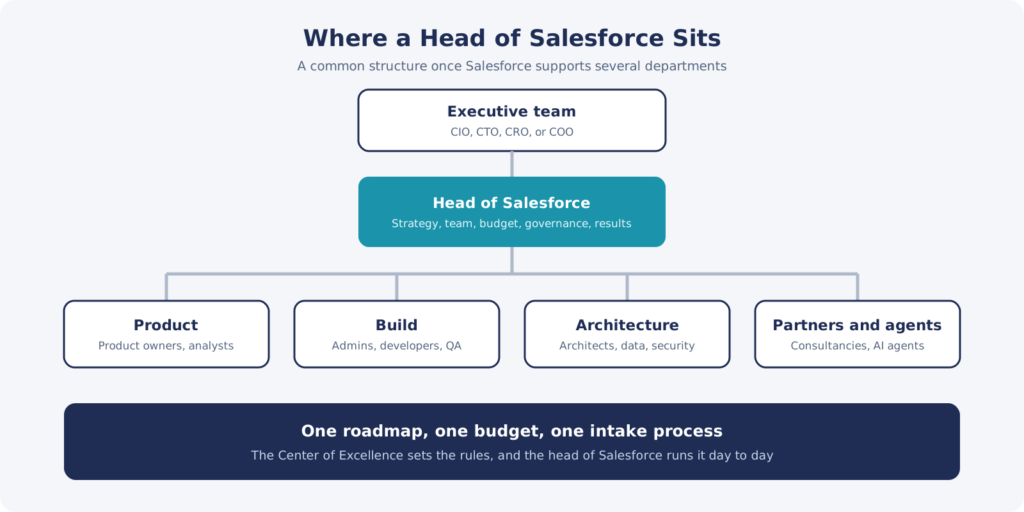
Reporting lines vary. In some companies the head of Salesforce reports to the CIO or CTO, in others to the chief revenue officer or chief operating officer. The reporting line shapes the job: an IT reporting line usually means more focus on architecture, security, and integration, while a revenue reporting line means more focus on sales and service outcomes.
Head of Salesforce vs Architect vs Product Owner
| Role | Main question | Typical scope |
|---|---|---|
| Head of Salesforce | Is the platform delivering value for what we spend? | Strategy, team, budget, governance, results |
| Salesforce architect | Is the platform designed to scale? | Data model, integration, security, technical standards |
| Salesforce product owner | What should the team build next? | One ordered backlog for one area |
| Salesforce admin lead | Is the org running well today? | Configuration, users, and day-to-day support |
Many heads of Salesforce come up through one of these roles. A former architect brings technical depth, a former product owner brings prioritization, and a former consulting partner leader brings delivery experience. Each path leaves gaps the others fill. Our guides to hiring a Salesforce architect and hiring a Salesforce product owner cover those roles, and our Salesforce career path guide shows how people move up.
The role also differs from a CRM leadership seat inside a consulting partner, where the job is selling and delivering projects for clients. This guide is about the customer side: the person who owns your company’s own Salesforce platform.
Credentials That Matter
No certification qualifies someone to lead a Salesforce platform. Credentials still help screen the field. Platform Administrator shows the candidate understands how the org works, and an architect credential such as Platform Data Architect, or the Certified Technical Architect, signals technical depth. Verify any Salesforce credential on the credential verification page.
For this role, evidence of leadership matters more. Look for teams the candidate built, budgets they managed, roadmaps they delivered, and results they can quantify. Our guide to the Salesforce certifications that matter when hiring covers the rest of the catalog.
5 Skills to Look For in a Head of Salesforce
These five skills separate a head of Salesforce who drives the business from one who runs a ticket queue.
1. CRM strategy tied to business goals
Strong candidates start with revenue, service, and cost targets, then work back to the platform. Ask how they built a roadmap, what they cut from it, and how they explained the trade-offs to executives.
2. Team building
The head of Salesforce decides which roles to hire, which to contract, and which to leave to partners. Look for someone who has built a team from a few people to a full delivery group and kept good people. Our guide to Salesforce team structure shows the common models.
3. Financial ownership
Licenses, partner fees, and staff add up quickly. A strong candidate can explain total platform cost, how they negotiated a renewal, and how they measured return. Ask for a budget they owned and one decision that saved money.
4. Governance without gridlock
Good governance means one intake process, clear priorities, safe releases, and clean data, without making every change wait a month. Ask how the candidate handled technical debt and how they stopped executives from going around the process. Our guide to Salesforce technical debt covers what happens without it.
5. AI and agent leadership
In 2027, the head of Salesforce decides where AI agents go first, how they are tested and monitored, and how the team changes as agents take on routine work. Ask what the candidate has shipped, what went wrong, and how they measured it. Our guide to Salesforce digital labor covers the wider shift.
Head of Salesforce Salary in 2027
Our 2027 Salesforce salary guide does not include a separate leadership band. Two benchmarks help set a range:
| Benchmark | US base pay | Source |
|---|---|---|
| Computer and information systems managers, median (May 2025) | $175,140 | US Bureau of Labor Statistics |
| Senior or lead Salesforce solution architect | $165,000 to $210,000 | SF Talent 2027 salary guide |
| Principal Salesforce solution architect | $195,000 to $240,000 | SF Talent 2027 salary guide |
The Bureau of Labor Statistics describes computer and information systems managers as people who plan, coordinate, and direct computer-related activities, which is close to the head of Salesforce role. Because candidates often come from senior architect roles, many companies find they need to match or beat architect pay to make the move worthwhile. Bonus and equity matter more at this level, and scope drives the number: a leader of a 20-person team across several clouds sits well above one managing three admins.
How to Hire a Head of Salesforce
Define the mandate before the title
Write down what the leader must achieve in the first year, what budget and team they own, and who they report to. A vague mandate attracts generalists. A clear one attracts people who have done the job.
Expect a passive search
The strongest candidates are usually employed and not looking. That makes this a search role, built on outreach and referrals more than job postings. Our comparison of a Salesforce headhunter vs staffing vs placement agency explains which model fits a senior search.
Test strategy and judgment
Give finalists a short case: your current org, team, spend, and goals. Ask for a 90-day plan and a one-year roadmap, and have them present it to the executives they would report to. Listen for questions about the business before answers about the platform.
Consider an interim leader
If the role is urgent, an interim or contract leader can stabilize the team, reset priorities, and help define the permanent role. Our comparison of contract vs full-time Salesforce hires covers the trade-offs.
Watch for red flags
- Talks only about features, never about cost or results
- Has never managed a budget or hired a team
- Cannot describe a time they said no to an executive
- Has no view on AI agents beyond a demo
Our recruiters are Salesforce certified and screen every head of Salesforce candidate on real platform and leadership experience. For urgent needs, we can also place interim leaders from a vetted network.
Frequently Asked Questions
What does a head of Salesforce do?
A head of Salesforce owns the company’s Salesforce platform: the roadmap, the team, the budget, governance, and results. They decide what gets built, who builds it, and how the platform supports business goals, and they report outcomes to the executive team.
Is a head of Salesforce the same as a director of CRM?
Usually, yes. Companies use titles such as director of CRM, Salesforce platform owner, and VP of business systems for similar roles. Check the scope, team size, and reporting line, since those matter more than the title.
When does a company need a head of Salesforce?
Common triggers are several departments sharing the org, rising platform spend, multiple admins or partners with no single leader, an AI agent rollout, or a merger. One admin supporting one team usually does not need the role yet.
How much does a head of Salesforce earn?
Our 2027 salary guide has no separate leadership band. The Bureau of Labor Statistics reports a May 2025 median of $175,140 for computer and information systems managers, and senior to principal Salesforce solution architects earn $165,000 to $240,000 in base pay, so leadership offers often need to match or exceed that.
Should the head of Salesforce report to IT or the business?
Either can work. An IT reporting line favors architecture, security, and integration, while a revenue or operations reporting line favors business outcomes. Choose based on where the platform’s biggest problems are.
Can we promote our lead admin or architect?
Often, yes, if they want to manage people and budgets and have the trust of executives. Support the move with a clear mandate and coaching, since leading the platform is a different job from building in it.
Find Your Head of Salesforce
The right leader ties the platform to business results, builds a strong team, owns the budget, and makes clear decisions about AI. Define the mandate first, plan for a passive search, and test candidates on your real situation.
Ready to hire a head of Salesforce? Talk to our Salesforce recruiters.